
Russian President Vladimir Putin has faced widespread ridicule this week following Sunday’s dramatically downgraded Russian Navy Day celebrations, with detractors claiming the sorry spectacle has underlined his failure to secure Russian airspace against Ukrainian drones.
Russia’s annual Navy Day festivities have traditionally served as an opportunity to flex the country’s maritime muscles. In the past, the holiday has featured a naval parade involving dozens of ships from the Baltic Fleet sailing down the Neva River in St. Petersburg amid much pomp and ceremony.
In contrast, this year’s scaled down event took place in a nondescript courtyard with no warships whatsoever in sight due to concerns over possible Ukrainian drone strikes. Instead, Putin addressed a small group of officers while standing alongside a giant picture of a single submarine. For a man who has long sought to reassert Russia’s military superpower status, it was a humbling moment.
This was the latest in a series of high-profile humiliations that have exposed the deteriorating security situation in the skies above Russia. In early May, the Ukrainian drone threat forced Putin to hold Russia’s annual Victory Day parade in Moscow without any military hardware for the first time in decades. The Kremlin dictator was so alarmed about the possibility of attacks that he even sought US President Donald Trump’s help to broker a temporary ceasefire. Ukrainian President Volodymyr Zelenskyy took full advantage of Putin’s evident discomfort, issuing a spoof presidential decree permitting the parade to proceed.
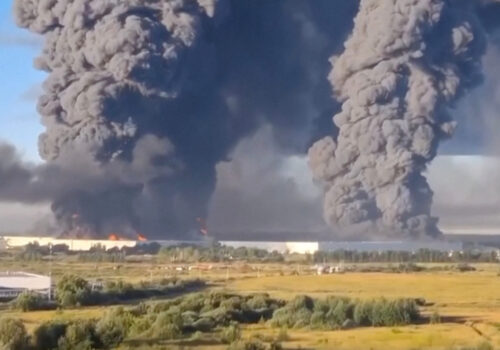
Weeks later, Ukraine marked the start of Russia’s annual international economic forum in St. Petersburg by launching long-range drone strikes targeting the city’s main oil terminal and naval base. As visiting delegations made their way to the official opening of the flagship event, they were greeted by huge plumes of black smoke dominating the St. Petersburg skyline. This attention-grabbing attack on Putin’s hometown as he hosted large numbers of foreign guests was a personal embarrassment for the Russian leader that made a mockery of his carefully crafted strongman image.
Stay updated
As the world watches the Russian invasion of Ukraine unfold, UkraineAlert delivers the best Atlantic Council expert insight and analysis on Ukraine twice a week directly to your inbox.
Ukraine’s strategic bombing campaign has escalated significantly since the start of the current year and has succeeded in inflicting damage that goes far beyond symbolic blows to Putin’s ego. During the first seven months of 2026, Ukrainian long-range drone strikes on military and industrial targets deep inside Russia have disrupted the Kremlin war machine, imposed mounting economic costs, and sparked the worst fuel crisis in Russia since the collapse of the Soviet Union.
In addition to military plants and oil refineries, Kyiv’s air offensive has recently expanded to include logistical hubs used to supply the invasion force in Ukraine with everything from body armor to drone components. Russian e-commerce giant Wildberries has been the primary target, with a number of major facilities damaged or destroyed in July. Together with fuel shortages, these attacks on the country’s largest online retailer have helped to bring the realities of Putin’s invasion home for millions of ordinary Russians.
Meanwhile, the Kremlin is struggling to cope with expanding Ukrainian mid-range drone strikes against logistics targets located tens of kilometers behind the front lines of the war. These attacks have focused on Russian-occupied Crimea, with Ukrainian drone units seeking to establish fire control over all access routes to the peninsula, creating what some officials have dubbed a “logistics lockdown.”
Eurasia Center events

Ukraine’s ambitious air offensive reflects the remarkable wartime development of the country’s domestic drone industry. When the full-scale invasion began in February 2022, there were only a handful of Ukrainian companies producing drones. This soon changed as it became apparent that cheap drone technologies could help Ukraine counter Russia’s overwhelming advantages in manpower and conventional firepower. Four years on, Ukraine is now producing millions of unmanned systems annually and is recognized as a world leader in drone warfare.
Ukrainian drone units have also proved highly adept at exploiting the limitations of Putin’s air defense network. For centuries, Russia’s vast size has been seen as the country’s single greatest military asset, but in today’s era of long-range drone warfare, distance no longer brings security. Faced with a growing drone threat, the Kremlin lacks sufficient air defense systems to simultaneously shield its army in Ukraine while also guarding major Russian cities and critical infrastructure. Instead, Putin must be selective, prioritizing the defense of high-value targets such as Moscow while leaving other regions exposed.
Ukrainian drone strikes alone cannot defeat Russia, but Kyiv’s bombing campaign is already redefining perceptions of the war. A conflict that was being fought exclusively on Ukrainian territory has now spread to large parts of Russia and is increasingly impacting the daily lives of the Russian population. With Putin’s army also struggling to advance on the battlefield, this is undermining Kremlin efforts to portray Russian victory as inevitable.
For now, Putin shows no signs of abandoning his maximalist war aims and remains committed to extinguishing Ukrainian independence. However, his bravado looks less and less convincing when viewed against a backdrop of canceled military parades and burning oil refineries. The Kremlin dictator’s evident inability to defend Russia’s airspace gives Zelenskyy an important trump card as he seeks to secure a negotiated settlement. If Ukraine can maintain the current momentum during the second half of 2026, the pressure on Putin to begin genuine peace talks will only grow.
Peter Dickinson is editor of the Atlantic Council’s UkraineAlert service.
Further reading


The views expressed in UkraineAlert are solely those of the authors and do not necessarily reflect the views of the Atlantic Council, its staff, or its supporters.

The Eurasia Center’s mission is to enhance transatlantic cooperation in promoting stability, democratic values, and prosperity in Eurasia, from Eastern Europe and Turkey in the West to the Caucasus, Russia, and Central Asia in the East.
Follow us on social media
and support our work
Image: Russian President Vladimir Putin visits the Main Admiralty to meet with commanders on Navy Day in Saint Petersburg, Russia. July 26, 2026. (Sputnik/Vyacheslav Prokofyev/Pool via REUTERS)