
Swedes will head to the polls on September 13 in an election that could return Social Democratic leader Magdalena Andersson to office and unseat Prime Minister Ulf Kristersson’s liberal-right government after one term. Polling has favored a change of government for much of the past year and a half, but the race appears to be tightening in the final week.
Kristersson’s Moderate Party is seeking another term with its current partners on the right, while Andersson is the clear contender to replace him. But Sweden’s fragmented political landscape means that securing a parliamentary majority and forming a viable government are two different challenges.
What’s the state of play?
The latest Novus/TV4 poll placed the four opposition parties—the Social Democrats, the Center Party, the Green Party, and the Left Party—collectively at 50.3 percent of the vote. The three government parties—the Moderates, Christian Democrats, and the Liberals—together with the supporting far-right Sweden Democrats, stood at 47.7 percent. The resulting 2.6 percentage-point gap is considerably smaller than the opposition leads recorded by Novus and SVT/Verian two weeks earlier—6.9 and 10 points, respectively—suggesting a tightening race.
Nevertheless, the Liberal Party remains the government’s most immediate electoral vulnerability. While its support has risen from 1.9 to 3.3 percent, the party remains below the 4 percent threshold, putting it at risk of losing representation in the Riksdag (Sweden’s parliament) for the first time. The Center Party, meanwhile, has been the clear winner this summer, rising from 5.4 percent in June to around 8 percent in August. If the poll results translated directly into seats and the Liberals failed to cross the threshold, the opposition would hold approximately 186 of the Riksdag’s 349 seats, compared with 163 for the government parties and the Sweden Democrats combined.
Despite trailing in the polls, the governing parties enter the election with a clearer path to success. Under a four-party accord negotiated after the 2022 election—the so-called “Tidö agreement”—the Sweden Democrats provide parliamentary support to Kristersson’s three-party minority government from outside the cabinet. Kristersson remains the bloc’s candidate for prime minister and has gone further by opening the door to Sweden Democrat ministers in a future right-wing government.
By contrast, the opposition has no unified governing plan. The Center Party backs Andersson as the most likely candidate for prime minister, opening a path for cooperation across Sweden’s traditional blocs. However, it rules out a government that includes the Left Party and opposes giving either the Left Party or the Sweden Democrats decisive influence over key policy areas. The Left Party, in turn, has declared that it will vote against any government in which it is not represented.
The opposition therefore has the clearer path to a parliamentary majority, but Andersson may still struggle to translate that advantage into a stable government.
How did we get here?
The 2022 election ended eight years of government led by the Social Democrats and brought Ulf Kristersson to office. The Moderates, Sweden Democrats, Christian Democrats, and Liberals secured 176 seats—three more than the Social Democrats, Center Party, Left Party, and Greens. The result also shifted the balance of power among Sweden’s right-wing parties. The Sweden Democrats gained eleven seats, overtaking the Moderates to become the country’s second-largest party. This produced an unusual governing arrangement in which the largest party on the right remained outside the cabinet while the leader of the smaller Moderate Party became prime minister.
What are the parties to watch?
Social Democrats (S)
Leader: Magdalena Andersson
Sweden’s largest party is seeking to return to office after one term in opposition. Its 2026 platform combines stronger welfare services, a focus on employment and household finances, and tougher policies on organized crime, while leaving the post-2015 shift toward more restrictive migration policies broadly intact.
Sweden Democrats (SD)
Leader: Jimmie Åkesson
The far-right Sweden Democrats have made migration, criminal justice, national identity, and household costs central to their campaign. The party’s 2026 program calls for reducing asylum migration to the lowest possible level, deporting foreign nationals convicted of serious crimes, tightening citizenship requirements, imposing harsher criminal penalties, and keeping fuel and energy costs down.
Moderate Party (M)
Leader: Ulf Kristersson
The current prime minister’s center-right Moderate Party is campaigning on continuity and delivery. Its principal election commitments include tax reductions intended to increase household disposable income, tougher action against organized crime, and shorter healthcare waiting times. Having been overtaken by the Sweden Democrats in 2022, the Moderates are also seeking to regain their position as the largest party on the right.
Left Party (V)
Leader: Nooshi Dadgostar
The socialist Left Party is campaigning on household costs, redistribution, and a stronger welfare state. Its priorities include freezing rents, lowering food prices, strengthening healthcare, reducing working hours, and curbing profits in banking and publicly funded welfare.
Center Party (C)
Leader: Elisabeth Thand Ringqvist
The Center Party is a liberal, pro-business party with agrarian roots. Its manifesto focuses on job creation, lower emissions, entrepreneurship, and access to welfare and public services throughout the country. Its combination of market-oriented economic policies and ambitious climate goals distinguishes it from the other opposition parties.
Christian Democrats (KD)
Leader: Ebba Busch
The socially conservative Christian Democrats have built their campaign around families, healthcare, public safety, infrastructure, and nuclear power. Their manifesto proposes transferring responsibility for healthcare from Sweden’s twenty-one regional authorities to the national government, increasing child benefits, lowering household taxes, and expanding support for homeownership.
Green Party (MP)
Spokespersons: Amanda Lind and Daniel Helldén
The Greens are seeking a return to government on a platform centered on climate action, equality, and environmental protection. Their 2026 manifesto proposes greater investment in renewable energy, railways, and green industry alongside stronger welfare provision and measures to reduce inequality.
Liberals (L)
Leader: Simona Mohamsson
The social-liberal Liberals are the smallest governing party and the one facing the greatest electoral danger. Education remains the party’s defining issue, with its manifesto proposing smaller primary-school classes, more textbooks and reading, cellphone-free schools, stronger authority for teachers, and national responsibility for education. With the party still polling below the 4 percent parliamentary threshold, its campaign is now as much about survival as policy.
How does the Swedish election system work?
Sweden holds elections every four years, with voters casting ballots in three simultaneous elections: for the Riksdag, regional assemblies, and municipal councils.
The Riksdag has 349 members elected through proportional representation. Of these, 310 are constituency seats, while 39 adjustment seats ensure that the final distribution reflects each party’s national share of the vote. Voters select a party and may also cast a preference vote for an individual candidate on that party’s list.
A party normally needs at least 4 percent of the national vote to enter parliament, although a party can exceptionally qualify for seats by winning 12 percent in a single constituency.
After the election, the speaker of the Riksdag consults the parties and proposes a candidate for prime minister. Winning the most votes does not necessarily determine who forms the government. What matters is whether a prime minister can be tolerated—that is, not actively rejected—by a majority in the Riksdag. The sitting government continues to govern until the prime minister is approved.
This system of negative parliamentarism has historically made Sweden prone to minority governments, such as after the 2018 election, when the Social Democratic Party under Stefan Löfven formed a minority government with the Greens, relying on support from the Liberals and the Center Party in the parliament.
What are the key issues?
Domestic issues
The 2026 campaign is primarily focused on domestic issues. According to the latest SVT/Verian survey, healthcare is the dominant concern, named by 64 percent of voters as one of their most important issues. Schools and eldercare also rank highly, underlining the centrality of welfare. Law and order, which were top priorities in the 2022 election, remain important but have declined since then, while energy policy, which dominated much of the previous campaign, has fallen to ninth place.
Crime and migration nevertheless remain central to the government’s case for reelection. Since taking office in 2022, it has pursued reforms intended to reduce immigration, increase returns, and improve the integration of those already living in Sweden. The Social Democrats also support a continued restrictive migration policy as they seek to challenge the right’s electoral advantage on these issues. At the same time, they are foregrounding healthcare, schools, employment, and household finances, with higher taxes underpinning their welfare agenda.
More broadly, Sweden’s polarized and often pessimistic debate contrasts with the country’s more favorable image abroad, with recent international coverage highlighting the country’s economic adaptability, low public debt, and strong conditions for investment and innovation—even as unemployment remains well above the EU average and long healthcare waiting times help explain dissatisfaction at home.
Energy has declined as a voter priority, but it could become an important coalition fault line. The parties disagree over the role of nuclear power, how quickly new generation can be delivered, and how much financial risk the state should assume. The Social Democrats have called for a broad, cross-party energy agreement covering the expansion of all forms of fossil-free electricity, including nuclear power. That ambition could itself become a coalition challenge: Any Social Democratic-led government reliant on the Center Party, Left Party, and Greens would need to reconcile the Center Party’s opposition to state subsidies for nuclear power, the Left Party’s opposition to expanding nuclear generation, and the Greens’ rejection of public subsidies for new reactors.
Foreign policy issues
On foreign policy, the main disagreement concerns Sweden’s response to the war in Gaza and the broader Israel-Palestine conflict. A more left-leaning government could take a more openly critical stance toward Israel and advocate stronger support for Palestine. Sweden became the first EU country to recognize Palestine under the Social Democratic–led government in 2014, and a large majority of voters on the left today hold a negative view of Israel.
The previous Social Democratic government also gained international recognition for its “feminist foreign policy,” under which all foreign policy was to be guided by a gender equality perspective aimed at strengthening the rights of women and girls globally. The current government abandoned the agenda, but the Social Democrats intend to reinstate it if they regain office this year.
Defense and security policy, by contrast, is less likely to decide the election precisely because the parties broadly agree on Sweden’s strategic direction. The remaining disagreements concern implementation and Sweden’s posture within NATO rather than whether the country should remain in the alliance or continue supporting Ukraine.
Should NATO allies and Ukraine be worried about the result?
No—at least, they should not worry about a reversal of Sweden’s fundamental security policy.
NATO membership, increased defense spending, and support for Ukraine rest on broad political and public foundations. In May, 67.9 percent of Swedes viewed NATO membership positively, compared with 21 percent who viewed it negatively, figures broadly unchanged from the previous year.
All eight parliamentary parties have also backed the financing framework for Sweden’s defense buildup, with the government intending to reach 3.5 percent of GDP in core defense spending by 2030. The cross-party Swedish Defence Commission likewise identifies Russia as a long-term threat, NATO as the foundation of Sweden’s defense, and sustained support for Ukraine as central to Swedish security.
Ukraine should expect continuity as well. Since Russia launched its full-scale invasion in 2022, Sweden has provided approximately 156 billion kronor ($16.3 billion) in military and civilian assistance, including 128 billion kronor ($13.4 billion) in military support. A long-term framework provides 80 billion kronor ($8.4 billion) for military assistance during 2026 and 2027, while the Riksdag’s Committee on Defence reaffirmed that support should continue for as long as necessary. Much of the funding for Ukraine has been made possible by a reorientation of Sweden’s aid policy. The opposition has criticized the government’s aid priorities and could seek to redirect some funding toward other parts of the world, but not to upend Sweden’s fundamental commitment to Ukraine.
Even the Left Party and the Greens, which historically opposed NATO membership, are not expected to reverse course in the near term. The Greens have explicitly accepted the parliament’s 2022 decision. While the Left Party’s program retains a longer-term aspiration to develop alternative arrangements with a view to leaving NATO, Nooshi Dadgostar recently stated that her party will not pursue withdrawal during the coming parliamentary term.
The more immediate disagreements concern how Sweden operates within NATO. Five of the Riksdag’s eight parties—the Moderates, Sweden Democrats, Christian Democrats, Liberals, and Center Party—favor Swedish participation in efforts to strengthen nuclear deterrence in Europe. The Social Democrats, however, are more cautious, while the Left Party and the Greens want stronger restrictions on nuclear weapons. A similar split emerged over the Defense Cooperation Agreement with the United States, which six parties supported and the Left Party and the Greens opposed.
The election could therefore affect the pace and priorities of Sweden’s defense buildup, as well as its approach to NATO’s nuclear dimension, but not the country’s broader strategic direction.
How important is migration?
Migration is one of the issues for which the election could produce the clearest policy consequences.
The government, strongly influenced by the Sweden Democrats, calls its migration agenda a “paradigm shift” intended to correct what it regards as years of overly permissive migration policy and failed integration. Since taking office in 2022, it has introduced reforms to bring Swedish asylum rules closer to minimum EU requirements, tighten family reunification and labor migration rules, and strengthen the enforcement of return decisions.
Some measures have proved contentious. In June, parliament narrowly approved new reporting obligations for several state agencies concerning people believed to lack the right to remain in Sweden. The government has also faced criticism over so-called “teenage deportations” involving young people who faced removal after turning eighteen because they no longer qualified for residence through family ties or for an independent permit.
The Social Democrats have also moved toward a significantly more restrictive position since the 2015 migration crisis. Their current platform calls for a restrictive policy aligned with EU minimum requirements, higher expectations concerning language and employment, and more effective returns for rejected asylum applicants.
Even a Social Democratic-led government would therefore be unlikely to return Sweden to its pre-2015 migration policy. The greater uncertainty concerns which parts of the current government’s migration framework prospective coalitions would seek to revise. The Center Party favors a more liberal approach to asylum and labor migration, while the Left Party and Greens support permanent residence permits as the default, alongside stronger family-reunification rights.
A new government could therefore reverse some reforms on permanent residence, family reunification, and labor migration. But Sweden’s broader movement toward more restrictive migration policy is likely to endure.
Could foreign interference affect the election?
Yes—but the more plausible danger is disruption and distrust, not political realignment.
The Psychological Defence Agency identifies Russia as the main foreign information threat to the election, largely due to Sweden’s strong support for Ukraine. It nevertheless assesses that Sweden is not currently a priority target for Russian influence operations. Unlike Germany’s Alternative for Germany and Hungary’s Fidesz, no Swedish parliamentary party is campaigning to reduce support for Ukraine. Even the far-right Sweden Democrats have largely aligned with the government on Ukraine and supported a recent proposal authorizing the transfer of up to sixteen JAS 39 Gripen C/D fighter jets. This consensus limits Russia’s opportunities to weaken Swedish support for Ukraine through electoral interference, although the agency warns that the situation could change quickly.
That relative resilience, however, does not make Sweden immune. The pro-Russian Matrjosjka network recently targeted the Swedish election with disinformation alleging election fraud and making false accusations against the prime minister, including fabricated videos bearing the logos of major Swedish and European media outlets. The same network has also been linked to disinformation campaigns targeting elections and political figures in Germany and France.
Swedish authorities have prepared accordingly. The government has strengthened coordination among the Election Authority, Security Service, Police Authority, Psychological Defence Agency, and civil-resilience bodies. Preparations cover the possibility of foreign information manipulation, cyberattacks, hacked or altered material, AI-generated content, threats against candidates, and incidents affecting election infrastructure.
While there is currently no evidence that such activity is reshaping the campaign or is likely to determine the result, the principal risk is an attempt to erode confidence in the electoral process or inflame existing domestic divisions—not an electoral reversal on NATO or Ukraine.
Anna Wieslander, PhD, is director for Northern Europe and head of the Northern Europe Office in Stockholm, Sweden.
Louise Blomqvist is project manager at the Atlantic Council Northern Europe Office.
Carl Ågård is project coordinator at the Atlantic Council Northern Europe Office.
The Europe Center promotes leadership, strategies, and analysis to ensure a strong, ambitious, and forward-looking transatlantic relationship.
Related Reading
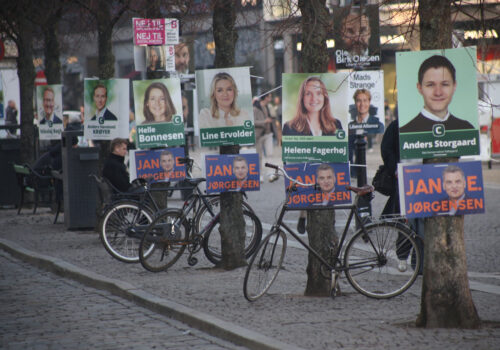

Image: Leader of the Social Democrats, Magdalena Andersson, meets Ulf Kristersson, leader of the Moderate Party, in a political debate on Swedish Television in Uppsala, Sweden, September 7, 2022. General elections will be held in Sweden on September 13, 2026. (Wennerlund Fredrik/Stella Pictures/ABACA via Reuters Connect)