
Optimizing the NATO 1.5 percent investment commitment for energy security
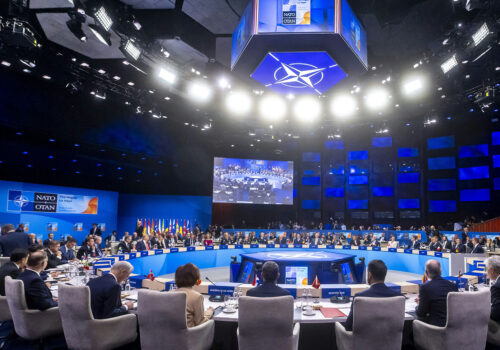
When Russia’s full-scale invasion of Ukraine in February 2022 failed to produce a quick and decisive victory, the Russian military, which had initially preserved Ukraine’s physical infrastructure, began to attack it directly. Russia’s strategy, which increasingly resembled total war, sounded an alarm in Brussels. At its 2025 summit in The Hague, NATO announced a commitment to invest 5 percent of member states’ gross domestic product into defense-related capabilities, including up to 1.5 percent for resilience.
Elsewhere, the closure of the Strait of Hormuz, repeated attacks on Baltic subsea infrastructure, and the vulnerability of other energy chokepoints further reinforce the need for NATO member states to make resilience a priority for defense spending.
NATO’s 1.5 percent commitment can be the catalyst that connects capital to capability across the alliance. This broad mandate, applying across thirty-two member states with differing political considerations and priorities, requires a capability-based framework grounded largely in lessons from Ukraine’s defense of its energy system but also in other recently exposed vulnerabilities.
Meeting this mandate will require building an energy system that can serve civilian and military energy demands and is resilient to physical and digital threats. This undertaking will be a generational challenge requiring long-term investment.
Ukraine has paid for these lessons under fire, but NATO retains the advantage of learning them in peacetime. The progress review set for 2029 is the natural forcing function, and the alliance should arrive at it with this framework already converted from proposal to measurement.
view the full issue brief
about the authors



Stay connected
Sign up for PowerPlay, the Atlantic Council’s bimonthly newsletter keeping you up to date on all facets of the energy transition
related reading

explore the program

The Global Energy Center develops and promotes pragmatic and nonpartisan policy solutions designed to advance global energy security, drive economic opportunity, and foster a sustainable energy future.
Image: Rescuers remove debris at a thermal power plant damaged by multiple Russian missile strikes, amid Russia’s attack on Ukraine, in an undisclosed location in Ukraine February 9, 2026. REUTERS/Valentyn Ogirenko