
Russia’s air war against Ukraine has recently entered a deadly new phase with round-the-clock attacks on civilian targets across Kyiv as Vladimir Putin seeks to make the Ukrainian capital unlivable and break the country’s resistance. This escalation has been enabled by a new generation of jet-powered Russian drones that are capable of evading Ukraine’s existing air defenses and striking targets with a high degree of precision. The race is now on to find technological solutions to the jet drone terror before everyday life in Kyiv becomes impossible.
Data provided by Ukrainian officials offers an insight into the scale of the air defense threat that is now facing the country. In July 2026, Russia launched around 1500 jet drones at targets across Ukraine. The following month, this figure rose to 2850. During September, approximately 3200 jet drones were deployed. There are concerns that this upward trajectory will continue, with the Kremlin believed to have stockpiled jet drones ahead of the coming winter season.
The main target is Kyiv. In recent weeks, the Ukrainian capital has experienced a relentless series of airstrikes against civilian sites throughout the city including schools, hospitals, residential buildings, gas stations, supermarkets, internet data hubs, business centers, the National Academy of Sciences, and bridges across the Dnipro River. Whereas previous Russian bombardments typically took place overnight, jet drone attacks are timed to run continuously throughout the day. This creates an additional layer of fear and disruption, with schools, businesses, shops, restaurants, and public transport unable to operate.
Stay updated
As the world watches the Russian invasion of Ukraine unfold, UkraineAlert delivers the best Atlantic Council expert insight and analysis on Ukraine twice a week directly to your inbox.
Russia’s jet drones represent a significant upgrade to the Kremlin’s airstrike arsenal. They are more than twice as fast as their propeller-driven predecessors and are able to operate at much higher altitudes, making them extremely difficult to target and destroy using existing air defense tools. They also feature enhanced guidance and targeting systems, aiding evasion and improving accuracy.
This creates major challenges for Ukraine’s defense tech sector. At present, the country is forced to reply on a relatively small selection of weapons systems to counter Russia’s jet drones. The interceptors that proved so useful against propeller drones are now too slow to be effective. Instead, Ukrainian engineers must develop jet-powered solutions of their own. This will require sophisticated military-grade technologies, with Kyiv’s European partners potentially well-placed to provide support.
There are already reports of successful interceptions with prototypes, but developing the necessary tech is only part of the problem. In addition to designing a new generation of interceptors, Ukraine must also scale up production and create the necessary infrastructure for deployment in Kyiv and across the country. This could potentially take months to achieve at a time when every single day counts.
As the search for a suitable interceptor solution continues, Ukraine is relying heavily on fighter jets armed with air-to-air missiles and cannon. These weapons systems are highly effective against jet drones, but each flight means more wear and tear on Ukraine’s overworked and aging aircraft, leading to high maintenance requirements. Recent reports indicate that around half of Ukraine’s entire F-16 fleet may currently be grounded and undergoing servicing. With pilots and crews forced to operate defensive patrols more or less continuously, the potential for mechanical and physical exhaustion is clear.
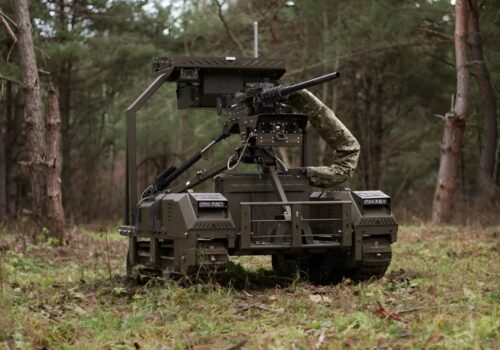
Ground-based countermeasures are also gaining pace. This week, Ukrainian Air Force officials announced the first successful interception of a Russian jet drone by an automated machine gun turret system utilizing artificial intelligence for targeting. A number of these robotic systems have already been installed close to sensitive targets in Kyiv and elsewhere, with more planned.
Eurasia Center events

No matter how successful Ukraine’s countermeasures are, defensive steps alone will not be enough to blunt the threat posed by Russian jet drones. The Kremlin plans to increase drone production and intends to overwhelm Ukraine’s defenses with large-scale attacks. In order to be truly effective, Kyiv’s response must also include the ability to target and disrupt supply, production, and launch infrastructure inside Russia. This will require additional backing from Ukraine’s partners, both in terms of weapons delivery and financial support to boost domestic production of long-range strike weapons by Ukrainian companies.
Putin’s decision to intensify the air war against civilian targets comes as his army struggles to advance on the battlefield. Russian territorial gains in 2026 have slowed to glacial pace, while losses have continued to climb. With little prospect of a military breakthrough on the horizon, the Kremlin dictator appears to have concluded that his most realistic pathway to victory now lies through terrorizing the Ukrainian population and bombing the country into submission.
Russia’s current aerial offensive is expected to expand further as winter draws closer, with fresh waves of attacks on civilian heating, power, and water services. Putin clearly has no intention of ending his invasion and has chosen escalation over possible peace negotiations. He aims to deliver a decisive blow during the coming cold season and force Kyiv to capitulate. One of the key factors in this air war will be Ukraine’s ability to counter the jet drone threat.
Mykola Bielieskov is a research fellow at the National Institute for Strategic Studies and a senior analyst at Ukrainian NGO “Come Back Alive.” The views expressed in this article are the author’s personal position and do not reflect the opinions or views of NISS or Come Back Alive.
Further reading


The views expressed in UkraineAlert are solely those of the authors and do not necessarily reflect the views of the Atlantic Council, its staff, or its supporters.


The Eurasia Center’s mission is to enhance transatlantic cooperation in promoting stability, democratic values, and prosperity in Eurasia, from Eastern Europe and Turkey in the West to the Caucasus, Russia, and Central Asia in the East.
Follow us on social media
and support our work
Image: Firefighters attempt to extinguish fire at the site of the Ukraine's Academy of Sciences building hit by a Russian jet-powered drone strike, amid Russia's attack on Ukraine, in Kyiv, Ukraine. September 28, 2026. (REUTERS/Sergiy Chalyi)