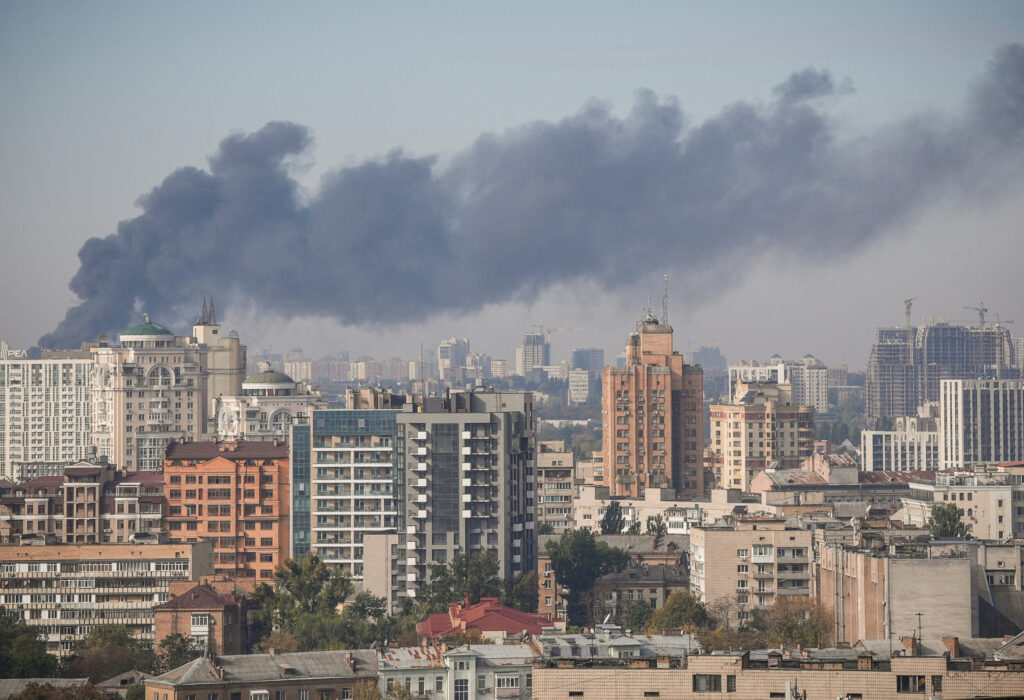
Since the last weeks of the summer season, jet-powered Russian attack drones have begun appearing in large quantities over Kyiv and other Ukrainian cities. These jet drones have succeeded in transforming the air war, handing Moscow the initiative and sending Ukrainian defense tech developers scrambling for solutions.
This is not an entirely novel threat, of course. Russia has deployed attack drones against Ukraine’s cities and civilian infrastructure since the early stages of the full-scale invasion. The first generation of propeller-driven Russian drones were initially a major issue for Ukraine, but during 2025 air defense crews learned to counter them with domestically assembled interceptor drones.
The aerial drone contest is now entering a new phase with Russia holding the strategic edge. Ukrainian President Volodymyr Zelenskyy acknowledged in late September that while Ukraine was able to intercept around 90 percent of propeller-driven Russian drones, the country was only managing to stop just over half of the new jet-powered models.
Russia’s jet drones are more than two times faster than their predecessors and feature a range of additional technological upgrades that improve guidance and accuracy while making them far harder to intercept. Recent Ukrainian analysis of downed jet drones has found that they contain multiple foreign components from countries including China, Germany, and the United States.
The Kremlin is exploiting its current advantage in the air to launch round-the-clock attacks on Kyiv that are designed to maximize disruption to everyday life and render the Ukrainian capital unlivable. Airstrikes take place throughout the day and across the city, with recent targets including schools, hospitals, residential buildings, business centers, gas stations, supermarkets, internet data hubs, and bridges across the Dnipro River.
As Ukraine races to design suitable interceptors and scale up production, the country is currently relying on its fighter jet fleet to shoot down jet drones using air-to-air missiles or onboard cannon. This approach works but is far too expensive to be a viable long-term option. More cost-effective solutions are desperately needed, particularly as Russia is expected to significantly expand jet drone production during the coming year.
Targeting production sites will likely prove impossible. Ukrainian analysis of recent satellite images indicates that Russia is following the Iranian model and is moving drone production underground. This will further limit Ukraine’s ability to break manufacturing cycles or destroy jet drones before they can be deployed.
Stay updated
As the world watches the Russian invasion of Ukraine unfold, UkraineAlert delivers the best Atlantic Council expert insight and analysis on Ukraine twice a week directly to your inbox.
The emergence of Russia’s jet drone fleet represents a serious and mounting security threat to the whole of Ukraine. It also creates potential geopolitical challenges for the country as Kyiv seeks to build on its burgeoning reputation as a military innovator and position itself as a security partner rather than an aid recipient.
In early 2026, Ukraine responded to the outbreak of hostilities in the Middle East by offering to help the United Arab Emirates, Saudi Arabia, Qatar, Kuwait, and Jordan shoot down Iranian drones. This led to the signing of security agreements with a number of Gulf states, highlighting the value of Ukraine’s unrivaled drone warfare experience. However, Russian jet drones could now render this trump card redundant.
The countries of the Gulf region are closely monitoring developments in the skies above Kyiv. With negotiations between Washington and Tehran yet to produce a breakthrough, renewed fighting in the Middle East remains possible. While there is no evidence that the Kremlin has shared jet drone technologies with Iran, this channel is well established.
Ukraine claims Russia has already passed jet drone plans to North Korea. Based on past experience, it would be reasonable to assume that the Iranians will also soon acquire the necessary information to upgrade their domestic program and deploy a new generation of jet drones. The Shahed drones that Russia initially used to attack Ukraine were designed and produced in Iran. Tehran then agreed to provide Moscow with the necessary blueprints, enabling large-scale domestic production inside Russia.
Russian and Iranian military technologies are moving in both directions. The Financial Times reported recently that Moscow has been helping Tehran develop a supersonic cruise missile since 2023. With the Russian and Iranian economies heavily burdened by international sanctions, trading in military know-how makes sense for both countries. They are also ideologically aligned and share a common commitment to undermining the Western-dominated world order.
Eurasia Center events

Faced with the very real prospect of fresh Iranian attacks, the Gulf states have good reason to back Ukrainian defense tech companies as they seek to counter Russian jet drones. This should lead to investments in the joint development and production of new Ukrainian interceptors.
Europe also has an obvious interest in effective countermeasures to neutralize the Russian jet drone threat, as do the United States, Canada, Japan, and many others. All these countries should view helping Ukraine regain the initiative in the air war as a matter of national security rather than international aid.
In addition to enhanced support for Ukraine, sanctions measures and export controls could be enforced with greater thoroughness and could potentially be extended to include Chinese jet engine makers along with trade intermediaries. Further steps could seek to target logistics chains and banks involved in the trade of dual use technologies between Russia, Iran, and China. Moscow’s authoritarian allies are already closely collaborating; Ukraine’s partners must do likewise if they wish to keep pace in today’s high tech arms race.
The Russian invasion of Ukraine is widely recognized as a watershed event for global security that is redefining how modern wars are fought. Innovations continue to appear at a relentless pace, shaping the battlefield and creating new military realities that will reverberate far beyond the borders of Ukraine.
Russian jet drones are currently terrorizing Ukraine’s civilian population and disrupting daily life for millions of people. It is only a matter of time before others are also confronted by this threat. Developing effective solutions now in partnership with Ukraine will allow Kyiv’s allies to upgrade their own defenses in anticipation of the challenges to come.
Leonid Baratz is an investigative journalist and Middle East correspondent for Ukrainian national television and radio who also writes for Israel’s BeSheva media group covering diplomacy and security in the region.
Further reading


The views expressed in UkraineAlert are solely those of the authors and do not necessarily reflect the views of the Atlantic Council, its staff, or its supporters.


The Eurasia Center’s mission is to enhance transatlantic cooperation in promoting stability, democratic values, and prosperity in Eurasia, from Eastern Europe and Turkey in the West to the Caucasus, Russia, and Central Asia in the East.
Follow us on social media
and support our work
Image: Smoke rises over the city during a Russian jet-powered drone strike, amid Russia's attack on Ukraine, in Kyiv, Ukraine. October 8, 2026. (REUTERS/Anna Voitenko)