Indonesia has all that it takes to move up the value chain
Ahead of the 2026 IMF-World Bank Annual Meetings in Bangkok, Indonesia finds itself at an important strategic moment. Few emerging economies sit at the intersection of as many global priorities: resilient growth, critical minerals, digital transformation, climate finance, and geoeconomic fragmentation. Strong macroeconomic fundamentals have helped establish the country as one of the world’s most promising emerging markets, according to the IMF.
But the question facing policymakers is no longer whether Indonesia can grow. It is whether Jakarta can translate today’s momentum into lasting productivity gains—a challenge that extends well beyond Indonesia. Many of the emerging markets and developing economies gathering in Bangkok face the same test as uncertainty over global trade, economic governance, and geopolitical leadership continues to grow.
Accounting for roughly 41 percent of ASEAN’s population and 35 percent of its GDP, Indonesia’s economy has more than tripled since 2000 while maintaining growth well above the global average. Over the past twenty-five years, it has grown at an average annual rate of 4.9 percent—nearly two percentage points faster than the global average.
The agenda in Bangkok will closely mirror Indonesia’s own development priorities, from investment and trade to structural reforms, climate finance, and economic resilience. For Jakarta, the meetings therefore offer a chance to strengthen investor confidence, mobilize long-term capital, deepen strategic partnerships, and demonstrate how it intends to navigate an increasingly fragmented global economy.
A delicate balancing act between Washington and Beijing
China is Indonesia’s largest trading partner—accounting for roughly one-quarter of its total merchandise trade—and a major source of investment, particularly in nickel, stainless steel, electric vehicle (EV) batteries, and transport infrastructure. At the same time, the United States remains an essential destination for Indonesian exports and a critical partner in advanced technology, digital services, finance, and higher education.
As global supply chains are reconfigured, this economic balancing act has become increasingly valuable. In recent years, it has helped Indonesia attract investment into advanced manufacturing, digital infrastructure, and critical minerals, strengthening its position within the global economy. Yet maintaining strong ties with both Washington and Beijing has also created risks. Intensifying US-China competition, rising protectionism, and evolving trade and industrial policies expose the limits of a “China plus one” strategy. Indonesia’s policy of strategic autonomy provides flexibility, but long-term resilience will require more than balancing between major powers. It will depend on strengthening domestic productive capacity, moving further up global value chains, expanding technological capabilities, and diversifying export markets.
From nickel to capital, Jakarta’s economic clout is growing
Indonesia’s strategic position and economic ties aren’t its only competitive advantages, however. The country also has an unusually broad set of economic assets, including abundant natural resources, a rapidly growing digital economy, favorable demographics, and a growing pool of state capital:
- Natural capital: The country’s exceptional natural capital, including the world’s third-largest tropical rainforest, the largest mangrove ecosystem, and vast carbon-rich peatlands, positions Indonesia as a global leader in nature-based solutions and high-quality carbon markets. Realizing this potential will require stronger environmental governance, robust monitoring, reporting, and verification systems, and greater market integrity.
- Resource wealth: Indonesia is home to the world’s largest nickel reserves and produces nearly 60 percent of global mined nickel, making it a critical supplier to EV battery supply chains. Together with its substantial cobalt, copper, and gold resources, this gives the country a strong foundation for industrial upgrading. The next phase of development should focus on moving into battery manufacturing, advanced materials, and research and development.
- Digital economy: Indonesia’s $90 billion digital economy, the largest in Southeast Asia and accounting for more than one-third of ASEAN’s total, is emerging as a key engine of growth. Investments by Microsoft, Google, Amazon, Nvidia, and others underscore its growing regional importance. Sustaining this momentum will require stronger digital infrastructure, cybersecurity, data governance, and workforce skills.
- Energy: The country remains the world’s largest coal exporter, accounting for roughly half of global thermal coal shipments, with around 75 percent destined for Asia and 43 percent going to China alone. Coal still accounts for approximately 36 percent of total energy supply and 70 percent of electricity generation. Yet Indonesia’s energy advantage extends beyond coal. The country also has massive renewable potential, including around 40 percent of global geothermal reserves, alongside significant solar, hydropower, and wind potential.
- State capital: Danantara Indonesia, established in 2025 with approximately $1 trillion in assets under management, is the world’s seventh largest sovereign wealth fund. By consolidating state-owned assets under a single investment platform, it aims to strengthen governance and mobilize long-term capital for strategic priorities. Its success will depend on operational independence, transparency, and investor confidence—key messages Indonesia can reinforce at the annual meetings in Bangkok.
- Demographics: Nearly 70 percent of Indonesians are of working age, while almost half of the population is under thirty. At a time when much of East Asia is aging, that is a significant advantage. But a young population is only an asset if workers have the skills and opportunities to be productive. Indonesia will therefore need greater investment in education, skills, productivity, and female labor-force participation.
Making the fall meetings count
The 2026 IMF-World Bank Annual Meetings offer Indonesia a strategic opportunity to reinforce its position as one of the world’s leading emerging economies. At a time of intensifying geoeconomic fragmentation and heightened competition for global capital, Jakarta enters the meetings with significant strengths: sound macroeconomic fundamentals, abundant critical minerals, a dynamic digital economy, exceptional natural capital, and favorable demographics. But converting these advantages into sustained productivity-led growth will require more than just capital.
Success in Bangkok should be measured not only by the volume of investment commitments secured, but by Indonesia’s ability to attract the long-term financing, technology, and strategic partnerships needed to accelerate industrial upgrading, strengthen human capital, expand digital and green infrastructure, deepen downstream value addition, and support the energy transition. Strong governance—including through institutions such as Danantara Indonesia—will be equally important for strengthening investor confidence. The opportunity is clear.
Indonesia has the resources, market size, demographics, and strategic position to become a leading destination for investment and higher-value production. The challenge is to turn those competitive advantages into durable productivity gains and inclusive development. The annual meetings provide Jakarta with a platform to demonstrate that it is ready to do so.
Amin Mohseni-Cheraghlou is a senior consultant with the Atlantic Council’s GeoEconomics Center, a senior lecturer in economics at American University, and a faculty affiliate at Columbia University.
Related Reading



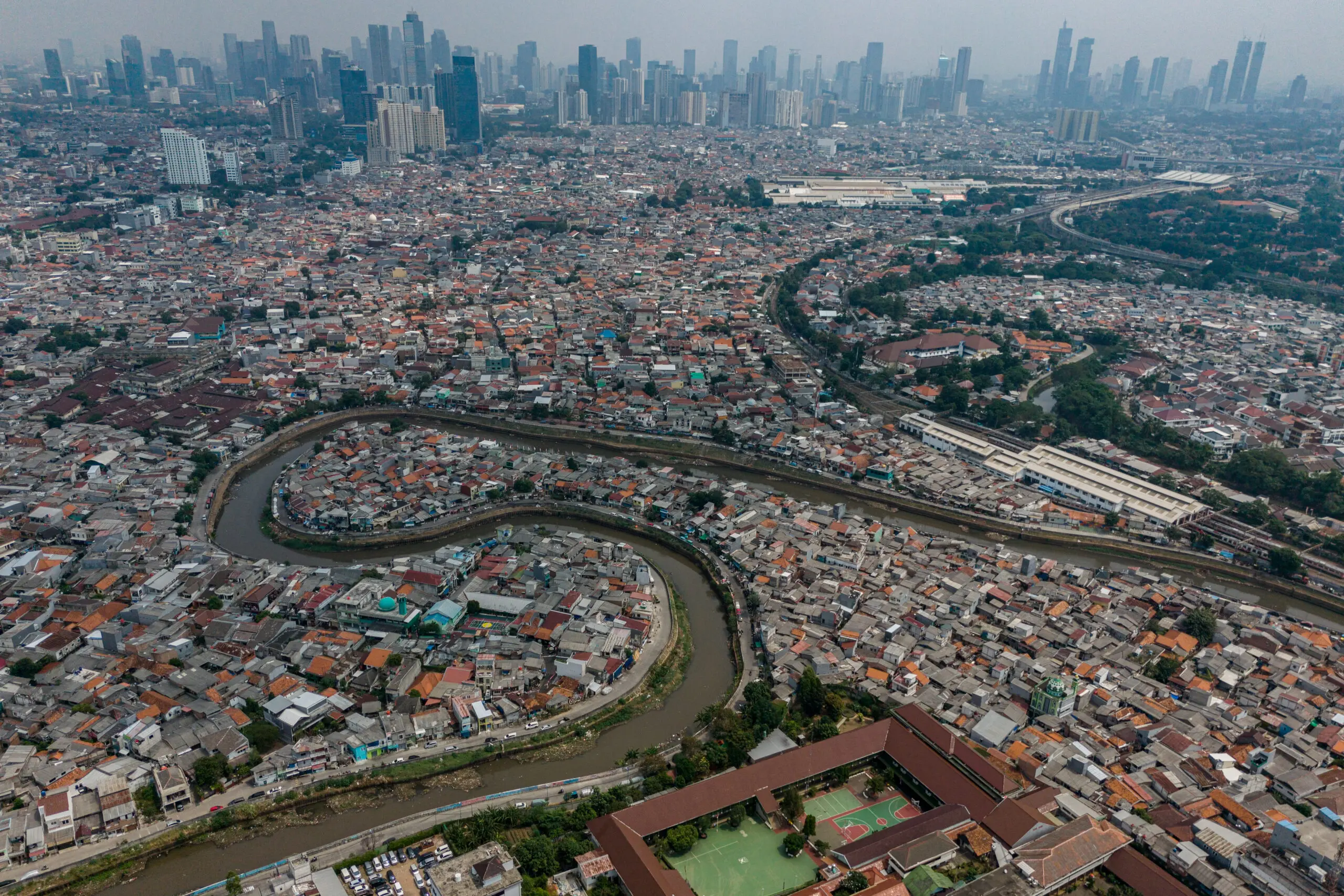
Image: An aerial photo of the Ciliwung River meandering through a densely populated residential area in Jakarta, Indonesia. Source: Reuters/Claudio Pramana/NurPhoto.