Nine months into the Strait of Hormuz shock, energy security was on the agenda at last week’s Japan-ASEAN and Asia-Pacific Economic Cooperation (APEC) summits. The second price shock in five years has forced Asian policymakers to rethink energy security planning and institutions—but China is not leading the charge despite its significant role in regional energy security.
China’s priorities are domestic, not regional
As the world’s largest oil importer, China has much in common with neighboring import-dependent countries weathering the Strait of Hormuz supply disruption. Yet it is largely absent from emerging regional policy discussions over new cooperative energy security planning mechanisms and institutions.
Over the past eight months, China has focused on domestic energy priorities—and its actions have sometimes harmed other Asian importers. Only a week after the US and Israeli attack on Iran, China banned export licenses for nearly all petroleum products. China relaxed those restrictions in subsequent months, but in October—after a significant decline in stocks of diesel and other fuels—Beijing again restricted product exports.
China is only the third largest petroleum product exporter in East Asia (after South Korea and Singapore), but unexpected changes to its export quotas alter market balances. For example, China supplied nearly one-third of Australia’s jet fuel imports in 2025, so its March jet fuel ban left Australian airlines scrambling for alternatives.
More broadly, China’s lack of transparency creates challenges for its neighbors. Its 2025-March 2026 inventory builds supported global oil demand, while a combination of lower refinery runs, caps on domestic fuel prices, and export restrictions contributed to an unprecedented decline in crude imports between February and June. Analysts note that China’s pricing power in oil markets stems from the timing and volume of its crude purchases. But while domestic considerations drive these decisions, they often leave China’s neighbors to plan around its actions. Despite the announcement of an ASEAN-China Energy Cooperation Partnership, its neighbors have reason to be cautious about China’s commitment.
Asia’s forced oil import pivot
After steep declines in the early months of the energy shock, Asian oil imports have rebounded. But the disruption has affected all importers that depend on Middle Eastern oil and gas. Japan typically imports more than 90 percent of its crude oil from the Middle East, so it has been forced to find alternatives from the United States or Latin America (in September, US crude oil accounted for 27 percent of Japan’s imports, up from 3 percent the previous year). India, which normally imports most of its liquefied petroleum gas from the Middle East, has turned to the United States for supply. Other Asian importers have struggled to secure petrochemicals feedstocks.
Importers are re-evaluating their supplier relationships. As International Energy Agency (IEA) Executive Director Fatih Birol stated at an April 2026 Atlantic Council event, importers now have three important objectives: “Diversify from whom you get your energy. Diversify your energy mix. And diversify your trade routes.” This is a difficult task for Asian importers with longstanding dependence on the Middle East, especially those with refineries configured to process crude oil grades from the Gulf and Iraq.
Addressing energy security threats with new institutions
Governments in the region see two major threats to their energy security. First, the shale revolution and the decline in US oil imports have given Washington freer rein to act in ways that can raise their energy costs and jeopardize supplies. And second, that global energy security institutions are no longer fit for purpose, since they were created amid the 1970s oil shocks—when Asia made up a much smaller share of the global economy and global oil and gas consumption.
Energy leaders see a need for new Asian energy security architecture, as governments seek to diversify supplies, build inventories, and explore joint purchasing and sharing mechanisms. Japan aims to lead this effort and has proposed several new programs to bolster energy security.
In Manila last week, leaders from Japan and Southeast Asia updated plans for the Tokyo-led Asia Zero Emission Community (AZEC) initiative and the related Partnership on Wide Energy and Resource Resilience Asia (POWERR Asia) framework. The AZEC action plan emphasizes cooperation on emissions reductions, carbon removal, and decarbonization of the transportation sector. Takaichi also proposed a new Asian oil security task force and referred to it as “an Asian version of the International Energy Agency.”
In April, Japan committed up to 1.5 trillion yen ($9.4 billion) under POWERR Asia to support regional procurement of new hydrocarbon supplies, infrastructure to bolster fuel storage and supply chain resilience in Asia, and diversification of energy sources. State institutions including the Japan Organization for Metals and Energy Security (JOGMEC) and Japan Bank for International Cooperation are expected to support these plans that aim to broadly support Asian energy security. In several bills expected to be approved by Japan’s Diet in December, Takaichi’s government tasks JOGMEC with investing in alternative supply infrastructure including bypass pipelines and storage facilities.
At the Japan-ASEAN summit in Manila, Japanese Prime Minister Sanae Takaichi also proposed a new “POWERR Gulf” initiative to enhance cooperation between oil exporters in the Gulf and Asian importers. Inventories will likely be a key focus. Japan in particular is already building on existing joint stockpiling with Gulf national oil companies Saudi Aramco, Abu Dhabi National Oil Company, and Kuwait Petroleum Corporation. On November 20, Saudi Arabia and Japan announced an expanded joint oil stockpiling program. Japan intends to buy 8 million barrels of Saudi crude oil to replenish its stockpiles, and will lend Saudi Arabia new crude oil storage capacity of 16 million barrels, in addition to Aramco’s current 8.2 million barrels of capacity. Under Japan’s current joint oil stockpiling program, Gulf national oil companies lease storage capacity and use it for commercial operations in normal times, but Japanese companies have preferential rights to this crude oil in times of emergency. If the broader region embraces POWERR Gulf, the Gulf-Japan arrangement could become a template for other nations.
Asia will need more than one energy blueprint
The effectiveness of these new energy security initiatives remains to be seen. Japan and other countries in the region will remain highly dependent on the Middle East for crude oil and petroleum products. Energy resource endowments and energy systems also vary greatly across ASEAN countries, so their vulnerabilities and planning principles may differ from one country to the next.
Governments also face a strategic choice. After the second oil and gas price shock in five years, some policymakers in Southeast Asia and South Asia may lean toward more drastic changes in energy policy to emphasize resilience and use of domestic energy resources. Governments in these regions may well decide to direct scarce resources toward expanding electrification, renewable energy generation, battery storage, and grid resilience rather than new fossil fuel infrastructure.
It is notable that Japan is playing such a prominent role in region-wide energy security initiatives. This is unsurprising, since import-dependent Japan excels in long-term energy security planning and policy, including through its Strategic Energy Plans. Some officials and analysts in the broader region, however, worry that the proposed frameworks are too focused on fossil fuels, arguing that new investment should focus on electrification and renewable energy.
Opportunities for energy security leadership
As Asian governments devise new plans and institutions to bolster energy security and resilience, China is both absent and inescapable. China is the world’s largest oil importer, holds the world’s largest oil stockpiles, and is a key customer for nearly all the Gulf countries. More than any other importer, its actions will affect prices and energy security for its neighbors.
Beyond the oil and gas sector, China’s “electrostate” model and its many innovations in electrification, electric vehicle manufacturing, battery technology, and clean energy deployment will be important for Asian countries seeking to cut import dependence and build energy resilience. Yet it is not playing an especially active role in emerging multilateral discussions about how to bolster energy security in Asia. China’s lack of transparency and focus on domestic issues leaves a policy and planning gap that Japan is well positioned to fill.
about the author

stay connected
Sign up for PowerPlay, the Atlantic Council’s bimonthly newsletter keeping you up to date on all facets of the energy transition.
related content

our work

The Global Energy Center develops and promotes pragmatic and nonpartisan policy solutions designed to advance global energy security, drive economic opportunity, and foster a sustainable energy future.
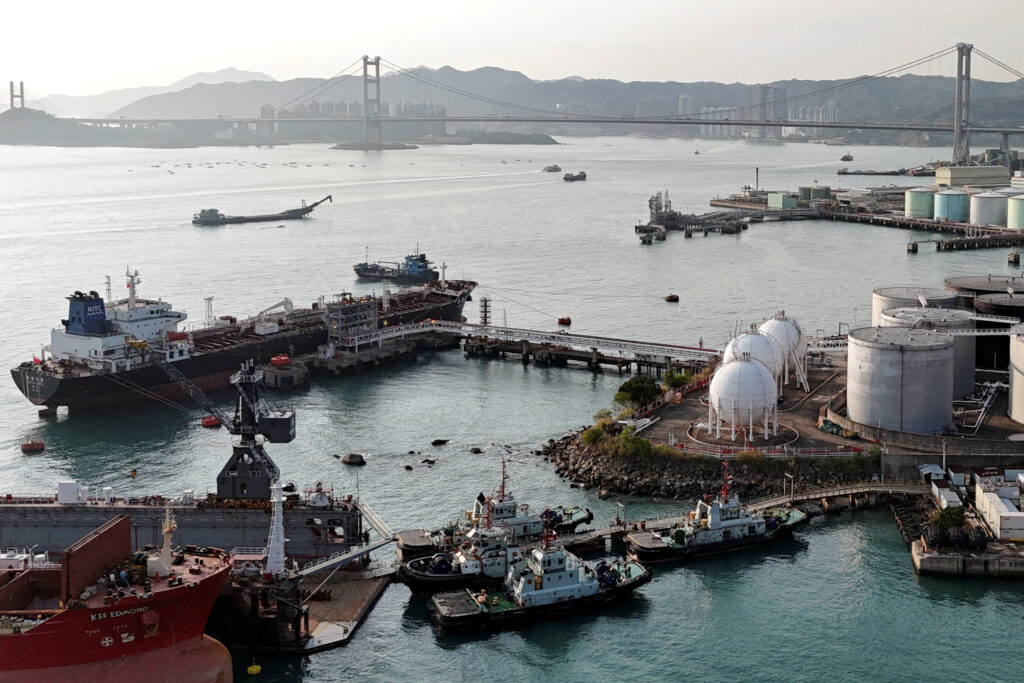
Image: FILE PHOTO: A drone view shows a Chinese-flagged oil tanker moored at an oil terminal at Tsing Yi port, with Tsing Ma bridge in the background, in Hong Kong, China March 19, 2026. REUTERS/Joyce Zhou/File Photo