Egypt’s debt has grown sharply in recent years. The country’s external debt was $163 billion as of March 2026, necessitating an estimated $8 billion in interest payments per year. Debt management consumes much of the country’s foreign exchange and budget resources, while constraining the government’s ability to fund development projects through new borrowing, especially from foreign institutions. Cairo has long relied on external financing as its primary economic stabilization tool via a combination of foreign assistance, International Monetary Fund (IMF) tranches, and debt rollovers.
As a mitigation tool, Egypt began shifting in recent years from debt-financed projects to land monetization and development via Chinese and Arab partnerships. Since 2015, Egypt has increasingly contributed public land as equity, while foreign investors provide capital, development expertise, and project execution. Once a project is completed, revenues are shared according to pre-agreed division. This approach received implicit World Bank endorsement when, in 2023, Egypt appointed the bank’s International Finance Corporation as its advisor for the asset monetization program, leveraging its experience supporting emerging markets.
While land monetization has been tried elsewhere, Egypt’s projects are among the largest. There’s little doubt that these projects will have measurable economic benefits. For example, Egypt’s debt as a share of gross domestic product has begun to fall and is projected to continue its decline in the coming years. However, land monetization projects are unlikely, by themselves, to put the country’s economy on a solid footing.
Dire economic straits
Nearly 30 percent of Egyptians are living below the national poverty line. Although official unemployment in late 2025 was moderate, at just over 6 percent, the 2026 forecast for labor force participation of around 43 percent is quite low. This indicates that true unemployment may be much higher as many Egyptians who want to work have given up trying to find a job, but employment is hard to measure given the size of Egypt’s informal economy.
SIGN UP FOR THIS WEEK IN THE MIDEAST NEWSLETTER
According to 2024 Organisation for Economic Co-operation and Development data, informal employment accounted for around 67 percent of all jobs in Egypt, an indicator that the formal economy is inadequate for employing all job-seeking adults. Labor in the various projects made possible by land monetization will help address unemployment, both during development and after the projects are completed, although job and population growth are in a perpetual race in Egypt.
The Egyptian pound’s dramatic fall—from .70 pounds to one US dollar in 1988 to 53 pounds to the dollar today—is the result of dependence on imported goods, the high external debt, and foreign-currency shortages, combined with periodic forced devaluations when the official exchange rate could no longer be defended. The most recent currency declines can be mostly attributed to the war in Iran, which has caused energy prices to spike and tourism to plunge.
Because daily life in Egypt is tightly linked to imported goods, pound devaluations hit the average Egyptian in immediate and painful ways. It remains unclear whether land monetization projects will prevent enough debt to stabilize the Egyptian pound in an enduring way.
How asset monetization works
For the Ras el-Hekma development on the country’s North Coast, Egypt contributed approximately 40,600 acres of state-owned land along the Mediterranean. The UAE (via its ADQ sovereign wealth fund) committed roughly $35 billion, the largest foreign direct investment in Egyptian history. Egypt received immediate foreign currency inflows for the land, a 35 percent stake in the project, and long-term profit participation.
When Egypt signs a deal like Ras el-Hekma, the capital arrives in dollars, which increases the country’s foreign exchange, improves its balance-of-payments position, allows it to service existing debt and potentially qualify for more borrowing, and reduces pressure on the currency. Also, unlike borrowing, this cash is equity investment, not requiring repayment.
A similar project, also on the North Coast, is Alam el-Aroum/Samla near Marsa Matrouh. The Qatar Investment Authority-linked Qatari Diar is investing almost $30 billion, which includes a $3.5 billion upfront land payment for some 20 million square meters and $26 billion in development investments. A revenue share for Egypt (15 percent after cost recovery) is part of the deal.
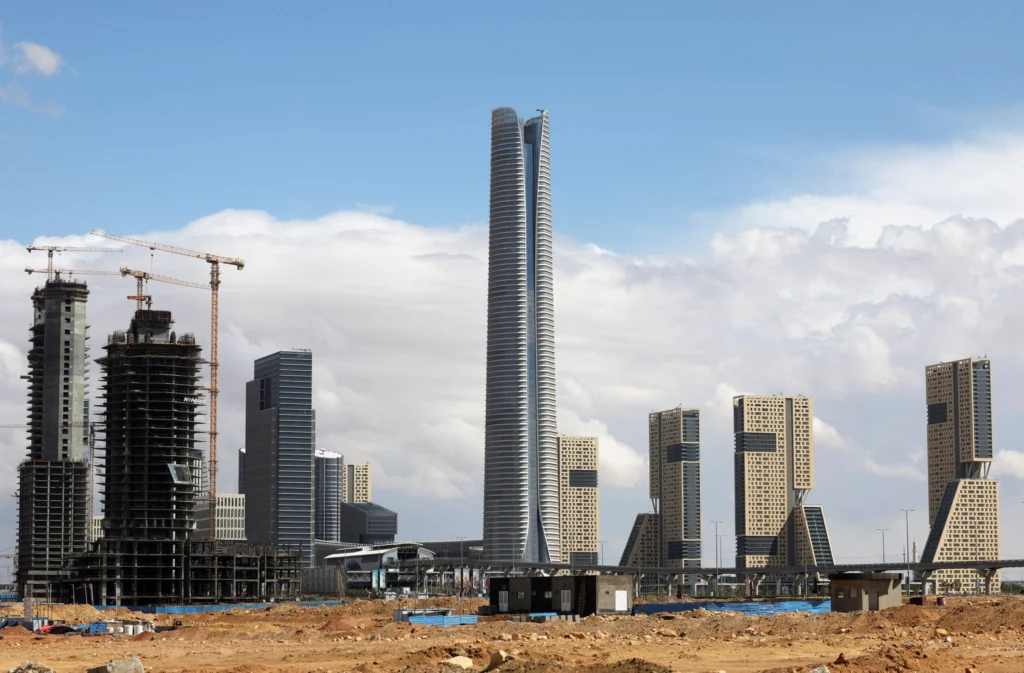
Another arrangement is in place for Egypt’s New Administrative Capital (NAC). About thirty miles east of Cairo, the NAC is designed as the government seat and a commercial hub; reports estimate total development costs of up to $58 billion, including infrastructure and governmental, commercial, and residential districts. Foreign direct investment plays a role in specific sub‑components like the Central Business District (CBD) and future free-trade‑zone ventures. Chinese banks led by the Industrial and Commercial Bank of China provided 85 percent of funding for twenty towers in the CBD. The China State Construction Engineering Corporation developed the CBD; Gulf investors (such as the United Arab Emirates’ DP World) developed commercial parcels. The state monetized land incrementally for the NAC, and parcel sales financed development, without increasing Egypt’s debt. Anticipated benefits include reduced congestion in Cairo, a showcase of state capacity, increased revenue, and the enhancement of Egypt’s regional standing.
A similar pattern helped develop exurban cities such as Shaykh Zayed and 6th of October decades ago. Financing was primarily via Gulf capital, with Egypt providing desert land. Developers profited through real estate sales. The Abu Dhabi Fund for Development provided significant financing for Sheikh Zayed City (named after the UAE’s founder), including for utilities, potable water systems, a two-hundred‑bed hospital, schools, mosques, and other infrastructure as part of the city’s initial build. In 6th of October, the Emirati Majid al-Futtaim Group developed the Mall of Egypt and other commercial projects, while China’s SAIC Motor is building an MG car factory. In 2024, Cairo gave the green light for the sale of land plots in eight cities to thirty-four foreign companies, all priced in US dollars.
In a variation on the pattern, Egypt contributed land in the Suez Canal Economic Zone via long-term leases. Foreign investors—China, Saudi Arabia, and the UAE—developed industrial zones, without Egypt’s forfeiting land ownership, and generated foreign exchange via exports.
Egypt and its partners
Cairo is making whatever economic decisions it can to buy debt relief. Land is being monetized, using various techniques, but it is done under financial distress, and the long-term upside may disproportionately benefit the foreign investors. The terms of these projects are often unclear; state control over development priorities is limited as developers select the projects they deem profitable.
China’s involvement is consistent with its longstanding interest in expanding its economic and diplomatic influence in the Middle East. Saudi Arabia and the UAE are driven by their own regime security concerns, because they rely on Egypt—the Arab world’s most populous state—as a military and political pillar in the region and fear that volatility in Egypt could spread to their own states.
The Egyptian economy struggled after the Arab Spring democratic experiment ended in 2013, as a result of the Ukraine war’s impact on global wheat prices, and due to the COVID-19 pandemic. As Cairo recovered from these crises, the Gulf states became less interested in unconditional aid and began looking for investment opportunities. Moreover, GCC Islamic institutions and sovereign wealth funds are interested in Sharia-compliant investments, which Egypt has used in a land monetization variant that uses land as collateral for Islamic Bond issuance.
The bottom line
Land monetization reduces unsustainable borrowing, brings in valuable foreign exchange, develops underutilized land, imports managerial expertise, and helps stabilize currency. The immediate cash flow is crucial for Egypt’s balance-of-payments management and is supplemented with long-term profit participation and tax revenues.
Egypt’s increasing use of land monetization is likely to continue and will help cover financing gaps, including budget deficits and balance-of-payments pressures. However, the proceeds are typically used to finance current obligations or other investments; they do not necessarily reduce existing debt unless explicitly designated for debt repayment, which is planned for only some of the generated revenues.
Also, economist Mohamed Fouad told Al-Ahram Weekly that in transforming unutilized state land into revenue-generating infrastructure, Egypt must avoid becoming a quasi-rentier state that relies on rent-based sources of finance rather than an unfettered economy.
Despite advice from international organizations, Egypt has not carried out sufficient sustained fiscal consolidation—structural reforms that lead to smaller budget deficits, reduced debt, reduced state role in the economy, improving the investment climate, etc.—that could trigger faster economic growth, according to the IMF. Land sales may provide temporary help. But deeper reforms are the key to Egypt’s long-term revival.
Amir Asmar is a nonresident senior fellow at the Scowcroft Middle East Security Initiative in the Atlantic Council’s Middle East Programs. He is an adjunct professor of Middle East issues at the National Intelligence University. He was previously a senior executive and Middle East and terrorism analyst in the US Department of Defense.
Related Reading
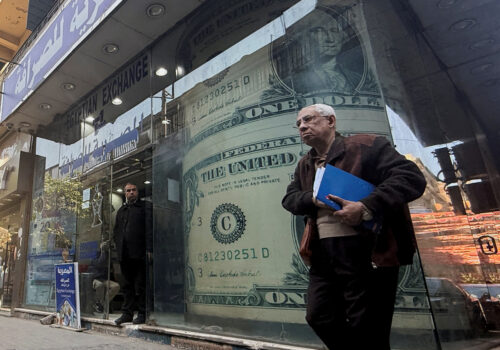

Image: The construction site of the futuristic Iconic Tower skyscraper in a business district, built by China State Construction Engineering Corporation (CSCEC) in the New Administrative Capital (NAC) east of Cairo, Egypt, March 25, 2026. REUTERS/Mohamed Abd El Ghany