
Tracking Iraq’s 2025 elections and coalition building
This post was updated on October 23.
On October 15, Iraq’s parliament approved eleven ministerial appointments and three deputy prime ministers, filling eight outstanding cabinet vacancies and adding three new portfolios. The seat for the minister of migration and displacement remains vacant, while a vote on a fourth deputy prime minister was postponed. This tracker maps the composition of Prime Minister Ali al-Zaidi’s government and the political negotiations that shaped it.
This post will continue to be updated with new developments.
How Iraq got here
Iraq’s elections rarely produce an outright winner. Instead, coalitions and political negotiations determine who leads the country. After the election in November 2025, the government formation process took nearly six months. On April 11, the Council of Representatives elected Nizar Amedi, the Patriotic Union of Kurdistan’s (PUK) nominee, as president after he secured 227 of the 249 votes cast in the second round. After the Coordination Framework (CF), a coalition of predominantly Shia political parties, reached agreement on April 27, Amedi named al-Zaidi prime minister-designate and tasked him with forming a government within the constitutional thirty-day window. On May 14, the Council of Representatives approved al-Zaidi’s government program and confirmed an initial slate of ministers in a vote of confidence.
On October 15, five months after the government took office, the Council of Representatives convened with 261 members present to vote on the outstanding appointments. The vote on the migration and displacement portfolio was postponed following a dispute between the Christian Suyana bloc and the Babylon Movement over the ministry. According to the Kurdistan Democratic Party (KDP), it and al-Zaidi had previously agreed to appoint an independent minister unaffiliated with either bloc, but candidates linked to Babylon drew objections from Suyana. The dispute also delayed the vote on the KDP’s nominee for a fourth deputy prime minister, Fares Brifkani, as parties sought to maintain the balance in the distribution of senior government posts.
Iraq’s confirmed ministers
Al-Zaidi submitted twenty-three ministerial nominees for parliament’s May 14 vote of confidence. Of those, fourteen were approved, five were rejected (interior, planning, higher education, construction and housing, and culture), and four were not brought to a vote (defense, labor and social affairs, youth and sports, and migration and displacement). This left nine portfolios without confirmed ministers until the October 15 vote.
The October 15 vote approved eleven ministers, filling eight of the nine portfolios left vacant in May and adding three newly created posts: a ministry of digital economy, governance, science, and technology; a standalone ministry of tourism and antiquities, previously part of the ministry of culture; and a minister of state for minority affairs. These additions expanded the cabinet from twenty-three to twenty-six ministerial portfolios, twenty-five of which are now filled.
Parliament also confirmed three deputy prime ministers: Mohsen al-Mandalawi, Mohammed Ali Tamim, and Laith al-Khazali. Al-Khazali is a senior leader of Asaib Ahl al-Haq, which the United States designated a foreign terrorist organization in 2020. He and his brother Qais al-Khazali were also named specially designated global terrorists that year. The Treasury Department sanctioned both brothers in 2019 for serious human rights abuses in Iraq, including violence against protesters.
Iraq’s cabinet: confirmed ministers
Twenty-five of twenty-six ministries filled. Fourteen confirmed on May 14, 2026; eleven on October 15, 2026.
Source: Atlantic Council, Iraq Initiative. Colors encode the community of the nominating party. Migration and displacement, reserved for the Christian quota, remains vacant after parliament postponed the vote. Three portfolios were newly created in October: digital economy, governance, science, and technology; tourism and antiquities, from which culture was separated; and a minister of state.
Background: The November 2025 vote
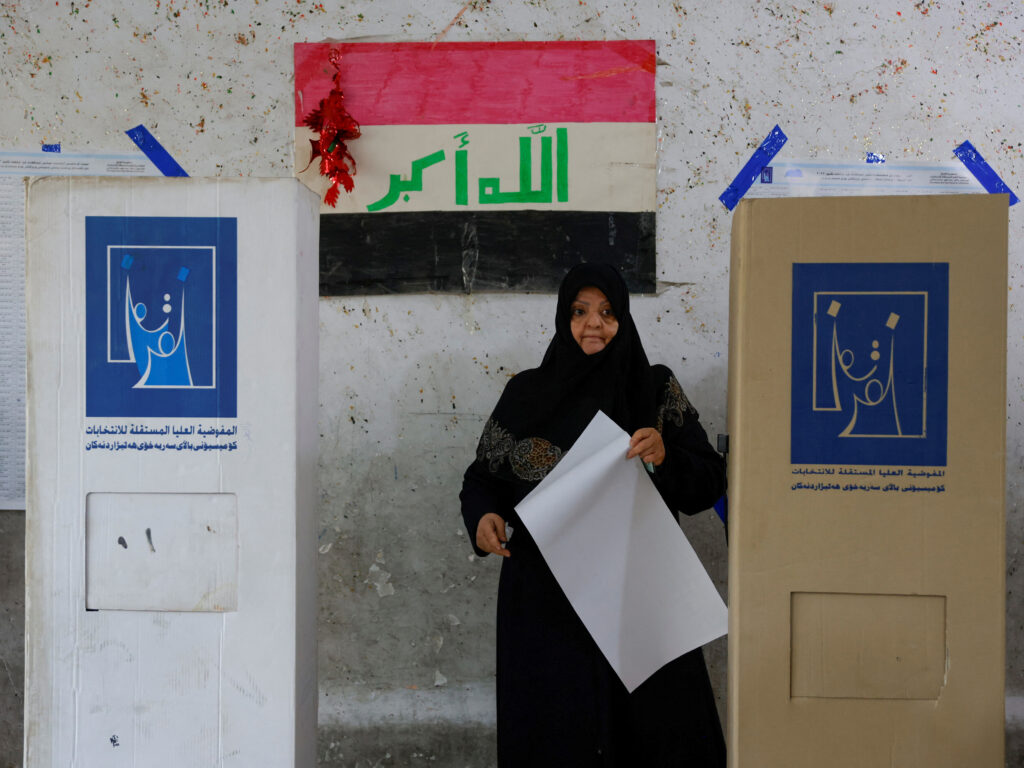
More than two decades after the fall of Saddam Hussein, Iraq’s elections remain competitive, but their outcomes are shaped as much by post-election negotiations as by the distribution of parliamentary seats. The November 2025 election and the coalition-building process that followed again demonstrated the influence of established political parties over government formation
The CF retained decisive influence over the government formation process. As in previous cycles, the premiership was determined through post-election bargaining among CF, Kurdish, and Sunni leaders, a process reflective of Iraq’s political equilibrium, in which an informal elite pact trades reform for order and stability. Notably, outgoing Prime Minister Mohammed al-Sudani did not secure a second term; the premiership instead went to al-Zaidi as a compromise candidate after the CF’s leading contenders failed to command consensus.
Campaigns had been visible across Baghdad and the provinces, and the Independent High Electoral Commission reported turnout of 56.11 percent, with 12 million votes cast. That marked an increase from 2021, when approximately 9.6 million Iraqis voted, representing a turnout of 43.5 percent. The comparison is not straightforward, as the commission calculates participation against registered biometric cardholders, a pool that contracted from 22.1 million in 2021 to 21.4 million in 2025, even as the population grew. Measured against all Iraqis aged eighteen and over, research firm IIACSS estimates true participation at roughly 41 percent.
Widespread patronage, substantial campaign spending, and alleged vote buying gave established parties with access to financial resources and state employment networks significant advantages in mobilizing voters. These practices continued to undermine confidence in elections as a mechanism for political accountability. The boycott by prominent Shia cleric Moqtada al-Sadr’s Sadrist Movement, which had won seventy-three seats in 2021 to become the largest parliamentary bloc, further reduced competition and narrowed participation.
Election results
Note: This does not include smaller winning coalitions that are affiliated with the larger blocs listed above. For example, two separate coalitions in Anbar with a total of six seats are generally considered to be affiliated with Taqadum but have not been added to Taqadum’s tally.
What to know about the electoral system
Iraq’s 2025 parliamentary elections were governed by Law No. 4 of 2023, which reversed key electoral reforms adopted in 2020 following the Tishreen protest movement. The new law replaced smaller electoral districts with governorate-wide constituencies and restored the modified Sainte-Laguë system, favoring established political blocs over smaller parties and independents that had made gains in 2021.
The amendments restored proportional representation using the modified Sainte-Laguë formula, under which political lists’ vote totals are divided by a series of divisors (1.7, 3, 5, 7, and so on) to allocate seats. Each of Iraq’s eighteen provinces serves as a single electoral district, with its share of the 329 parliamentary seats determined by population. Seats won by each list are awarded to the candidates who received the highest individual vote totals. Iraqi law reserves at least 25 percent of parliamentary seats, or eighty-three seats, for women, along with nine seats for minorities: five for Christians and one each for Yazidis, Shabaks, Mandaeans, and Feyli Kurds. When a seat becomes vacant, it passes to the next-highest vote-getter on the same list or, in the case of minority quota seats, according to the applicable community-specific replacement rules. While supporters of the current law argue that it strengthens stability and party cohesion, critics contend that the return to larger districts and closed party lists weakens independent candidates and concentrates power among established elites.
Key political players and alliances
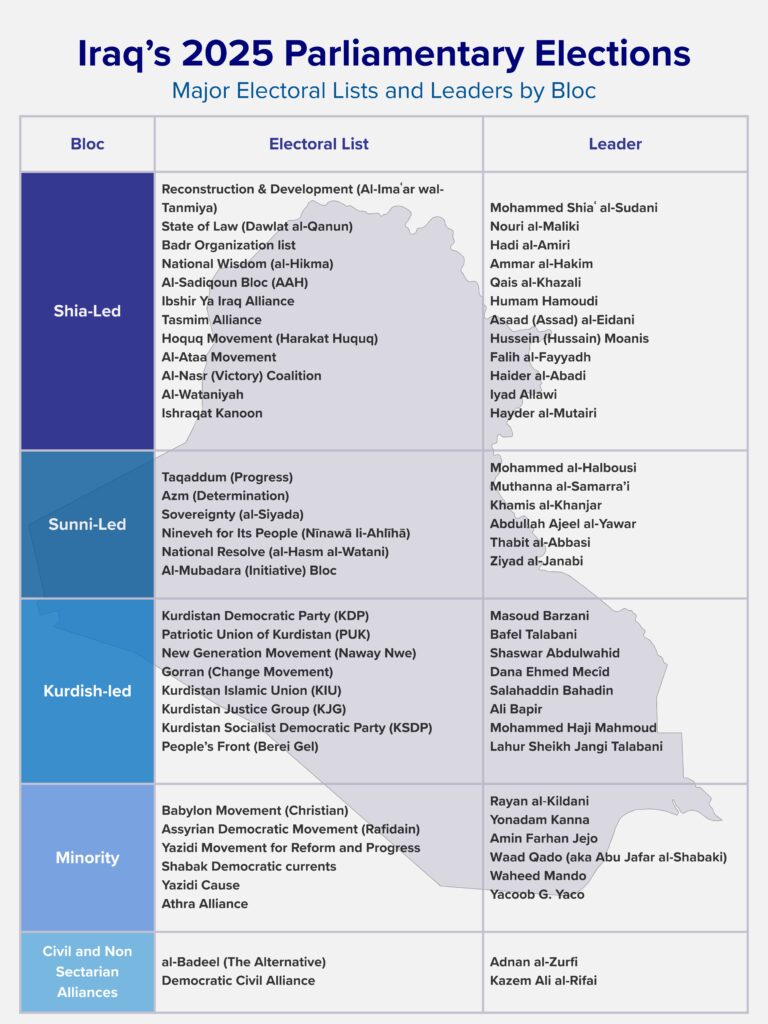
What the parliament has looked like over time
Victoria J. Taylor is the director of the Iraq Initiative in the Atlantic Council’s Middle East programs.
Nibras Basitkey is the associate director of the Iraq Initiative at the Atlantic Council’s Middle East programs.
Daniah Jarrah is the program assistant of the Iraq Initiative at the Atlantic Council’s Middle East programs.
Related Events
Related Content
Stay updated
Stay connected
The Iraq Initiative is driving policy-oriented programs and analysis that advance Iraq’s stability and sovereignty, regional integration, and democratic and economic development. It also aims to promote a strengthened US-Iraq partnership.
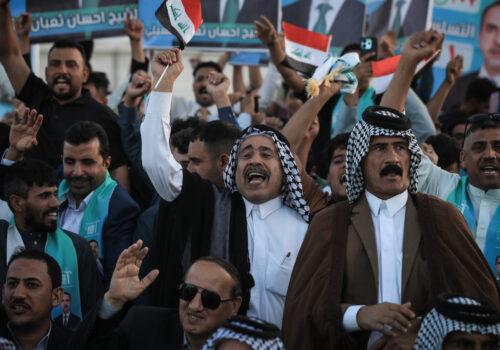
Image: Supporters attend an election campaign rally for the State of Law Coalition, ahead of Iraq's parliamentary elections, in Baghdad, Iraq November 7, 2025. REUTERS/Thaier Al-Sudani
Follow the conversation on X with @AtlanticCouncil and @ACMideast using the hashtag #ACIraq