Mexican presidential candidate sees risk of an anti-American Mexican leader
The “rhetoric of hate” that has dominated US President Donald J. Trump’s approach to Mexico could impact the outcome of Mexico’s presidential elections in 2018 and determine the future of the US-Mexican partnership, Margarita Zavala, a candidate for the Mexican presidency, said at the Atlantic Council on March 7.
“We have a rhetoric of hate coming from the president of the United States, beginning with the campaign,” said Zavala, urging: “It’s important to take that kind of rhetoric seriously because of what it gives rise to. That’s the risk we’re seeing in Mexico.” She said Mexico is ready to take a step back from its relationship with Washington “and that’s because of what’s happening in the United States.”
The prospect of an anti-American Mexican president “is a matter that has an impact on future relations and the future of us all,” she added.
Zavala and her opponent for the presidency, Andrés Manuel López Obrador, both strongly oppose Trump’s proposed policies—from doing away with the North American Free Trade Agreement (NAFTA) to building a border wall. These are issues Trump raised on the campaign trail and echoed in the Oval Office, which have caused Mexico to reassess its relationship with the United States. However, where Zavala wants to maintain the North American partnership, López Obrador represents an antagonistic stance toward close relations with Washington. His position appeals to the surge of populism in Mexico, fueled by fear and frustration, which could usher in an end to the US-Mexico alliance.
“A strong US-Mexico alliance is the key to stability, security, and prosperity, not only along the border, but in the United States,” said Peter Schechter, Atlantic Council vice president and director of the Adrienne Arsht Latin America Center. However, he added, “a rift is widening.”
According to Zavala, the 2018 presidential elections in Mexico “may be marked by polarization, hate, the relaxation of public policies having to do with security of trade—we all lose if that’s the case.”
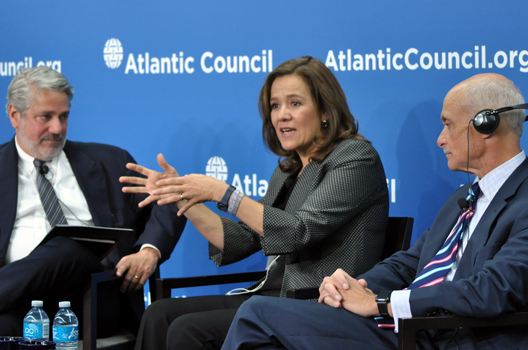
Zavala joined Michael Chertoff, former US secretary of homeland security, to discuss the dangers of a fractured relationship between the United States and Mexico, as well as reaffirm the fundamental significance of that relationship. Schechter moderated the discussion.
The event coincided with the launch of an Atlantic Council publication: Beyond the Headlines: A Strategy for US Engagement with Latin America in the Trump Era, part of a series of strategy papers for the new US administration. The paper focuses on maximizing opportunities and minimizing challenges in US relations with Latin America. In introductory remarks to the event, Jason Marczak, director of the Latin America Economic Growth Initiative at the Adrienne Arsht Latin America Center and one of the authors of the issue brief, said: “Latin America is today a formidable global player and a key strategic partner for the United States.” Focusing on Mexico, he added, “we cannot risk the long consequences of fracturing a relationship with one of our closest allies.”
According to Zavala, that relationship is in jeopardy. Describing the general attitude toward the United States among Mexican citizens, Zavala said that Trump’s aggressive and humiliating tone toward Mexico has united the country in sentiments of national pride and frustration with its northern neighbor. However, she claimed, “I would rather we united around ideas and thoughts and visions, not around a conflict with the United States.”
In order to emphasize the importance of continued partnership between Washington and Mexico City, Zavala said “we have to be very clear about what’s in jeopardy in our country and in the United States,” namely trade and security.
NAFTA– a free-trade deal negotiated between Mexico, the United States, and Canada—has been the foundation of relationships between the three countries that extend beyond the economic realm. Trump has said that he will take the United States out of NAFTA, calling it “the worst deal ever.”
However, “sometimes the rhetoric we hear from the White House exceeds the actual policy,” said Chertoff, who also serves as co-founder and executive chairman of the Chertoff Group. He said it is more feasible to renegotiate rather than repeal the deal. Zavala conceded that NAFTA, an agreement brokered twenty-five years ago, needs to be updated, but it should remain in place for the benefit of all stakeholders.
NAFTA currently provides 14 million US jobs, and Mexico is the top trading partner for many US states, particularly those that rely on agricultural exports.
The movement of goods is closely linked to the movement of people. While Trump has been vocal about the threat to US jobs posed by Mexican immigrants, recently passing an executive order facilitating the deportation of unauthorized Mexican immigrants, there are more Mexicans leaving the United States than coming to the country. The majority of immigrants who are coming across the border with Mexico are fleeing violence from the Northern Triangle of Central America –Honduras, Guatemala, and El Salvador. Acting as a buffer, Mexico is the United States’ greatest asset in stemming the flow of illegal immigration from the south. “In a world of chaos, the strong working relationship with Mexico has been critical to ensuring that [US] security starts far away from our southern border,” said Marczak.
“We need to stop associating the word ‘migration’ with negative concepts,” said Zavala. “Rhetoric shouldn’t prevent people from understanding what Mexico has contributed to the United States.”
To halt the flow of migration, Trump has proposed building a wall along the US-Mexico border. He has said the Mexican government will pay for the wall. Zavala asserted this will not happen.
She said such a construction would be ineffective, expensive, and symbolic. “The issue of the wall needs to be pointed out because of what it symbolically represents,” she said. While a physical “wall” or fence has existed along the US-Mexico border since the 1990s, Zavala said there is now a backdrop of xenophobia and fear that needs a scapegoat. Chertoff said, “we are in a very strange time in the West.” He attributed the rise of xenophobia to surging populism.
However, said Zavala, “we’re not going to solve the weighty issues of the day by hating each other.”
Chertoff said immigration control is a fair expectation of US citizens, “if we could get by the rhetoric and just fix the problem, we could get around this constant irritant.” According to Zavala, “it’s in the best interest of our people if we focus on real security issues and not just putting up a wall… that’s going to lead to more violence.”
“It may be that migration, with the cooperation of Mexico, is better solved without concrete, but with human dimensions forefront,” Thomas R. Pickering, a former US undersecretary of state, said in his introductory remarks.
“This is clearly part of a larger trend,” he said, expressing concern that similar sentiments will become prevalent in Mexico as well.
While Trump continues to make Mexico one of his negative talking points, there are many stakeholders in a positive relationship on both sides of the border, Schechter said. According to Zavala, “we need to make people understand this. People in the United States need to understand that good relationships or bad relationships have their consequences.”
“We are now living in a very challenging period where getting the facts and the truth out is by no means easy,” said Chertoff. However, he said, “we need to get stories out there… so there’s a greater understanding of the fact that Mexico is not just our neighbor, but one of our closest allies and friends.” Zavala echoed his sentiment, saying, “it’s clear we need a communications strategy in a difficult moment when demagogy and misinformation can prevail.”
Should the relationship between the United States and Mexico fall apart, other countries will fill the void. China, in particular, is poised to assume the benefits of a close trade relationship with Mexico. “I am quite sure that both Russia and China would love to be welcomed into the Western hemisphere,” said Chertoff. “From an economic and security standpoint, we should recognize that we are not the only game in town… If we back away, especially in a hostile way, we open the door to other rivals,” he added.
Leaders in both countries have important decisions to make about the future of the US-Mexico relationship, said Schechter. Zavala said not only leaders, but the public need to play an active role in this process. She called for Mexican citizens, who will go to the polls in July of 2018, as well as US citizens, to be conscious and thoughtful about their actions and interactions, which, at the most fundamental level, will shape the future of the relationship between the two countries. “Don’t underestimate the electorate,” she cautioned.
“Of course, we need change,” she conceded, “however what’s important to ensure is that whatever change occurs is responsible.” While the rhetoric of hate might find success in the outset of a campaign or administration, said Zavala, “we have to be far more astute and follow the path of rationality.”
Rachel Ansley is an editorial assistant at the Atlantic Council.
Image: (from left) Peter Schechter, Atlantic Council vice president and director of the Adrienne Arsht Latin America Center, moderated a discussion with Margarita Zavala, Mexican presidential candidate, and Michael Chertoff, former US secretary of homeland security at the Atlantic Council on March 7, 2017. (Atlantic Council)