During this year’s St. Petersburg International Economic Forum, Gazprom’s pavilion featured a design conspicuously inspired by wood. To many, this was an unmistakable reference to Vladimir Putin’s 2022 remarks, when he mocked Europeans by suggesting they could always burn firewood instead of Russian gas, much like they did “in the Middle Ages.”
Yet even as Moscow continues to weaponize its hydrocarbon dominance to exert influence across the European Union (EU), other countries on Europe’s periphery are slowly forging more resilient energy pathways. Turkey, long dependent on Russian gas itself, is at the forefront of this shift. It has embarked on an aggressive diversification policy that pairs long-term Eurasian pipeline diplomacy—particularly with neighboring Azerbaijan—with an unprecedented, US-backed expansion of liquefied natural gas (LNG) infrastructure. By reshaping the regional energy landscape, Ankara aims to transform itself from a vulnerable consumer into a critical gateway for Europe.
Azerbaijan becomes a cornerstone of Ankara’s long-term gas strategy
A recent sign of the tectonic shift in Turkey’s energy strategy came in May, when Ankara and Baku concluded a fifteen-year deal covering 33 billion cubic meters (bcm) of natural gas supplies. The agreement ensures a stable supply of Azerbaijani gas until the mid-2040s, underpinned by landmark production agreements including the Absheron Phase Two project involving the State Oil Company of the Azerbaijan Republic (SOCAR), the Turkish state-owned BOTAŞ Petroleum Pipeline Corporation, the Abu Dhabi National Oil Company (ADNOC) and TotalEnergies. According to a SOCAR official, half of this new production is earmarked for the Turkish domestic market, while the remainder helps free up exports for a supply-starved Europe.
Turkey’s energy partnership with Azerbaijan is hardly new. What has changed is the urgency with which Ankara is pursuing diversification. Turkish officials have long been aware of their country’s deep dependency on Russian gas, but for years that dependence appeared too deeply embedded to unwind. The government’s recent drive to secure alternative supplies therefore marks a profound shift. As former Turkish Minister of Energy and Natural Resources Ali Riza Alaboyun told the author, Azerbaijan’s natural gas offers Turkey a combination of competitive pricing and reliable supply.
Despite diversification, Russia remains the largest supplier
Following the start of pipeline imports from Iran in 2001, Turkey continued to diversify its supply network by importing natural gas from Azerbaijan in 2007, commencing with a modest initial volume of roughly 1.26 bcm. Prior to bringing this new supply route online, Turkey’s dependence on Russian energy supplies was exceptionally high. In 2006, Russian gas accounted for approximately 63.9 percent of the country’s total natural gas import mix.
By 2014, Turkey imported 6.08 bcm of gas from Azerbaijan, but this remained dwarfed by a staggering 26.97 bcm from Russia. Fast forward a decade, however, and imports from Azerbaijan have nearly doubled to 11.48 bcm and now account for roughly 22 percent of Turkey’s total gas imports. Meanwhile, the volume of Russian imports has fallen to 21.57 bcm. Though this still represents a substantial 41 percent share, underscoring Russia’s continued importance in Turkey’s energy mix, its once-dominant grip is visibly loosening.
At the same time, Russia’s full-scale invasion of Ukraine in 2022 has not completely derailed Turkey’s gas imports from Moscow. In fact, Russia’s market share only experienced a temporary dip, falling from 44.9 percent in 2021 to 39.5 percent in 2022, before quickly rebounding to 42.3 percent in 2023.
US LNG emerges as a major force in Ankara’s energy transformation
Parallel to this Eurasian pipeline expansion is another, even more disruptive trend: the meteoric rise of the US as a dominant player in the Turkish energy market. In less than a decade, Turkey has transformed its LNG regasification capabilities at an unprecedented scale. Although its LNG sector began modestly in 1994 with a contract with Algeria, imports have grown exponentially since 2016, driven largely by US LNG purchased on the spot market.
The scale of this infrastructure boom is staggering. As Turkish Energy Minister Alparslan Bayraktar recently highlighted, the country’s LNG regasification capacity skyrocketed from 32 million cubic meters per day in 2016 to approximately 161 million cubic meters per day in 2025—a fivefold increase. Operating five sophisticated LNG terminals—comprising two land-based facilities and three floating storage regasification units (FSRUs)—Turkey can now import roughly 58 bcm of gas in liquefied form annually, a volume that exceeds its entire national gas consumption in 2025. To borrow from Putin’s 2022 remarks, this means that even if a major geopolitical rift were to emerge with Russia, Turkey would not be forced to “resort to firewood.”
This infrastructure flexibility has also allowed Washington to reshape Turkey’s gas market. According to the Centre for Eastern Studies, US LNG imports to Turkey surged to 9.19 bcm in 2025, capturing nearly 16 percent of the total import market, up from a virtually negligible 0.52 percent in 2016. Looking ahead, this partnership is expected to evolve from volatile spot purchases toward secure, long-term, cost-efficient supply contracts.
Notably, contracts with major suppliers such as the Swiss-based energy firm Mercuria and the US company Cheniere Energy are set to take effect in 2026, delivering roughly 1.2 bcm and 4 bcm annually, respectively. This supply will be further bolstered in 2027, when a major ten-year agreement with ExxonMobil comes into force, injecting an additional 3.45 bcm per year into Turkey’s energy mix.
Against this backdrop, Russia’s shrinking footprint is striking. Its share of Turkey’s gas imports has fallen from roughly 60 percent two decades ago to 41.3 percent in 2024, before dipping to 37 percent in early 2025. If these trends continue, the combined forces of Azerbaijani pipeline gas and US LNG could unseat Russia as Turkey’s largest gas supplier during the 2030s. At the same time, Turkey’s domestic natural gas production is projected to meet 30 percent of national consumption, according to Bayraktar.
While Russia would remain a major supplier of natural gas, it would no longer be the dominant player in Turkey’s import mix. And with the EU set to ban Russian gas imports by the end of September 2027, Ankara’s bargaining position vis-à-vis Moscow is likely to strengthen significantly.
Bypassing Moscow altogether remains a distant prospect
Despite Ankara’s logistical maneuvers, completely eliminating its dependence on Russian gas remains an extraordinarily elusive, if not impossible, goal in the near term. The simple reality of energy economics is that no other single source can meet Turkey’s baseload energy demand with the sheer volume and infrastructure-backed reliability that Russia provides. Turkey’s natural gas consumption is expected to rise to between 60 and 65 bcm per year over the next five years, and Russian gas is likely to remain a significant part of the country’s energy mix. Given Ankara’s ambition to become a natural gas hub and energy exporter, abundant supply will continue to be a critical factor.
While LNG offers remarkable flexibility, it is inherently exposed to global market shocks and maritime choke points—vulnerabilities highlighted by ongoing instability in the Middle East. Following the cancellation of a scheduled shipment from Qatar due to disruptions in the Strait of Hormuz, Pakistan was forced to resort to the spot market in May and purchase an LNG cargo at an exorbitant rate, marking its most expensive acquisition in four years. Turkey, however, is largely shielded both from spot-market fluctuations, thanks to long-term deals, and from maritime risks, since its largest LNG suppliers—the US and Algeria—enjoy direct and unimpeded access to the Mediterranean.
Pipelines, by contrast, offer a steady and predictable flow of energy that a growing industrial economy such as Turkey requires to maintain grid stability. Still, alternative regional suppliers can come with immense geopolitical baggage. As Alaboyun notes, Iran has historically been a crucial addition to Turkey’s gas mix, for instance, but its broader potential to meet both Turkish and European energy needs hinges entirely on a diplomatic breakthrough between Washington and Tehran—a highly remote scenario in the current geopolitical climate.
Ankara’s energy hub vision complicates its diversification efforts
Ankara’s overt aspiration to transform itself into a sophisticated regional gas hub where natural gas is not just transmitted, but actively priced and traded, has complicated its diversification efforts. This ambition, in particular, has drawn scrutiny from the US and Europe over concerns that a homogenized Turkish blend could be utilized to obscure the origin of Russian gas. Skeptics warn that such a mechanism may enable Russia to bypass Western sanctions.
While the technical infrastructure—such as the expanded FSRU fleet and interconnected pipelines—has been successfully developed over the last few years, achieving a true financial trading hub remains a distant milestone. After all, as Alaboyun emphasizes, a genuine hub requires deep private-sector involvement, regulatory liberalization, and a level of supply diversity that the Turkish domestic market has yet to achieve. Ultimately, however, Turkey’s aggressive diversification strategy should not be misconstrued as a total decoupling from Moscow, but rather as an exercise in maximizing geopolitical leverage. By deepening its ties to Azerbaijan’s Absheron fields and bolstering its maritime supply routes with US LNG, Ankara is successfully eroding Russia’s ability to use energy as a political tool. Turkey is transitioning from a vulnerable, dependent client into a critical transcontinental energy bridge.
İlker Sezer is the managing editor of Türkiye Today.
The views expressed in TURKEYSource are solely those of the authors and do not necessarily reflect the views of the Atlantic Council, its staff, or its supporters.
Explore the program
Within the Atlantic Council’s longstanding commitment to strengthening the transatlantic relationship, the Atlantic Council Turkey Program conducts research, provides thought leadership, and offers a platform for strategic dialogue between the US, Turkey, and NATO allies to address the region’s toughest challenges and explore opportunities, including in the fields of energy, business & trade, technology, defense, and security.
Related Reading



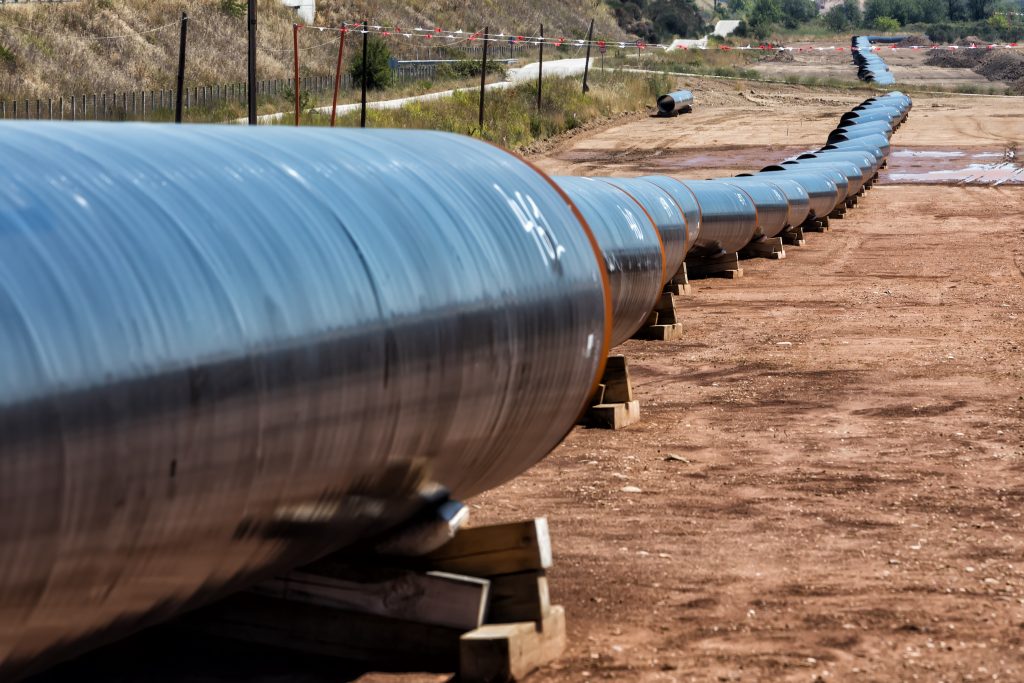
Image: Construction of gas Trans Adriatic Pipeline in Northern Greece. Source: Vasilis/Shutterstock.