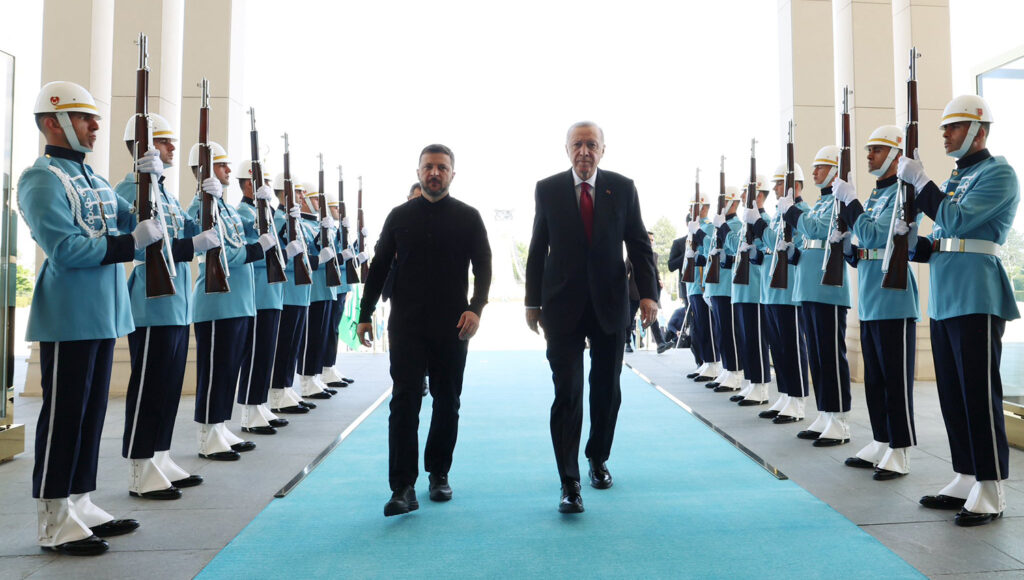
With the Ukrainian parliament’s ratification of the free trade agreement with Turkey on July 14, a deal nearly two decades in the making is now poised to enter into force.
Negotiated since 2007, the agreement—which was signed during President Recep Tayyip Erdoğan’s February 2022 visit to Kyiv—has generated both enthusiasm and resistance within the two countries’ business communities. The central challenge was balancing Ukraine’s interest in gaining access to Turkey’s heavily protected agricultural market with Turkey’s push to export more industrial goods to Ukraine. Producers in sensitive sectors on both sides feared heightened competition.
Under the agreement now set to enter into force, liberalization will be substantial but deliberately phased to give sensitive domestic sectors time to adjust. Turkey will immediately eliminate tariffs on 93.4 percent of Ukrainian industrial goods and 7.6 percent of agricultural products. Tariffs on an additional 1.5 percent and 28.5 percent, respectively, will be removed over the next three to seven years. Meanwhile, Ukraine will initially lift tariffs on 56 percent of Turkish industrial goods and 11.5 percent of agricultural products, before phasing out tariffs on an additional 43.2 percent and 53.7 percent over transition periods of up to five years for industry and ten years for agriculture.
Yet the deal will enter into force under circumstances neither side could have anticipated when negotiations began. Russia’s full-scale invasion of Ukraine has radically altered the economic and geopolitical landscape in which the deal will operate, prompting the inclusion of a special clause allowing both sides to review selected provisions after ratification.
Expanding economic cooperation beyond trade
The free trade agreement’s immediate objective is to expand bilateral commerce toward the $10 billion target set out by Volodymyr Zelenskyy and Recep Tayyip Erdoğan. According to the Ukrainian Ministry of Economy, bilateral trade reached $8 billion in 2025, making Turkey Ukraine’s third-largest trading partner and second-largest export market, with Ukrainian exports totaling $2.7 billion.
Yet the structure of this trade remains unbalanced. Ukraine has traditionally maintained a trade surplus with Turkey, but the destruction of industrial capacity and the Russian occupation of agricultural regions have reversed this dynamic. Ukrainian exports have declined, while wartime demand has driven up imports of Turkish machinery, vehicles, fuel, equipment, and construction materials.
Currently, grain and sunflower oil account for approximately 77 percent of Ukrainian exports to Turkey. Much of this production is processed by Turkish companies into higher-value products, such as flour and consumer foods, for sale domestically or re-export to third markets. As a result, much of the added value is generated in Turkey rather than Ukraine.
The free trade agreement could help change this pattern. While many Ukrainian commodities already enter Turkey at low or zero rates, the new framework improves access for processed foods, feed concentrates, and more deeply processed oil products. This creates a stronger incentive to build processing capacity in Ukraine instead of exporting raw materials.
But the agreement also carries risks for the Ukrainian economy while benefiting Turkish businesses. Turkish textile, machinery, fruit, and vegetable producers are highly competitive, while their Ukrainian counterparts face high energy costs, labor shortages, damaged infrastructure, and restricted access to finance. The agreement could deepen this imbalance if it merely leads to more Ukrainian commodity exports alongside more Turkish manufactured imports. From Kyiv’s perspective, its success will ultimately depend on whether it generates investment and value-added production inside Ukraine.
A blueprint for reconstruction and European integration
This investment dimension is especially important for reconstruction. According to Burak Pehlivan, president of the Turkish-Ukrainian Business Association, Turkish investment in Ukraine has approached $5 billion over the past five years, with more than 1,100 Turkish companies active in construction, manufacturing, agriculture, energy, and other sectors. Strikingly, despite the intensity of Russia’s war on Ukraine, approximately $300 million in new Turkish capital entered Ukraine between 2022 and 2025.
Turkish firms possess a high tolerance for geopolitical risk, honed through decades of operating in complex environments such as Iraq, Afghanistan, and Syria—and many already have a strong track record in Ukraine and are well positioned to help rebuild roads, bridges, housing, ports, energy facilities, and other critical infrastructure.
For Turkey, the commercial opportunity is even more significant. The free trade agreement gives its competitive industrial producers wider access to a nearby market where demand for machinery, vehicles, construction materials, equipment, and consumer goods is likely to grow substantially during reconstruction.
Moreover, many reconstruction projects are expected to be financed by international institutions such as the European Bank for Reconstruction and Development, as well as by the European Union (EU) and donor governments such as Japan. Turkish companies will therefore be able to compete for profitable, externally financed contracts without Ankara itself having to supply the bulk of the capital.
The agreement provides a more predictable commercial framework that could encourage these companies to move beyond short-term contracting and establish long-term partnerships and production facilities in Ukraine. Joint ventures could combine Turkish financing, machinery, and commercial networks with Ukrainian engineering, resources, labor, and increasing access to the European market.
The deal also has a broader European dimension by incorporating the revised pan-Euro-Mediterranean rules of origin. Ukrainian manufacturers will be able to import Turkish components, integrate them into local production, and still retain preferential tariff access when exporting the finished goods to the EU. This framework fills a missing regulatory link among the Ukrainian, Turkish, and EU markets. It integrates Ukraine more deeply into European supply chains ahead of EU membership while encouraging Turkish manufacturers to locate production in Ukraine as the country adopts European standards. Even as modernization of the EU-Turkey Customs Union remains stalled, the bilateral agreement can connect all three economies through investment, manufacturing, and logistics.
The defense-industrial pillar of cooperation
The free trade agreement should also be viewed as part of a broader Ukrainian-Turkish strategic partnership. Over the past decade, the two countries have developed significant defense-industrial ties encompassing drones, aircraft engines, naval platforms, and other technologies. Turkish unmanned aircraft became an early symbol of Ukrainian resistance, while Ukrainian engines have powered advanced Turkish systems, including the Akinci drone.
During Turkish Foreign Minister Hakan Fidan’s July visit to Kyiv, the two sides emphasized the importance of resuming the work of the Joint Ukrainian-Turkish Commission on Defense-Industrial Cooperation following a three-year pause. Although defense cooperation falls outside the agreement’s formal scope, its ratification sends a broader signal of mutual trust and creates a more predictable environment for investment, component supply chains, joint production, and access to third-country markets.
Ankara has also indicated its readiness to contribute to future security guarantees for Ukraine and play a leading role in their maritime component alongside NATO allies. Protecting freedom of navigation, ports, critical infrastructure, and regional supply chains would be essential to both reconstruction and trade. Black Sea security, defense production, and economic integration are therefore mutually reinforcing pillars of the partnership.
For Turkey, stronger relations with Ukraine offer strategic diversification amid Moscow’s repeated weaponization of trade. Shortly after Fidan’s Kyiv meetings, Russia banned stone-fruit imports from Turkey, officially on phytosanitary grounds. But the timing recalled Moscow’s ban on Turkish agricultural imports following the 2015 crisis over Turkey’s downing of a Russian Su-24 fighter jet. Ukraine cannot replace Russia economically, but stronger regional partnerships can reduce Turkey’s vulnerability to Russian pressure.
Toward a more durable partnership
This does not mean that Ukrainian and Turkish interests always coincide. Kyiv expects partners to increase economic pressure on Russia, prevent sanctions circumvention, restrict its shadow fleet, and stop the export of grain stolen from occupied Ukrainian territories. Ankara, meanwhile, is wary of further military escalation in the Black Sea, particularly of Ukrainian attacks on Russian sanctioned vessels that could bring hostilities closer to Turkey’s coastline.
Despite these differences, the two countries’ strategic interests overlap—from deterring Russian expansionism to protecting freedom of navigation and strengthening a European security architecture that extends beyond the EU’s borders. The ratification of the free trade agreement marks yet another step in bringing Kyiv and Ankara closer together. If properly implemented, it can create a shared market of more than 120 million people, expand bilateral trade, support Ukraine’s reconstruction, integrate the region more deeply into European supply chains, and help both countries scale up defense production. More fundamentally, it adds a durable economic pillar to an increasingly multidimensional partnership that links trade and investment with defense-industrial cooperation, reconstruction, maritime security, and regional connectivity.
Yevgeniya Gaber is a nonresident senior fellow at the Atlantic Council Turkey Program. She previously served as a Ukrainian foreign policy adviser and diplomat, including serving in the Ukrainian embassy in Ankara from 2014 to 2018.
The views expressed in TURKEYSource are solely those of the authors and do not necessarily reflect the views of the Atlantic Council, its staff, or its supporters.
Explore the program
Within the Atlantic Council’s longstanding commitment to strengthening the transatlantic relationship, the Atlantic Council Turkey Program conducts research, provides thought leadership, and offers a platform for strategic dialogue between the US, Turkey, and NATO allies to address the region’s toughest challenges and explore opportunities, including in the fields of energy, business & trade, technology, defense, and security.
Related Reading
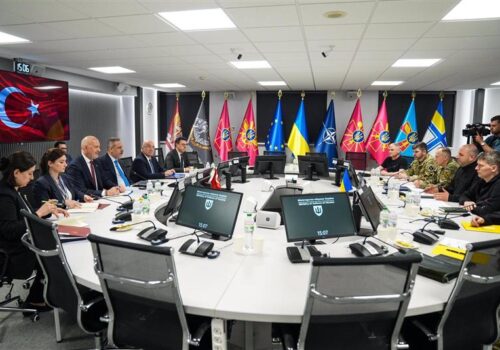
Image: Turkish President Recep Tayyip Erdogan shakes hands with Ukrainian President Volodymyr Zelenskyy at the presidential palace in Ankara, May 15, 2025. Source: Eyepress.