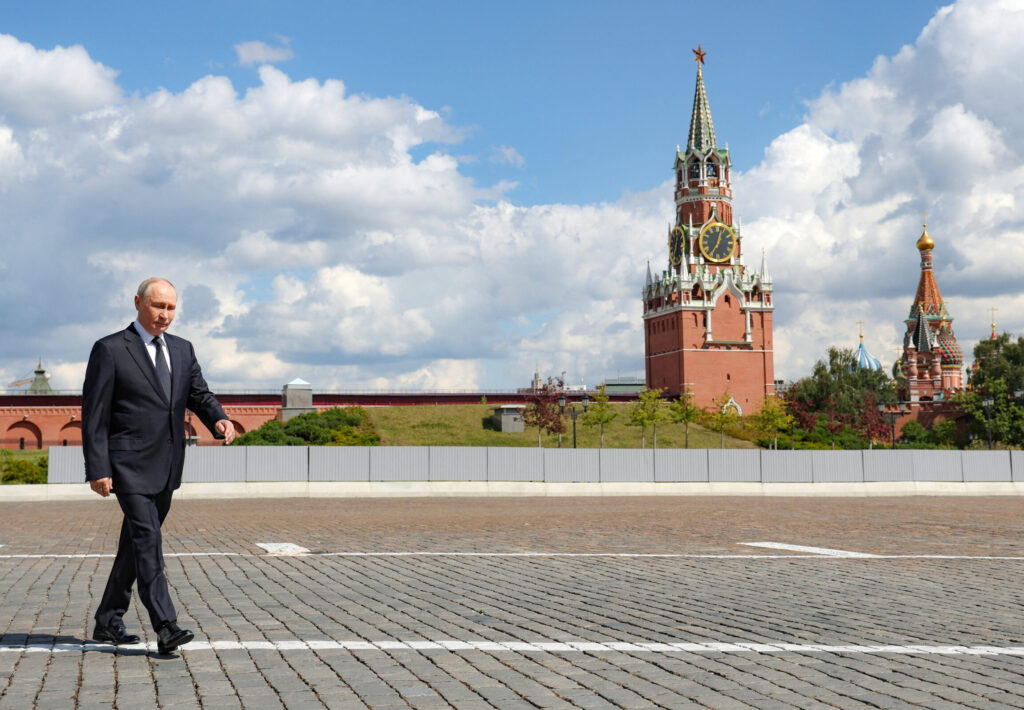
The Kremlin warned Britain this week of unspecified but inevitable “consequences” and accused London of “deliberately opting for escalation” following reports of British-made drones being used to strike targets inside Russia. This threatening language comes as Russian President Vladimir Putin steps up efforts to intimidate Ukraine’s allies with a campaign of gray zone aggression designed to deter further international support for Kyiv.
Russia’s strongly worded statement was issued in response to British media claims that Ukraine has recently begun using drones produced by two separate British companies as part of Kyiv’s strategic bombing campaign targeting military and industrial sites across Russia. Since the start of 2026, long-range Ukrainian strikes on oil refineries, export terminals, and logistics hubs have caused significant damage to Russia’s war economy and sparked the worst fuel crisis in the country since the collapse of the Soviet Union. The vast majority of drones used in these attacks are known to be made in Ukraine.
Britain did not appear to be unduly concerned by Russia’s threats, with recently appointed UK Prime Minister Andy Burnham commenting that London would “continue to support Ukraine 100 percent.” Burnham did not directly address Moscow’s allegations regarding the use of British-made drones, but did underline that the UK was “providing support so that Ukraine can defend itself.”
For now, newspaper reports of British-produced drones being deployed by the Ukrainian military inside Russia remain unconfirmed. Even if these media claims prove accurate, Moscow’s attempts to accuse Britain of a new escalation lack credibility. In reality, London has already been allowing Ukraine to use far more powerful British-supplied weapons on Russian territory for almost two years.
The UK authorities first gave their Ukrainian counterparts the green light to use Anglo-French Storm Shadow cruise missiles inside Russia in November 2024. Ukraine has since reportedly deployed Storm Shadow missiles on multiple occasions to strike Russian targets. These missiles have a range of approximately 250 kilometers and carry a far more powerful payload than the British-made drones purportedly used in Ukraine’s latest airstrikes. This makes a mockery of Moscow’s attempts to accuse Britain of “opting for escalation.”
Stay updated
As the world watches the Russian invasion of Ukraine unfold, UkraineAlert delivers the best Atlantic Council expert insight and analysis on Ukraine twice a week directly to your inbox.
If Russian allegations of a new British escalation are demonstrably false, what is the Kremlin trying to achieve? Moscow’s threats may be intended primarily for domestic Russian audiences, who regard Britain as their number one enemy and delight in blaming the Brits for any and all misfortunes.
In the current security context, this week’s belligerent talk is far more likely to be part of a broader Russian intimidation campaign against Ukraine’s European allies that has been gaining considerable momentum in recent months. This campaign includes a wide variety of gray zone aggression, with the overall objective of unnerving European policymakers and alarming electorates while remaining just below the threshold requiring a military response.
Russia’s hybrid war against the West has been underway for many years, but may now be entering a dangerous new phase as Putin seeks to break the deadlock of his faltering Ukraine invasion. Russian troops in Ukraine have been unable to secure a decisive breakthrough despite suffering catastrophic losses. During the first seven months of 2026, Russian gains fell to multi-year lows while casualty rates reportedly outstripped the pace of recruitment.
Meanwhile, Ukraine’s expanding long-range strike capabilities have now made air raids a routine feature of daily life across much of Russia. Speaking this week in Moscow, Putin sought to downplay the impact of Ukraine’s airstrikes, but was forced to acknowledge that the bombing campaign was harming the Russian economy. With Ukraine expected to begin deploying domestically produced ballistic missiles by the end of the year, the outlook could soon deteriorate further.
Eurasia Center events

As the war comes home to Russia, Putin is escalating across Europe. Since the start of 2026, Russian drones and cruise missiles have repeatedly violated NATO airspace. In one of the most alarming recent incidents, an armed drone that investigators linked to Russia was discovered at Leipzig Airport in Germany close to cargo planes used by NATO and the Ukrainian military. Speaking on August 20 after Romania intercepted a suspected Russian naval drone in the Black Sea, European Commission President Ursula von der Leyen warned of “an escalating campaign of threats.”
In parallel to these high profile incidents, Russia stands accused of organizing an array of cyberattacks, sabotage operations, and assassination plots throughout the European Union. A US intelligence assessment released in recent weeks stated that the Kremlin may even be preparing to launch a limited attack on a NATO member country within a matter of months in an apparent bid to discredit the alliance.
There remains little realistic prospect of a conventional armed conflict between Russia and NATO, not least because Putin knows he would quickly lose. Instead, the Kremlin dictator will continue to escalate within the gray zone, testing NATO and pushing boundaries. His goal is to unsettle European audiences and encourage them to question the wisdom of further support for Ukraine.
These intimidation tactics reflect growing recognition within the Kremlin that Russia cannot hope to defeat Ukraine while Kyiv continues to receive backing from Europe. In other words, more than four years since the outbreak of hostilities, many in Moscow have now reached the conclusion that the outcome of the invasion hinges on their ability to cut the lifeline of European aid that sustains the Ukrainian war effort.
With Russia already struggling to advance on the battlefields of Ukraine and now also facing mounting setbacks on the home front, an increasingly desperate Putin may soon decide that he must become even bolder in his attempts to bully Europe. The Russian ruler has never made any secret of his contempt for his European counterparts, and has repeatedly exploited the continent’s collective fear of escalation during the invasion of Ukraine. This confrontation between a resurgent Russia and a reluctant Europe could now be approaching a climax.
As Putin intensifies efforts to divide Europe and isolate Ukraine, the coming months will serve as an unprecedented test of European unity and the continent’s ability to project strength on the geopolitical stage. If European leaders fail this test, they will embolden Putin, undermine international security for years to come, and dramatically increase the cost of stopping Russia.
Peter Dickinson is editor of the Atlantic Council’s UkraineAlert service.
Further reading


The views expressed in UkraineAlert are solely those of the authors and do not necessarily reflect the views of the Atlantic Council, its staff, or its supporters.


The Eurasia Center’s mission is to enhance transatlantic cooperation in promoting stability, democratic values, and prosperity in Eurasia, from Eastern Europe and Turkey in the West to the Caucasus, Russia, and Central Asia in the East.
Follow us on social media
and support our work
Image: Russian President Vladimir Putin arrives to attend a service at the Archangel Cathedral of the Kremlin in Moscow, Russia August 20, 2026. (Sputnik/Vyacheslav Prokofyev/Pool via REUTERS)