
Russia launched a major bombardment of cities across Ukraine early on June 2, leaving over one hundred civilians dead or wounded. The attack, which focused primarily on Kyiv and Dnipro, was the most recent in a series of deadly overnight bombing raids beginning in early May that have signaled a new phase in Kremlin efforts to target Ukraine’s civilian population amid mounting indications that Russia’s invasion is stalling on the battlefield.
The latest Russian aerial attack lasted throughout the night and featured 656 drones along with 73 missiles, according to Ukrainian Air Force officials. Significantly, this included more than thirty ballistic missiles, making it one of the largest ballistic bombardments of the entire war.
While Ukraine has developed effective air defense strategies to counter Russian drones and cruise missiles, Kyiv remains heavily dependent on US-made Patriot air defense systems to defend against ballistic missiles. However, Ukraine is known to be currently running short of the expensive interceptor missiles used by the Patriot system. Russian dictator Vladimir Putin apparently intends to exploit this vulnerability.
Ukrainian President Volodymyr Zelenskyy has acknowledged the threat posed by his country’s depleted air defenses and recently sent a written appeal to US President Donald Trump calling on him to facilitate the delivery of desperately needed Patriot interceptors. US Defense Secretary Pete Hegseth responded to this letter by stating that the United States would “find a way” to help.
The Ukrainian leader is also attempting to form a coalition of countries to create a European anti-ballistic air defense system. However, this is a long-term initiative that could take years to produce results. In the meantime, Ukraine is expected to remain reliant on the United States for the Patriot interceptors that are the only effective defense against Russia’s ballistic missile barrages.
Stay updated
As the world watches the Russian invasion of Ukraine unfold, UkraineAlert delivers the best Atlantic Council expert insight and analysis on Ukraine twice a week directly to your inbox.
The recent upsurge in Russian strikes on Ukrainian civilian targets has come at a time when Putin’s invasion appears to be in danger of unraveling. The Russian military has struggled to advance during the first five months of 2026, and may actually have lost ground in May. This loss of momentum is largely down to the increasing effectiveness of Ukraine’s drone-based defenses, which now dominate an area stretching more than ten kilometers beyond the nominal front lines of the war, creating a kill zone that is making large-scale offensive operations extremely challenging.
Despite failing to achieve any battlefield breakthroughs, the invading Russian army continues to suffer catastrophic losses in Ukraine. Since late 2025, Ukrainian officials claim to have inflicted more than thirty thousand Russian casualties each month. Overall, almost half a million Russian soldiers have now been killed during the full-scale invasion of Ukraine, British spy chief Anne Keast-Butler reported in late May.
Russia is also suffering military setbacks beyond the battlefield. In recent months, Ukraine has launched a highly effective campaign of mid-range drone strikes targeting Russian logistics behind the front lines. This has severely disrupted the resupply of front line troops while also threatening to cut the so-called “land bridge” connecting Russia with the occupied Crimean peninsula.
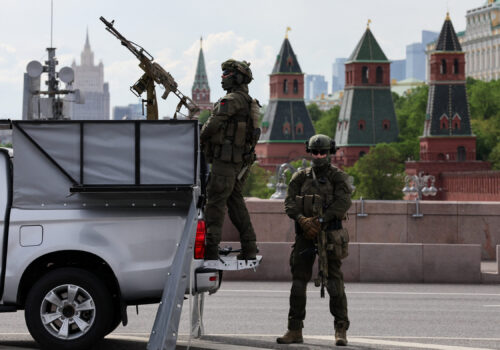
In parallel, Ukraine has expanded long-range bombing raids on military and industrial targets across Russia. Since the start of 2026, Ukrainian forces have carried out a series of strikes on military plants and energy infrastructure facilities located over one thousand kilometers from the Ukrainian border. In May, Russia was forced to dramatically scale back this year’s Victory Day parade in Moscow, a decision that confirmed the Kremlin’s inability to prevent Ukraine’s escalating air offensive.
Eurasia Center events

These mounting setbacks have undermined the Putin regime’s attempts to portray Russian victory in Ukraine as inevitable. Instead, the mood inside Russia now seems to be changing for the worse, with more and more people questioning the wisdom of the invasion and doubting whether Putin can still realistically achieve his maximalist goals in Ukraine.
This does not mean that the war is close to a conclusion, however. Putin remains firmly in control of Russia and has succeeded in creating a regime that is highly resistant to both palace coups and potential grassroots uprisings. With no plausible domestic threats on the horizon, he is likely to press ahead with his faltering invasion, despite what appear to be Russia’s rapidly diminishing chances of success.
From Putin’s perspective, the alternative to fighting on is even less appealing than the current uncertain outlook. Accepting a compromise peace based on today’s front lines would mean acknowledging the geopolitical reality of an independent, democratic, militarily powerful, and permanently hostile Ukrainian state on Russia’s doorstep. This would be viewed in Moscow as a defeat of historic proportions. Putin is well aware that he would probably not survive such an outcome.
Rather than seeking a negotiated end to the war, Putin will now almost certainly look to double down on his terror campaign against Ukraine’s civilian population. The Ukrainians themselves understand this and show no signs of breaking. The real question is how the international community will respond. Will they act as bystanders amid Russia’s escalating war crimes, or will they take steps to help Ukraine defend itself and impose additional costs on the Kremlin?
Peter Dickinson is editor of the Atlantic Council’s UkraineAlert service.
Further reading


The views expressed in UkraineAlert are solely those of the authors and do not necessarily reflect the views of the Atlantic Council, its staff, or its supporters.

The Eurasia Center’s mission is to enhance transatlantic cooperation in promoting stability, democratic values, and prosperity in Eurasia, from Eastern Europe and Turkey in the West to the Caucasus, Russia, and Central Asia in the East.
Follow us on social media
and support our work
Image: Credit Image: © Svet Jacqueline/ZUMA Press Wire