For many years, investigators have been documenting Russian atrocities in Ukraine, one crime at a time. Taken together, these investigations reveal a far larger and more disturbing pattern, with the scale, reach, and severity of the violence escalating dramatically following Russia’s full-scale invasion.
Since 2022, United Nations investigators have documented mass detentions and the industrial-scale torture of Ukrainian prisoners of war and civilians. Human rights organizations have exposed the largest forced deportation of children since World War II. Ukrainian prosecutors have cataloged vast networks of filtration camps and the ruthless eradication of Ukrainian national identity in regions under Russian occupation.
Most recently, The Wall Street Journal has documented systematic sexual violence against Ukrainians in Russian detention, mirroring longstanding evidence of similar abuses against women and children in occupied Ukraine. Survivors describe brutal assaults and other acts intended to ensure they would no longer be physically or psychologically capable of having children.
These most recent revelations of routine sexual violence against prisoners should shock every reader. But they should not surprise us. Instead, they should be seen as reinforcing an already overwhelming body of evidence showing the same deliberate effort to inflict lasting harm on Ukrainians.
Particularly significant are the perpetrators’ own words. As early as 2022, eyewitnesses reported Russian prison guards telling victims they would make them no longer want to have children. Investigators took careful note because such statements illuminate an intent that goes beyond cruelty.
The 1948 United Nations Genocide Convention lists “imposing measures intended to prevent births” within the victim group as a recognized act of genocide, when committed with the intent to destroy a group, in whole or in part. When perpetrators themselves describe their violence in such terms, their statements demand attention.
Three years later, independent investigations continue to arrive at the same conclusion from different directions. The methods evolve. The evidence grows. Yet the underlying objective remains consistent.
Stay updated
As the world watches the Russian invasion of Ukraine unfold, UkraineAlert delivers the best Atlantic Council expert insight and analysis on Ukraine twice a week directly to your inbox.
Sexual violence by Russian perpetrators is not occurring in isolation. Neither are acts of torture, child deportations, filtration camps, forced disappearances, attacks on cultural heritage sites, or the systematic destruction of critical civilian infrastructure. Together, these acts reveal far more than a series of disconnected war crimes. They expose a coordinated campaign directed against Ukrainians as a national group.
In 2023, I led a team of international lawyers and experts to examine these patterns collectively rather than individually. Our conclusion was that the cumulative evidence was consistent with Russia’s escalating commission of genocide in Ukraine. Three years later, the body of evidence has only grown stronger, even as international appetite to call these crimes by their proper name has faded.
Genocide differs from other international crimes because it is defined by its objective: Destroying a protected group. Across history, perpetrators pursuing that objective have displayed strikingly similar patterns of behavior. Understanding the Russian state’s objectives is crucial because prevention strategies must be tailored to the threat. Policies designed to deter conventional territorial aggression are unlikely to stop a campaign driven by the desire to destroy a people.
When leaders like Russian President Vladimir Putin embrace an ideology of national group destruction, history offers little reason to believe they can be persuaded to abandon that objective. Instead, the practical task becomes reducing their capacity to carry it out.
Ukraine is already addressing this challenge on the battlefield and through what Ukrainian President Volodymyr Zelenskyy refers to as “long-range sanctions.” Long-range Ukrainian drone strikes on Russia’s oil and gas industry are designed to weaken the Kremlin war machine and undermine Putin’s ability to continue his invasion. For Ukrainians, this a matter of national survival.
The Ukrainian authorities openly acknowledge that their country currently lacks sufficient air defenses to protect the population against Russian missile and drone attacks. Civilian casualties are already climbing to record highs and could increase dramatically in the coming months as Putin seeks to exploit Ukraine’s air defense shortages. Russia’s escalating bombardment of Ukrainian cities aims to make much of the country unlivable and has been named by legal experts as a crime against humanity.
Eurasia Center events

Recent steps in the United States toward strengthening the sanctions tools available to President Trump are encouraging. Every reduction in Russia’s ability to finance, equip, and sustain its war makes future atrocities harder to commit. However, further measures from the international community are urgently required.
The policy response must focus on capacity. Steps should include constraining Russia’s military-industrial base, limiting missile and drone production, disrupting the bureaucracies that sustain occupation and detention, and cutting the revenue that keeps the Kremlin’s war machine operating.
As Ukraine’s air-defense shortages grow, so does Russia’s capacity to inflict the crimes independent investigators have documented for more than four years. Atrocity prevention means weakening the machinery that makes those crimes possible. It means targeting the entire system that enables them: The soldiers who commit these crimes, the commanders who authorize them, the bureaucrats who organize them, the propagandists who justify them, and the economic networks that sustain them.
Negotiations, by themselves, do not dismantle the system the Kremlin uses to terrorize Ukrainians. In 2023, the Associated Press obtained Russian plans to expand detention infrastructure in occupied Ukraine by 2026. Despite years of diplomatic efforts, we have now reached that year.
Meanwhile, The Wall Street Journal is documenting torture and sexual violence inside Russian detention facilities, the very kinds of crimes this expanding infrastructure is designed to facilitate. The task now is to act on those warnings and weaken the Russian atrocity machine before it claims more victims.
Kristina Hook is assistant professor of conflict management at Kennesaw State University and a nonresident senior fellow at the Atlantic Council’s Eurasia Center.
Further reading


The views expressed in UkraineAlert are solely those of the authors and do not necessarily reflect the views of the Atlantic Council, its staff, or its supporters.


The Eurasia Center’s mission is to enhance transatlantic cooperation in promoting stability, democratic values, and prosperity in Eurasia, from Eastern Europe and Turkey in the West to the Caucasus, Russia, and Central Asia in the East.
Follow us on social media
and support our work
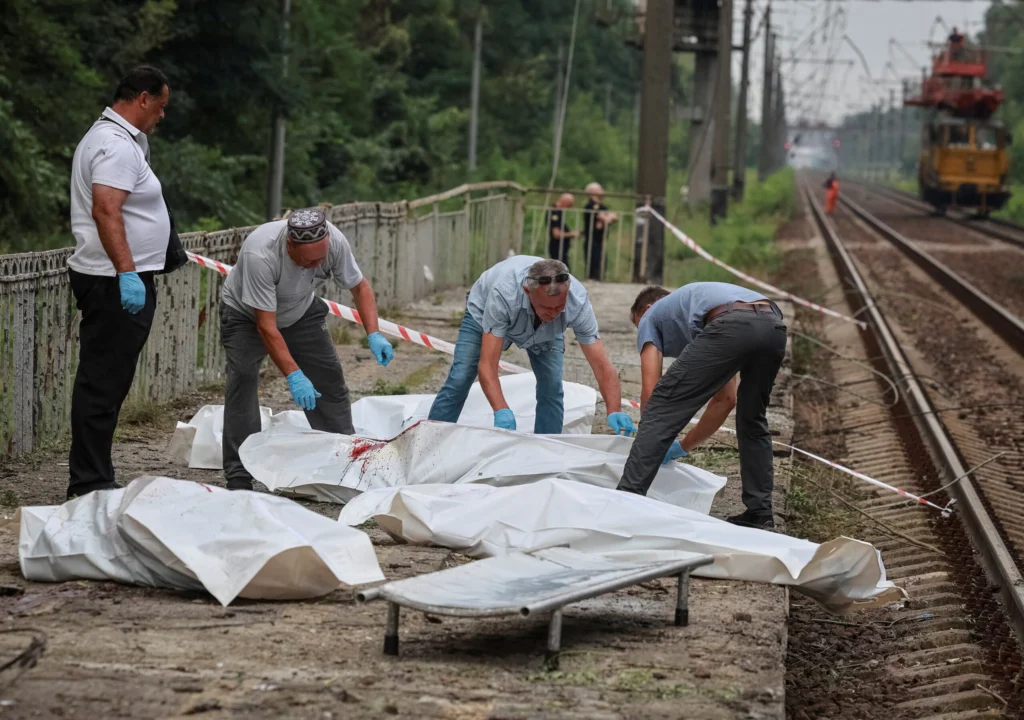
Image: Workers place bodies of residents into body bags after they were killed at a railway station, the site of Russian air strike, amid Russia's attack on Ukraine, in Kyiv region, Ukraine August 5, 2026. (REUTERS/Stringer)