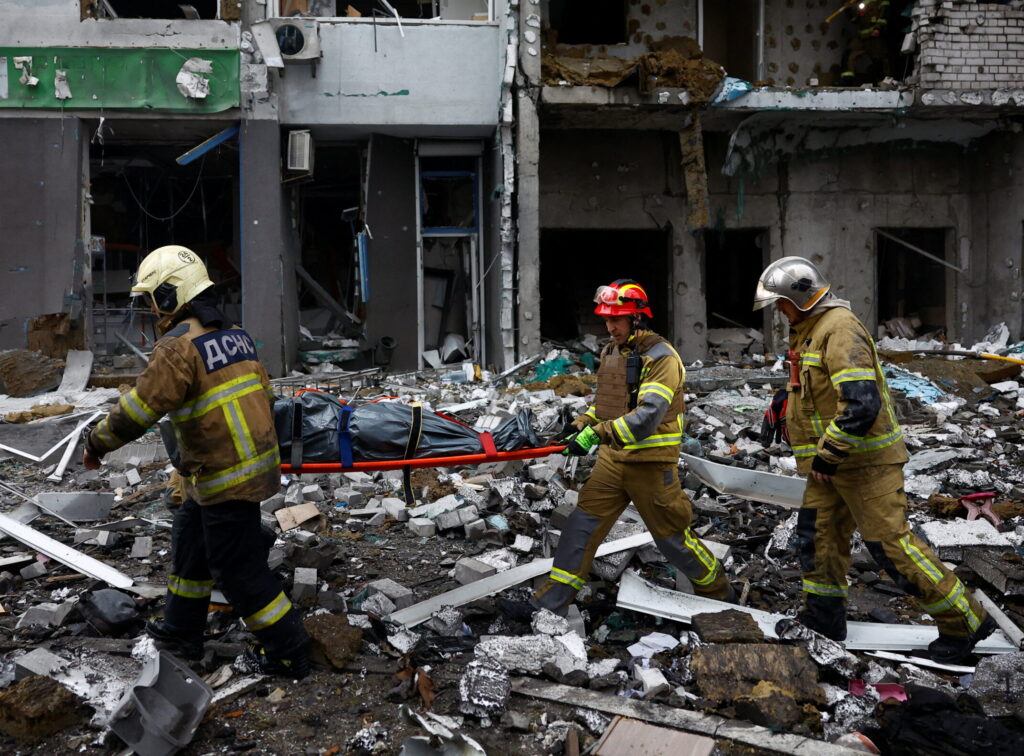
Since the start of Russia’s full-scale invasion in February 2022, Ukraine’s fight for national survival has captured the world’s imagination. This has generated widespread international admiration, but it has also fueled a more troubling trend. Over the past four-and-a-half years, it has become increasingly commonplace to treat Ukrainians as superheroes who are capable of enduring any hardship.
By celebrating Ukrainian resilience as an almost superhuman quality, the international community risks obscuring the much less glamorous reality that Ukrainians are actually ordinary people who have endured extraordinary violence for far too long. Their determination to survive amid Russia’s brutal invasion should not be mistaken for a willingness to suffer indefinitely.
Stay updated
As the world watches the Russian invasion of Ukraine unfold, UkraineAlert delivers the best Atlantic Council expert insight and analysis on Ukraine twice a week directly to your inbox.
Amid the largest European invasion since World War II, praise for Ukraine’s remarkable resilience is certainly understandable. It may also be convenient. For many, applauding Ukraine’s doggedness is far easier than accepting responsibility for enforcing the kind of deterrence necessary to counter a resurgent Russia.
The Kremlin has been engaged in a mounting confrontation with the Western world for many years. Following the onset of the full-scale Ukraine invasion, this hybrid war has intensified. Yet Western leaders remain fearful of escalation and have too often prioritized Ukrainian restraint over punishment of Russia. Narratives highlighting Ukrainian resilience have served to help legitimize this timid approach, allowing Ukrainian endurance to become a substitute for the international action required to stop Russian aggression.
Each example of Ukrainian ingenuity on the battlefield is toasted by international observers as evidence of the country’s innovative edge, creating the impression that Kyiv can always be relied upon to remain one step ahead of the Kremlin. In reality, however, Ukraine desperately needs more Western support as the country struggles to compete technologically against an adversary who enjoys overwhelming advantages in terms of manpower, firepower, and resources.
Likewise, the Ukrainian population’s ability to come through successive winter seasons amid the Russian bombardment of civilian heating and power infrastructure is too often interpreted as proof of their Herculean strength and sheer tenacity. This ignores the huge human toll of living for months on end in freezing darkness amid wave upon wave of Russian missile and drone strikes.
Narratives extolling wartime Ukraine’s superpowers tend to be self-reinforcing, with the country’s refusal to surrender portrayed as evidence of supposedly heroic qualities. In this manner, the longer Ukrainians can survive what should be intolerable, the easier it becomes for the rest of the world to tolerate what is being done to them. Russia’s imperial aggression is being steadily normalized, along with the suffering of Ukrainians.
Endless international veneration of Ukrainian resilience also encourages unrealistic expectations that have been internalized, creating additional burdens at a time when Ukrainian society is already facing life-changing challenges. Psychologists note that some Ukrainians are inclined to regard their own suffering as shameful or insufficient as they believe it pales in comparison to that of combatants or those who have lost homes and loved ones.
In other words, Ukraine’s civilian population is not only suffering from the immediate impact of the war itself. Some are also struggling with troubling feelings that they have somehow failed to match up to impossible expectations. This is one of the more disturbing consequences of the resilience narrative, as it obscures the true costs of a genocidal invasion targeted specifically at the civilian population.
Eurasia Center events
An over-emphasis on Ukraine’s ability to withstand Russia’s invasion risks undermining support for the country in very specific ways. While United Nations reports have increasingly highlighted Ukrainian resilience, significant gaps have appeared in funding for UN humanitarian initiatives. As Ukraine’s extensive volunteer networks and extraordinary civil society have scrambled to cover shortfalls, their ability to compensate for inadequate international aid has convinced some partners to provide even less. The very resilience that should prompt greater support instead becomes the rationale for withholding vital aid.
In the coming months, we can expect to see a new wave of international media coverage proclaiming Ukraine’s superhuman resilience as Putin once again attempts to weaponize winter and bomb the country into submission. Ukraine is currently critically short of the Patriot air defense interceptors that are the only reliable protection against Russian ballistic missiles, with little hope of adequate resupply. It is therefore reasonable to expect the coming winter season to be the most difficult of the entire war.
In such circumstances, enthusiastic talk of Ukrainian resilience without the necessary accompanying material support is worse than useless. It actually reduces the sense of urgency and disguises the scale of the threat to Ukraine’s civilian population.
This is particularly dangerous as Ukrainian society grows increasingly exhausted. Ukrainian resilience is not infinite. At the same time, the fact that people are physically and emotionally shattered after years of war must never be interpreted as consent for an unjust peace, or as an argument for surrender. Ukrainians did not choose this war, and they should not be forced to choose between endless suffering or submission to a state that intends to destroy them.
Instead of paying tribute to Ukraine’s much mythologized superpowers, the West should finally overcome its fear of escalation and focus on providing Ukraine with the tools to defeat Russia. If this approach had been adopted in the second half of 2022 when Russia was considerably more vulnerable, there is every chance the war would have ended and the current erosion of Western global leadership could have been avoided. It is not too late to correct this error.
The Ukrainian population clearly deserves to be recognized and honored for the incredible strength and courage they have demonstrated since 2022. However, it is equally clear that resilience has become the dominant characteristic associated with Ukrainians. This is a problem. It shifts international attention away from the need to address Ukraine’s extraordinary suffering, and encourages empty admiration for the country’s durability. But Ukrainians are not superhumans. They are ordinary folk who desperately need more help and support from the international community.
Lauren Van Metre is a nonresident fellow with the Atlantic Council’s Eurasia Center and president of Women in International Security. Elena Davlikanova a senior fellow at CEPA and the Sahaidachny Center.
Further reading


The views expressed in UkraineAlert are solely those of the authors and do not necessarily reflect the views of the Atlantic Council, its staff, or its supporters.

The Eurasia Center’s mission is to enhance transatlantic cooperation in promoting stability, democratic values, and prosperity in Eurasia, from Eastern Europe and Turkey in the West to the Caucasus, Russia, and Central Asia in the East.
Follow us on social media
and support our work
Image: Rescuers carry a body at the site of an apartment building, which was heavily damaged during Russian missile and drone strikes, amid Russia's attack on Ukraine, in Kyiv, Ukraine. July 6, 2026. (REUTERS/Valentyn Ogirenko)