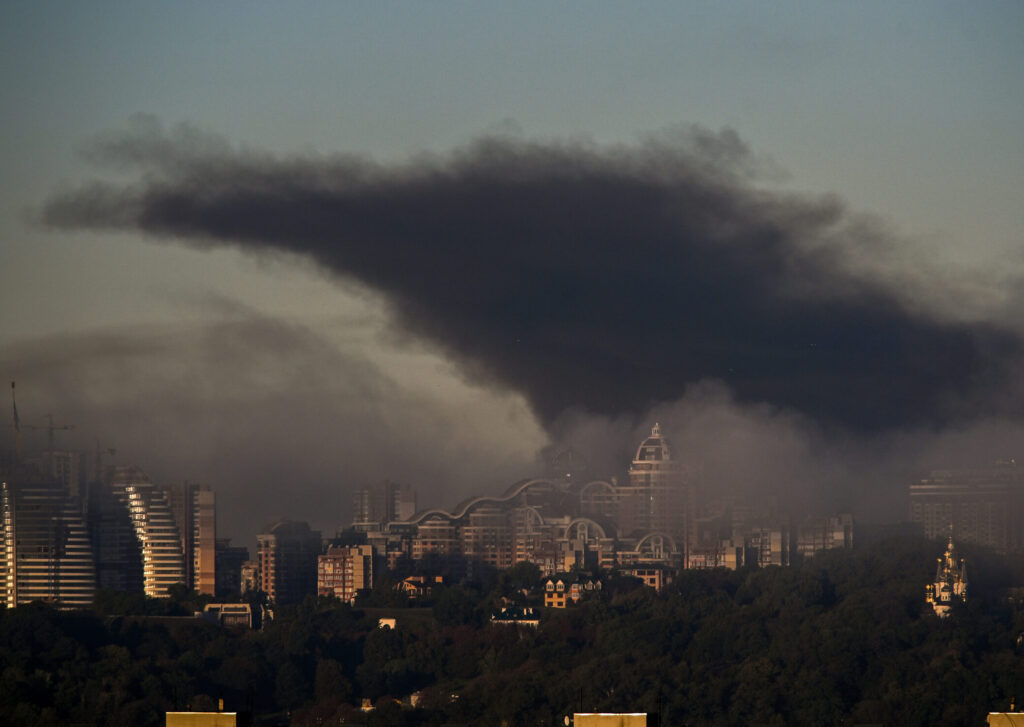
European embassies in Kyiv sent a message of defiance to Moscow this week following the Kremlin’s latest call for diplomats to leave Ukraine. Russia posted a statement on October 3 “urging” diplomatic missions to immediately exit Ukraine, echoing a similar appeal issued in May. This latest warning came amid a dramatic escalation in Russia’s bombardment of Kyiv and other Ukrainian cities.
Europe’s collective response was emphatic, with more than twenty EU embassies taking to social media to declare “We are staying.” Many also accused the Kremlin of attempting to intimidate the diplomatic community and deter them from backing Ukraine. “Russia’s further threats and calls to diplomats to leave Kyiv show that the Kremlin is trying to bully Europe and undermine our support for Ukraine,” commented Poland’s Ministry of Foreign Affairs.
EU Ambassador to Ukraine Katarina Mathernova underlined the determination among her European colleagues to reject what they see as Moscow’s attempts at coercion. “We have 25 member states with embassies in Kyiv and all of them are staying,” she commented. “Russia has made such threats several times already. In my opinion, this is a sign of frustration because they are failing to gain the upper hand on the battlefield.”
Stay updated
As the world watches the Russian invasion of Ukraine unfold, UkraineAlert delivers the best Atlantic Council expert insight and analysis on Ukraine twice a week directly to your inbox.
Russia’s renewed calls for embassies to leave Kyiv are part of a broader Kremlin campaign to isolate Ukraine and undermine international support for the country. These efforts are currently focused on Europe, which is seen in Moscow as the main sponsor of the Ukrainian war effort and the biggest obstacle to Russian victory. Kremlin officials recognize that as long as European countries maintain their current backing for Ukraine, it will be extremely difficult to force Kyiv’s capitulation.
European officials accuse the Kremlin of waging a so-called hybrid war against Europe involving a range of hostile acts that remain below the threshold that could trigger a military response. This includes sabotage, cyberattacks, airspace violations, political interference, and disinformation campaigns, with the overarching aim of destabilizing European countries from within and fueling doubts over the wisdom of continued support for Ukraine.
In recent months, Russia has faced accusations of escalating its campaign of gray zone aggression as Putin seeks to exploit domestic political tensions and growing geopolitical divisions within Europe. Last week, the Kremlin dictator engaged in nuclear saber-rattling over an alleged NATO threat to the Russian enclave of Kaliningrad, underlining the sense that he feels Europe is weak and vulnerable to intimidation.
Putin is well aware that many of his staunchest European opponents are growing increasingly unpopular with their own electorates, while pro-Kremlin parties are on the rise and may soon be in a position to take power in key countries including France and Germany. This is encouraging perceptions in Moscow that European support for Ukraine is fragile and will inevitably collapse. With US aid to Ukraine already reduced to minimal levels, a significant decline in European backing could prove decisive.
Eurasia Center events

Putin’s intensifying bombardment of Ukrainian cities and his escalating hybrid campaign against Europe are key elements of what he hopes will prove to be a war-winning strategy. With the Russian army unable to defeat Ukraine on the battlefield, Putin currently intends to achieve his goals by breaking Ukrainian civilian morale, depopulating the country, and cutting Kyiv’s lifeline of European support.
Russia is now using a combination of ballistic missiles and jet drones to undermine the foundations of the Ukrainian economy and render Ukraine’s major cities unlivable. This aerial offensive is expected to peak in the coming weeks with large-scale attacks designed to destroy critical civilian infrastructure as temperatures plummet ahead of the winter season. If Russia’s bombing campaign is successful, millions of Ukrainians will be left without heating, electricity, and water in subzero conditions.
In parallel, Russia will seek to crank up tensions in European capitals with a combination of deniable gray zone aggression and thinly veiled threats. European leaders are well aware of Putin’s objectives and are increasingly speaking out to denounce Moscow’s tactics, but they have so far stopped short of imposing any tangible costs on the Kremlin. Their reluctance to act undermines Europe’s credibility.
This week’s diplomatic drama in Kyiv gave Ukrainians a timely morale boost and served as a welcome show of solidarity from the country’s European partners. However, while rejecting Russia’s demands to evacuate the Ukrainian capital is commendable, it is unlikely to deter the Kremlin. Putin only understands the language of strength, but Europe has yet to find its voice.
Peter Dickinson in editor of the Atlantic Council’s UkraineAlert service.
Further reading


The views expressed in UkraineAlert are solely those of the authors and do not necessarily reflect the views of the Atlantic Council, its staff, or its supporters.


The Eurasia Center’s mission is to enhance transatlantic cooperation in promoting stability, democratic values, and prosperity in Eurasia, from Eastern Europe and Turkey in the West to the Caucasus, Russia, and Central Asia in the East.
Follow us on social media
and support our work
Image: A plume of black smoke rises into the sky after a morning Russian drone attack, Kyiv, Ukraine, September 23, 2026. Strikes on civilian facilities, including petrol stations and warehouses, sparked large fires in several parts of the city, causing heavy smoke and dense smog. (Photo by Yevhen Kotenko/Ukrinform) (Photo by Ukrinform/Ukrinform/Sipa USA)