

Featured analysis

Latest analysis

EconoGraphics

Mar 13, 2023

Silicon Valley Bank failed: What happens next?

By Hung Tran

Even if the contagion effects are contained, risks to the financial stability of the US and the world have increased significantly. The Fed can no longer focus only on bringing down inflation, but must also avoid exacerbating financial stability risks.

Economy & Business
Financial Regulation

Econographics

Jan 26, 2023

Global Sanctions Dashboard: How sanctions will further squeeze the Russian economy in 2023

By Charles Lichfield, Maia Nikoladze, and Castellum.AI

The effects of sanctions on the Russian economy; Venezuela’s pursuit of lifting energy sanctions; the plans for screening EU-US outbound investment going into China.

China
Economic Sanctions

Econographics

Jan 23, 2023

Russian finance pivots east

By Niels Graham

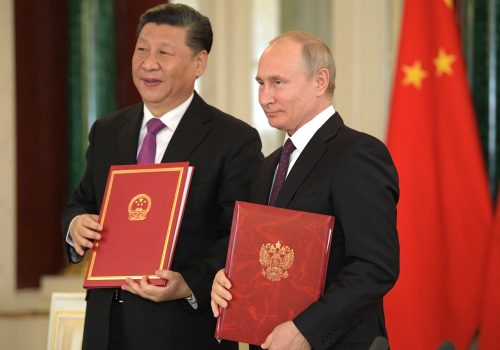
Starting in 2014 and accelerating after Russia’s invasion of Ukraine, Moscow launched a financial pivot toward China. While it initially worked for both countries, economic stress in China as well as the risk of overreliance on Beijing may hinder its future success

China
Economic Sanctions

EconoGraphics

Jan 14, 2023

Global Economic Events Calendar

By GeoEconomics Center

The Global Economic Events Calendar tracks key central bank meetings, major data releases, and significant international economic and political events

Economy & Business

Econographics

Jan 9, 2023

Fed reverse repos hit a new record: An unhealthy development

By Hung Tran

The Fed’s large footprint in private short-term financial transactions will have largely negative implications for the US financial system and economy.

Economy & Business
Macroeconomics

Econographics

Dec 15, 2022

A different monetary policy path in 2023

By Ole Moehr

Decisions and statements this week from the Fed, ECB, and the BOE tell us how they will each deploy tools at their disposal differently in 2023.

Economy & Business
Europe & Eurasia

Econographics

Dec 8, 2022

The numbers that drove China’s Zero-COVID policy

By Niels Graham

China’s adherence to zero-COVID was primarily driven by poor vaccination rates among seniors and weak health care infrastructure. As the country opens, both factors remain key health risks.

China
Coronavirus

Econographics

Nov 23, 2022

US-China competition after the US midterms and the CCP 20th Congress

By Hung Tran

For the first time since becoming President, Joe Biden met face-to-face with Secretary General Xi Jinping on November 14, 2022, at the outset of the G20 Summit in Bali, Indonesia. Against the backdrop of rising tensions between the two countries, the United States hoped it would “put a floor under the relationship.” But the recent […]

China
Economy & Business

Econographics

Nov 17, 2022

Global Sanctions Dashboard: What’s coming in 2023?

By Charles Lichfield, Maia Nikoladze, and Castellum.AI

Fall sanctions against Russia and Iran; implications of US semiconductor export controls against China; projected sanctions trends in 2023.

China
Economic Sanctions

Econographics

Nov 11, 2022

The target of limiting global warming to less than 1.5 degrees is practically dead. Why do emissions per capita matter?

By Amin Mohseni-Cheraghlou

Achieving the target to limit global warming to below 2, preferably 1.5 degrees Celsius, by the end of the century seems more unfeasible than ever. The reason is simple. The most critical of greenhouse gases have continuously risen in the past decade and CO2 emissions are only expected to grow more in 2022 and for the foreseeable future. COP27 needs to pave the path for a renewed international cooperative and enforceable framework to reduce global greenhouse gas emissions by the world’s top emitters both in absolute terms and in per capita terms.

Climate Change & Climate Action
Economy & Business

Content

EconoGraphics

Jun 16, 2015

Does ISDS Tip the Scales in Favor of Investors?

By Global Business and Economics

Looking at over 400 cases that have been decided through 2014, the rate of success for US and EU investors is 30% and 34%, respectively. Foreign states win against US claimants 42% of the time, and 36% of the time against EU-based firms, with the remainder being settled.

Economy & Business
European Union

EconoGraphics

Jun 9, 2015

Where Do Trillion-Dollar Asset Managers Hail From?

By Global Business and Economics

Of the 16 investment firms in the world that hold more than $1 trillion in assets, the US leads with 12 representatives, including well-known firms like BlackRock, Vanguard Group, and the asset management arms of Goldman Sachs and Bank of New York Mellon.

Economy & Business
France

EconoGraphics

Jun 2, 2015

How big is the opportunity to increase US exports in the Transpacific Partnership?

By Global Business & Economics

Data from 2014 shows that while American exports to the 11 other TPP nations totaled more than half a trillion dollars in absolute terms, there remains considerable room for improvement in relative terms

Americas
Australia

EconoGraphics

May 26, 2015

Who Will Finance Ukraine?

By Global Business & Economics Program

Ukraine's economic stability is uncertain as the conflict with Russia endures. Alongside the negative impacts to growth, exports, and investment, the level of Ukraine's debts are especially worrisome.

Economy & Business
Europe & Eurasia

EconoGraphics

May 20, 2015

Who’s Buying European Companies?

By Global Business & Economics

Who is purchasing European companies? Looking at the five biggest foreign acquisitions of European corporates since 2011 shows that the US are the biggest buyers by a considerable margin, with the China, Hong Kong, Brazil, and Japan following behind.

Brazil
China

EconoGraphics

May 12, 2015

Two Decades of Sovereign Debt

By Global Business & Economics

Sovereign default is considered to be a rare event. But as the lessons of the past two decades show, they are far from extraordinary. According to the IMF, the main sovereign debt restructurings from the period spanning 1998 – 2010 totaled $117.6 billion. When Greece’s 2012 default is added to that sum, it means that […]

Economy & Business
Fiscal and Structural Reform

EconoGraphics

May 5, 2015

Creating the Digital Single Market

By Global Business & Economics Program

European E-Commerce is still largely confined within national borders.

Economy & Business
Europe & Eurasia

EconoGraphics

Apr 28, 2015

Do Sanctions Work After All?

By Global Business & Economics

International Relations scholars disagree about whether economic sanctions are an effective tool to coerce countries to follow a certain course of action.

Economic Sanctions
Economy & Business

EconoGraphics

Apr 21, 2015

Exit, or Voice?

By Global Business & Economics

In March, the UK, Germany, Italy, and France decided to join the China-led Asian Infrastructure Investment Bank (AIIB), shocking the Obama administration.

Brazil
China

EconoGraphics

Apr 14, 2015

Who is Investing Abroad?

By Global Business & Economics

While the US still leads the world in outflowing Foreign Direct Investment (FDI), the emerging markets are catching up quickly. Chinese outflowing FDI, in particular has grown tremendously: since 2005, it increased more than 30-fold in 8 years from $5 billion to $166 billion. While initial Chinese foreign investments focused on natural resource industries, over time the investments have spread to diverse industries like agriculture, manufacturing, and professional services. BRIC FDIs are emerging as key growth drivers for low income countries, improving their business environment, building infrastructure, creating jobs, and adding much-needed revenue to government coffers.

China
Russia