JUST IN
It’s a lot to process. On Thursday, Nvidia CEO Jensen Huang resigned following reports of extramarital affairs, including one with a suspected Chinese spy. But the implications extend beyond the man and his former company, a critical engine of the artificial intelligence (AI) boom because of its leading-edge computer processors. Below, Atlantic Council experts work through how the personnel shakeup could impact US policy, global markets, and more.
TODAY’S EXPERT REACTION BROUGHT TO YOU BY
- Trisha Ray: Associate director and resident fellow at the GeoTech Center
- Graham Brookie (@GrahamBrookie): Vice president for technology programs and strategy
- Jessie Yin: Associate director with the GeoEconomics Center
- Kenton Thibaut (@kentonthibaut): Senior resident China fellow at the Digital Forensic Research Lab
What it means for Washington
- Nvidia’s advanced chips are “the linchpin of the United States’ leverage in slowing down the AI capabilities of its adversaries,” Trisha explains. But that advantage is also “a single point of failure,” since US export controls are only as strong as the security practices of a handful of companies and people within them.
- Graham sees the incident not as a failure in US intelligence, “but rather a broader failure of coordination and policy execution in how the US government manages national security threats.” With the AI industry vulnerable to intellectual property theft and direct targeting, Washington was “caught flat footed” in risk management and export policy enforcement.
- “As difficult as it is for investors to separate Nvidia’s success from Jensen Huang, it has become nearly as difficult for Washington to separate Nvidia from national security,” Jessie argues. She now sees an opening for Congress to exert greater oversight of the company’s impact on national security and tighten semiconductor export controls. Kenton points to growing momentum in Congress behind chip restrictions such as the AI Overwatch Act, the Chip Security Act, and the MATCH Act.
- Going forward, Trisha urges greater government scrutiny. “Given how few companies underpin the US AI lead, policymakers should seriously consider direct government oversight,” she argues, such as security clearance–like requirements for company leadership and their major customers, as well as security audits of the exporting entities as a precondition for export licenses.
What it means for Wall Street
- Markets were down slightly today, as Nvidia shares took a hit. Huang’s departure has investors wondering if Nvidia can sustain its dominance without the leader who became a synonym to its success. The company is “going to be unsteady for a while,” Jessie surmises.
- The stakes are higher than Nvidia’s stock price alone. The US economy is already highly exposed to the fortunes of a handful of AI companies that “also happen to be the country’s primary strategic assets in a determinative domain of geopolitical competition,” Graham warns. A failure at one could reverberate across the US economy and national security ecosystem.
- Beyond selling chips, Nvidia has become a major financier of the AI boom—known as “the central bank of AI”—investing in startups and supporting customers that buy its products. Jessie says that the coming months will show “how integral Nvidia has become to AI demand itself.”
Sign up to receive rapid insight in your inbox from Atlantic Council experts on global events as they unfold.
What it means for Beijing
- Ahead of a planned meeting next week between US President Donald Trump and Chinese President Xi Jinping, Beijing warned Washington earlier today against further technology restrictions, Kenton notes.
- Huang had long opposed strict export controls and was able to speak with both Trump and Xi. “But with Huang out of the picture, there is potentially more political leeway to push forward on a more hawkish approach,” Kenton says.
- Jessie adds that the scandal has “permanently damaged the company’s credibility to push back on export controls,” relationships aside.
- But tougher controls could invite retaliation, Kenton warns. “Beijing could answer new restrictions with curbs on critical minerals or probes of other American firms,” potentially complicating the upcoming Trump-Xi meeting.
Related Reading

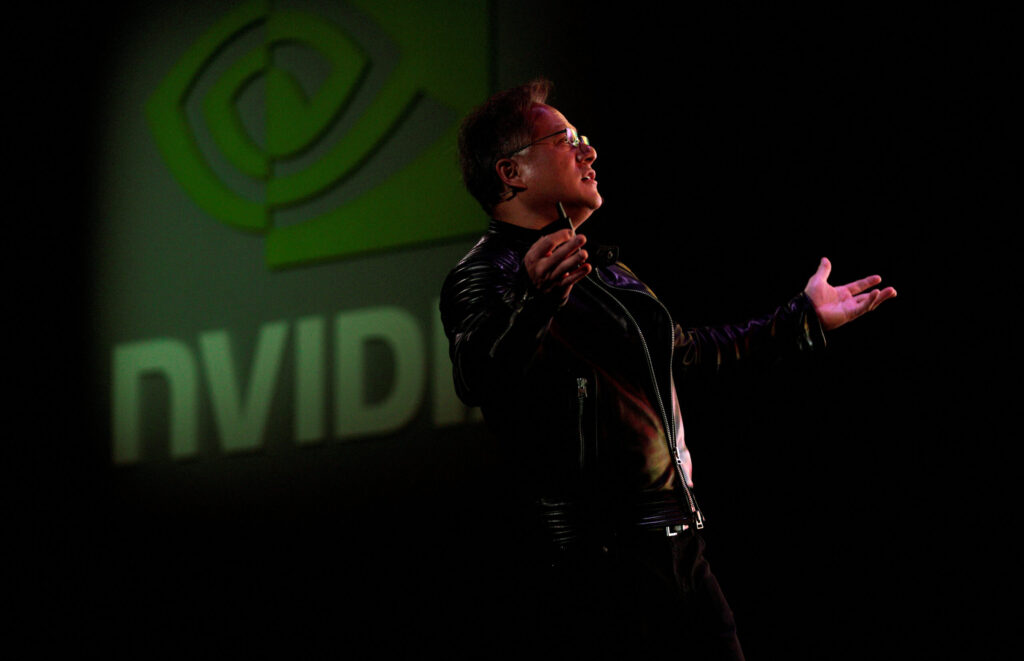
Image: Jensen Huang, CEO of Nvidia, reacts to a video at his keynote address at CES in Las Vegas, January, 2018. (Rick Wilking via Reuters Connect)