

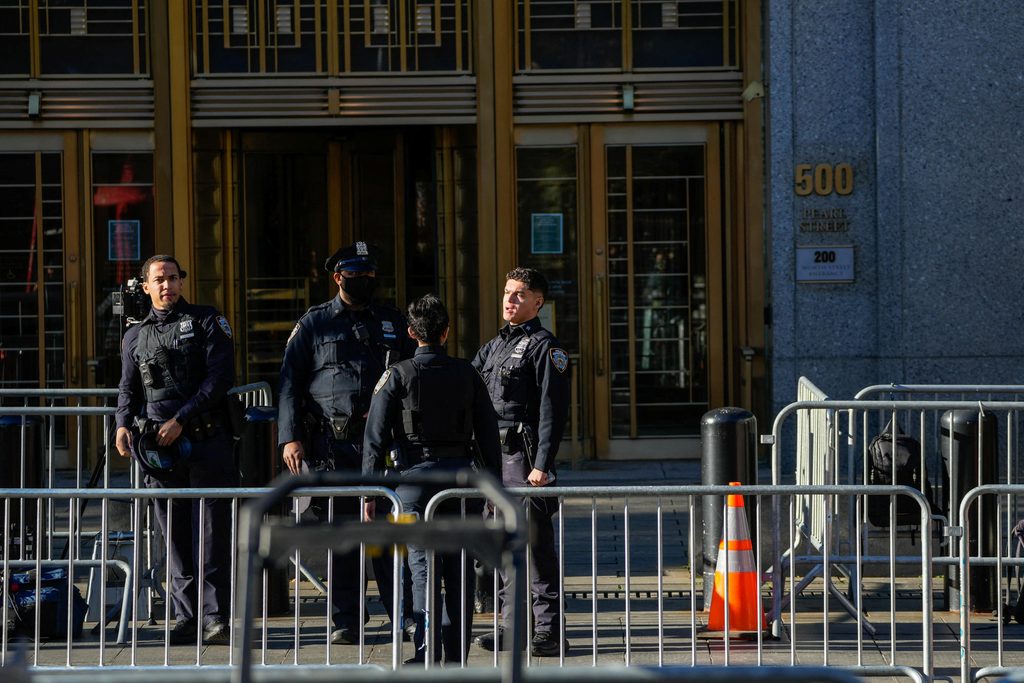
NEW YORK—Today, in a federal courthouse in Manhattan, Judge Alvin Hellerstein formally presented a charge of conspiracy to commit torture against Nicolás Maduro, the former dictator of Venezuela, and his wife Cilia Flores. The charge, to which both pled not guilty, has been added to the existing charges of narcoterrorism, drug trafficking, and weapons offenses against the defendants, whose trial is scheduled to begin in June 2027.
The torture allegations include the use of state repression against political opponents and perceived dissidents in Venezuela, including at least three Americans, and form part of the charges in a superseding indictment unsealed by the US Department of Justice on October 8.
The conspiracy to commit torture charge is significant for several reasons. Torture has a widely recognized definition, which is accepted by almost all United Nations (UN) member states. Torture is prohibited under international law, including by the UN Convention Against Torture, to which the United States and Venezuela are parties. Unlike the previous charges against Maduro, which center on alleged international drug trafficking and related weapons offenses, the new charge directly addresses the alleged use of state repression to quash political dissent in Venezuela—which international institutions have been documenting and reporting on for more than a decade, but with little prospect for redress.
Because US federal law expressly provides for extraterritorial jurisdiction over torture committed abroad when the alleged offender is present in the United States, the new charge creates a potential and rare avenue for criminal accountability for acts of torture allegedly committed in Venezuela.
What has happened in the case so far
While efforts to hold Maduro accountable have come to a head only this year, the case against him has been long in the making. The indictment against Maduro and members of his inner circle was unsealed in 2020. It alleged a wide-ranging drug trafficking operation aided by guerrilla groups and spanning multiple countries, dating back to 1999. In recent years, various co-conspirators pled guilty after extradition or surrender. As for Flores, she was first charged with drug trafficking and weapons offenses in December 2025. To date, the core allegations revolve around Maduro and Flores weaponizing parts of Venezuela’s law enforcement, the military, and the judiciary to protect a system of repression and corruption that allowed the couple and their inner circle to profit from drug trafficking and the theft of public funds.
Following the US military capture of Maduro and Flores in January of this year, a superseding indictment was unsealed. The physical presence of Maduro and Flores in a US federal courtroom, which had initially seemed improbable, is now a reality. The prosecution can therefore proceed with the defendants in the dock.
Torture charges are added
In the superseding indictment unsealed by the Department of Justice on October 8, a count alleging “conspiracy to commit torture” was added to the charges against Maduro and Flores. This new count was brought under the US extraterritorial federal torture statute, Section 2340A of Title 18 of the United States Code.
The indictment notes that in an effort “[t]o undermine Venezuelan democracy and entrench themselves in power,” Maduro and Flores “presided over a system of repression that relied on violence against political opposition, arbitrary detention, and the torture of detainees, including United States citizens.” The indictment also details the types of torture allegedly used during their rule, including “electric shock, asphyxiation, rape, forced nudity, prolonged isolation, starvation, punishment cells,” as well as psychological torture “such as threats to harm and kill victims’ families, including children.”
In one grim example, prosecutors allege that Maduro caused the death of a Venezuelan opposition figure. In 2018, the now-deceased dissident had returned to Venezuela after attending the UN General Assembly in New York. Maduro’s forces arrested him and transferred him to the headquarters of Venezuela’s intelligence agency, where he was ordered to be tortured. Just three days after his arrest, Venezuelan authorities reported that the man had jumped to his death from the tenth floor of the facility.
The indictment also alleges that Maduro and Flores tortured three unnamed US citizens. Dozens of Americans were wrongly detained during Maduro’s time in office. Upon release, many have recounted the torture they faced behind bars in media interviews and in civil lawsuits for damages.
One potentially important figure in the case is former Venezuelan general Hugo Carvajal, who was arrested in Spain in 2021, extradited to the United States, and then pled guilty last year to drug trafficking charges. He led Venezuela’s military intelligence agency, previously known as the Dirección de Inteligencia Militar (DIM), for close to a decade under the rule of Hugo Chávez, Maduro’s predecessor. The revised indictment repeatedly mentions the involvement of the successor organization to the DIM, the Dirección General de Contrainteligencia Militar (DGCIM), in alleged acts of torture. While the testimony of victims is critical in establishing the responsibility of perpetrators in criminal trials, prosecutors often rely on insider witnesses to establish the chain of command or speak to the structures and networks that substantiate a conspiracy charge. If Carvajal testifies against Maduro, his statement could be key.
Closing the impunity gap for Venezuelans
The torture charges represent an important step forward in securing accountability for Venezuelans, for whom justice pathways so far have been quite limited.
Since 2014, Venezuelan state forces led by Maduro have carried out waves of repression and violence against civilians. Following its establishment by the UN Human Rights Council in 2019, the Independent International Fact-Finding Mission on the Bolivarian Republic of Venezuela (FFM) has published multiple reports detailing how Maduro-led forces committed crimes against humanity in Venezuela, including extrajudicial killings, enforced disappearances, arbitrary detentions, and torture. Key to this repression is the role of the colectivos—pro-regime armed civilian groups tasked with repressing protests and political dissent and notorious for their brutality. Maduro’s human rights violations and atrocity crimes have received widespread condemnation by the UN, regional bodies in Latin America and Europe, countries around the world, and leading civil society organizations. Much of this is recounted in the unsealed indictment containing the torture charge.
Despite the extensive documentation of the Maduro regime’s crimes, justice efforts have been halting. The International Criminal Court launched a preliminary examination into Maduro’s crimes in February 2018 and an investigation in November 2021, but this process has not yet resulted in any arrest warrants for Maduro or his regime officials. Argentina took the bold step of issuing arrest warrants in September 2024 for Maduro and other regime officials for crimes against humanity, but he remained at large.
With Maduro and Flores now in US custody, and co-conspirators in the indictment potentially cooperating with US authorities, prosecutors may have a chance to hold Maduro and Flores to account for the system of widespread and systematic torture of Venezuelans they allegedly oversaw.
Torture victims can participate in the proceedings
Under subsection (b)(2) of Section 2340A of Title 18 of the United States Code, US courts can assert legal jurisdiction if the alleged offender is “present in” the United States, regardless of the nationality of the victim or the perpetrator. This means that a Venezuelan perpetrator who is in the United States can be held liable for torture committed against Venezuelan nationals in Venezuela—no other link to the United States is necessary for jurisdiction.
While the US federal torture statute was long used sparingly by prosecutors, recent years have seen successful convictions holding perpetrators to account. In September of this year, a former prison chief who served under Syria’s deposed dictator Bashar al-Assad was sentenced to sixty years in federal prison on charges that included torture of inmates in Syria between 2005 and 2008. And in August 2025, a member of a Gambian death squad was sentenced to more than sixty-seven years in prison on multiple counts of torture, following his conviction in April 2025 on those charges—making him the first non-US national to be convicted under the statute.
In both of those cases, the victims were non-US nationals. In the case against Samir Ousman Alsheikh, the Assad-era prison chief, civil society organizations represented victims and survivors who suffered during Alsheikh’s tenure at Adra Prison and who could speak to that brutality at trial and at his sentencing hearing. This testimony forms an important part of the legal and historical record about the atrocities of the Assad regime.
A similar approach could be applied in the case against Maduro and Flores. The revised indictment states that from 1999 to 2025 “thousands of Venezuelans were harassed, threatened, arrested, prosecuted, assaulted, tortured, or killed by individuals wielding the purported authority of the Venezuelan state” to keep Maduro and Flores in power. Many Venezuelans who escaped Maduro-era abuses now reside in the United States and could provide evidence to US federal prosecutors about Maduro and Flores’s alleged roles in the torture of non-US nationals. Venezuelan victims, too, could offer powerful testimony during the trial and at the sentencing stage, if a conviction is secured.
Changes to US law could help better deliver justice for atrocity crimes
The US federal torture statute is part of a fleet of extraterritorial statutes in the US Code that hold perpetrators to account for human rights abuses and atrocity crimes committed abroad. These statutes cover crimes including genocide, war crimes, recruitment or use of child soldiers, female genital mutilation, and trafficking.
Missing from this list is a statute on crimes against humanity. Years ago, US Senator Dick Durbin (D-IL) introduced the Crimes Against Humanity Act of 2010, which proposed making it a crime to commit a widespread and systematic attack against a civilian population that involves murder, enslavement, torture, rape, arbitrary detention, extermination, hostage taking, or ethnic cleansing. The act was ultimately unsuccessful, but a future Congress should consider reintroducing this legislation, with tweaks to align it with the more flexible requirement of a “widespread or systematic” attack as it is defined under international law—or whatever final definition results from the ongoing process to negotiate a global treaty on crimes against humanity. This would serve as an additional justice pathway for victims from Venezuela, as well as for victims from Iran, North Korea, and Cuba seeking redress for core international crimes.
Just as Republicans and Democrats came together in December 2022 to pass a much-needed amendment to the US federal war crimes statute that allowed for perpetrators to be arrested once on US soil, Congress should work in a bipartisan manner to ensure that crimes against humanity are also punished under US laws.
The significance for Venezuelans
The additional charge of conspiracy to commit torture against Venezuelan dissidents has introduced a justice pathway long desired by Venezuelan victims and survivors. But accountability for Maduro and other senior officials cannot, by itself, resolve Venezuela’s broader accountability crisis. Too much of the system that enabled these abuses remains in place.