

This article is part of a series featuring Atlantic Council experts’ analysis and recommendations on the key challenges facing allies at the upcoming NATO Summit in Ankara, Turkey, and beyond.
HELSINKI—Emerging technologies have become critical for strengthening defense and deterrence capabilities. Today, the pace of technological development is so rapid that it is exceeding traditional procurement and integration processes. In response, NATO has begun to place greater emphasis on faster testing, procurement, and operational integration mechanisms to sustain its technological and operational advantage.
In June 2025, NATO allies approved the Rapid Adoption Action Plan (RAAP), which aims to accelerate the adoption of emerging technologies across the Alliance. The plan emphasizes the need for faster acquisition procedures, increased willingness to accept early-stage development risks, and stronger communication of Alliance-wide capability requirements. To accelerate adoption of new technology, the plan calls for the testing, evaluation, verification, and validation cycle to assess whether new innovations are functional, reliable, interoperable, secure, and suitable for operational military use. This cycle is intended to be completed within one year of identifying potential solutions. Beyond testing and validation, common standards and aligned procurement frameworks are essential to ensuring that validated prototypes can be integrated and scaled within the Alliance.
Perhaps the most critical element in helping to bridge the gap between prototyping and operational deployment is a dedicated testing environment called an innovation range. These ranges are designed to enable militaries, as well as companies working on innovations with both military and civilian uses, to develop and test technologies in operational settings, before procurement decisions are made.
How NATO is testing innovation ranges
The idea behind innovation ranges is that they provide realistic, physical sites with standing facilities and supporting resources for the testing and experimentation of emerging technologies. This operational experimentation aims to shorten how long it takes to go from an idea or prototype to a deployed capability.
The innovation ranges are closely linked to NATO’s broader innovation ecosystem surrounding its Defence Innovation Accelerator for the North Atlantic, known as DIANA. They also reflect NATO’s growing emphasis on strengthening the defense industrial base through the inclusion of non-traditional suppliers, start-ups, and dual-use technology companies.
Since first proposed in June 2025, NATO has established five pilot innovation ranges across Europe, each focusing on a specific technological domain, aligned with the Alliance’s capability priorities.
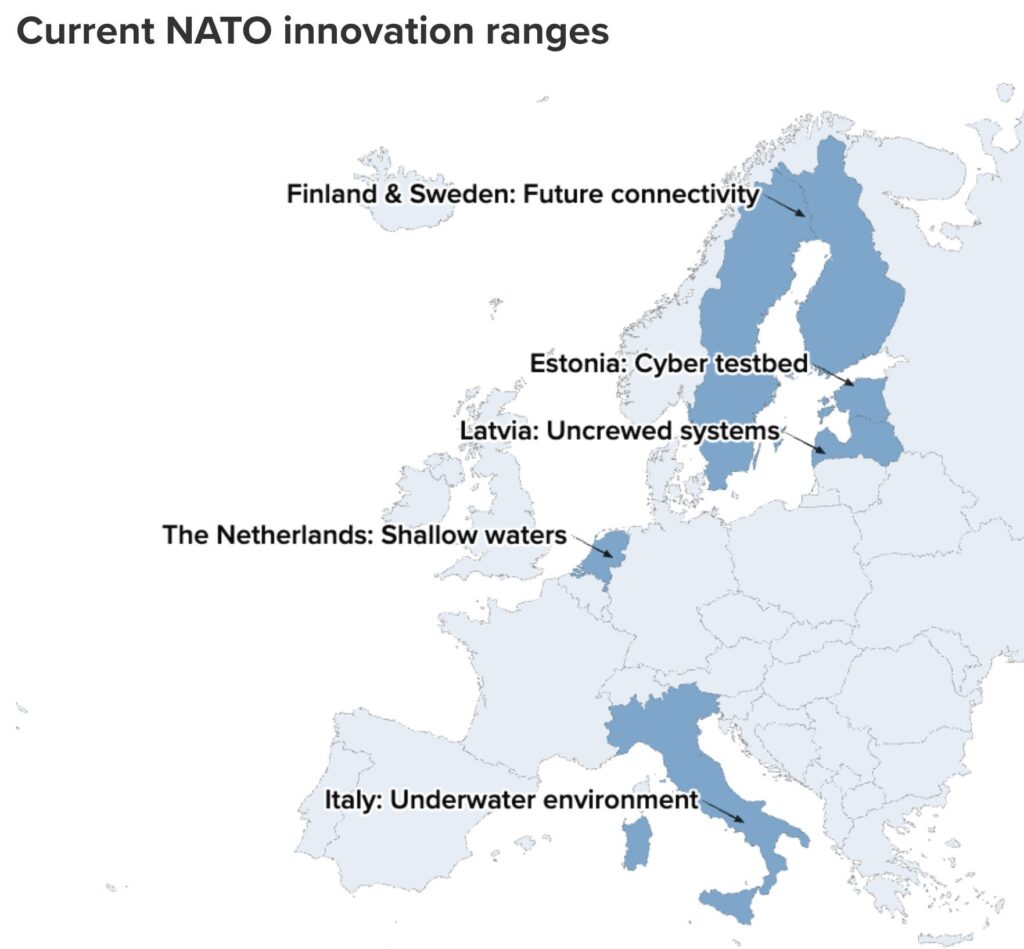
Among these host countries, Latvia has emerged as one of the first operational pilot environments within NATO’s innovation range initiative, focusing particularly on uncrewed and counter-drone technologies.
In March 2026, for example, defense companies, operational users, and government representatives from allied countries and Ukraine met at the Sēlija Military Training Area in Latvia to test interceptor drones, electronic warfare solutions, and other counter-drone technologies under realistic operational conditions.
Finland, too, has been active in operationalizing the innovation range initiative. In December 2025, NATO hosted an innovation range at the DEFINE Innovation Hub in Riihimäki, near where the Alliance’s Deployable CIS Module (DCM) is scheduled to start operations in 2027. The event focused on resilient communications, artificial intelligence–enabled decision support, autonomous and unmanned systems, secure data exchange in contested electromagnetic environments, and operational resilience in Arctic and high-altitude conditions.
Finland’s second innovation range event took place in June 2026. The multi-site campaign focused on interoperability, distributed operations, and the integration of emerging technologies across land, maritime, and networked operational environments. Participating companies and organizations tested solutions related to communications, artificial intelligence, autonomous systems, sensors, and situational awareness.
What the Alliance should do in Ankara
Defense industrial innovation and integration is one of NATO Secretary General Mark Rutte’s priorities for this year’s summit. Through innovation ranges and other initiatives, NATO has begun to strengthen and speed up the pathway from emerging technologies to operational capability. But the Alliance should build on these early efforts in Ankara.
As the challenge shifts from generating innovations to facilitating their adoption across member-state militaries, the Ankara summit offers allies an opportunity to revitalize the defense innovation pipeline. Early evidence from Latvia and Finland suggests that innovation ranges can strengthen NATO’s efforts to accelerate innovation adoption. The ranges do this by providing dedicated environments for testing, evaluation, verification, and validation, as well as platforms for interoperability development and ecosystem coordination.
In Ankara, allies should agree to expand this model by rolling out additional innovation ranges across the Alliance. NATO should also make it easier for small, new defense innovators to access the innovation ranges. At the same time, all stakeholders should pay particular attention to aligning standards and procurement frameworks to strengthen interoperability and facilitate adoption of new technology within the Alliance.