Bottom lines up front
- There is no silver bullet to solve the world’s energy security challenges—not even bypassing the Strait of Hormuz
- But combining Europe’s green energy expertise and the Gulf’s growing investments in clean energy would help diversify and secure the energy future
- Gulf producers hamstrung by the Strait of Hormuz closure can learn from Europe’s experience reducing its dependence on Russian gas
Energy demand in the future is likely to be gargantuan: According to the International Energy Agency, by 2030 global electricity consumption required for data centers is expected to reach 945 terawatt hours in a base-case scenario. AI can help optimize electricity grid efficiency, whether at the consumer, prosumer, or producer level, but the demand is growing to a challenging scale. Continued conflicts are setting the world back rather than helping meet increasing energy needs. Both the Russian invasion of Ukraine and the Iran war have demonstrated the vulnerability of the world’s energy security, with supply routes becoming limited or closed altogether, and gas price hikes and supply shocks. Finally, the double environmental costs of these conflicts cannot be overstated. As such, leaders in both Europe and the Gulf stand to do well by their countries if both regions remain internally unified, as they work together across regions to overcome some of most formidable challenges facing humanity.
The Middle East accounts for approximately 30 percent of global oil production and nearly 20 percent of global gas production. During the transition away from fossil fuels, Middle Eastern hydrocarbon producers—especially in the Gulf Cooperation Council—will play a central role in meeting demand, including for jet fuel, which is increasingly in short supply.
Europe is a major importer of hydrocarbons from the Gulf region, and European technology is helping drive the energy transition. In a geopolitical landscape marked by questions over US policy in the Middle East, Europe increasingly offers an alternative—or at least a reliable and stable partner. This is especially important as Iran appears to have emerged from the recent conflict more emboldened to disrupt global peace and the global
economy.
Investment in, and deployment of, green energy sources—including solar PV, wind, hydrogen, nuclear, energy storage, and emerging global advances in space-based energy technologies, such as space-based solar power—is critical not only to a more sustainable energy system but also to a more energy-secure world.
Read the full policy brief
About the author
Ariel Ezrahi is a nonresident senior fellow at the Atlantic Council and a member of the MENA2050 IMEC Council. Formerly Ezrahi was architect of the Gas for Gaza project and energy adviser to former UK Prime Minister Tony Blair.
Related reading

About the Europe Gulf Forum
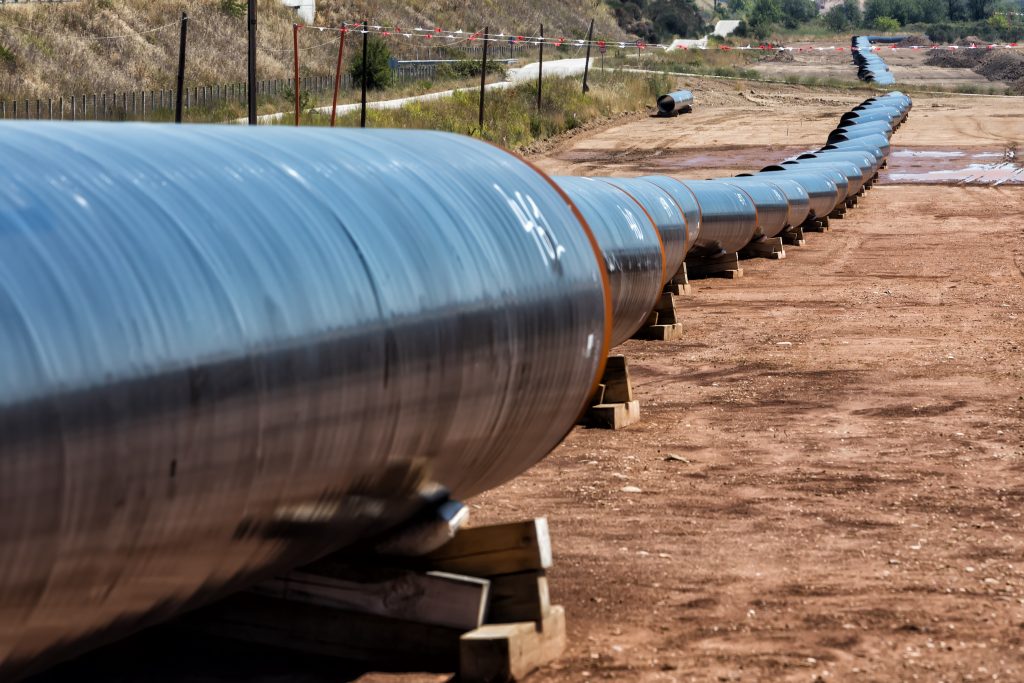
Image: Construction of gas Trans Adriatic Pipeline in Northern Greece. Source: Vasilis/Shutterstock.