
Redefining power systems: Turkish electric-sector engagement in Africa
“There is nothing so eternally adhesive as the memory of power.”
-Isaac Asimov, The Evitable Conflict
Complex energy markets require versatile partners
Amid the extraordinary shifts in Eurasian power politics since the turn of the century, the Turkish presence across Africa stands apart. Crisscrossing the continent for over twenty years, Turkey now runs more embassies than any other nation, Turkish Airlines has become the predominant carrier, and their industrial base administers an array of commercial relationships. Underexamined from afar, Turkey has become a consequential middle-power presence in Africa. Within this charged moment in energy geopolitics, creative approaches are necessary, and Turkish commercial entities may be unique partners, or competitors, which merit further understanding.
For many North American and European multinational corporations (MNCs) involved with energy infrastructure across emerging markets, a repetition of the commercial strategies deployed in the last thirty years may not be suitable for the next thirty years. The competitive position and the cultural perception of these MNCs have changed, especially across sub-Saharan Africa, and these shifts should influence the approaches of the next generation of commercial leadership. New ways of thinking are needed. In many emerging markets, this will require a consideration of middle-power capabilities.
Like many middle-power nations, Turkish commercial execution across Africa is a culmination of active diplomatic and cultural engagement, in parallel with the secular growth of their industrial conglomerates. As a result, Turkish firms have become energy, commodities, and infrastructure interlocutors across Africa. These firms, especially the engineering, procurement, and construction (EPC) entrants, have competed effectively in developing, designing, and building power projects across Africa. Since approximately 2003, Turkish contracting firms have completed over 2,000 projects in the region,1Hamza Kyeyune, “Turkish Companies Wining [sic] African Infrastructure, Superstructure Projects,” Anadolu Agency, updated January 14, 2024, https://www.aa.com.tr/en/africa/turkish-companies-wining-african-infrastructure-superstructure-projects/3108216. with a total value approaching $100 billion through 2024.2Direct investments from Turkey have approached $10 billion, according to the Türkiye-Africa Business and Economy Forum (TABEF). See “Bilateral Relations,” TABEF, accessed January 10, 2026, https://tabef.org/bilateral-relations.html. They appear motivated to accelerate this activity in the next decade. At the Türkiye-Africa Business and Economy Forum (TABEF), held October 2025 in Istanbul, Francisca Tatchouop Belobe, the African Union commissioner for economic development, trade, tourism, industry, and mining, acknowledged that: “Türkiye is an important partner for us in Africa,” adding that Africa is “open for business, both in green energy and in mining.” 3Handan Kazanci, “African Union Eyes Closer Cooperation with Turkish Companies in Mineral Processing, Renewables,” Anadolu Agency, updated October 22, 2025, https://www.aa.com.tr/en/africa/african-union-eyes-closer-cooperation-with-turkish-companies-in-mineral-processing-renewables/3721908.With nearly 20 percent of the international EPC market in Africa,4Yusuf Selman Inanc, “The Turkish Construction Companies Outfoxing China in Africa,” Middle East Eye, February 2, 2023, https://www.middleeasteye.net/news/turkey-africa-construction-companies-outfoxing-china. increasing market share will also require Turkish firms to secure new private-sector alliances that can deliver expertise, capital, and new technologies unavailable by other means.
Moreover, North American and European firms are looking to enhance raw materials access and manufacturing capacity across the electric-sector supply chain, while also successfully maintaining commercial relationships in growing international markets. This includes a heightened presence in nations across Africa. There should soon be a focus on trade and investment commensurate with the region’s economic promise and relevant resources, with a codevelopment approach distinct from prior generations of economic efforts in Africa. In many ways, the missed opportunities for these firms today in nations across sub-Saharan Africa are reminiscent of some of the missed opportunities across the Indian subcontinent since the early 1990s. While there are always trade-offs in forming partnerships, in rapidly changing, culturally intricate markets they may be essential.
Turkish energy firms are present at a vital moment for many African nations, particularly in sub-Saharan Africa, the regional focus of this report. These nations are now confronted with a multiplicity of powers vying for customers, resources, and attention. Yet with limited capital, bankable counterparties, or advanced, domestic technologies, they will encounter fundamental challenges. This includes securing and allocating the additional $400 billion in capital expenditure by 2030 for the new power generation, high-voltage transmission, and local electric distribution needed to reliably supply electricity across the continent.5“Estimating Investment Needs for the Power Sector in Africa 2023-2030,” African Development Bank, October 24, 2024, www.afdb.org/en/documents/estimating-investment-needs-power-sector-africa-2023-2030-africa-report. But unlike prior eras, sub-Saharan ministerial, electric utility, and industrial leaders now have options for national partners. Any assumptions that incumbent firms can operate as in prior eras, with limited competition and minimal finesse, must be reconsidered.
After more than twenty years of engagement, Turkey has signed twenty energy and mining partnership agreements (as of October 2025) as part of its Africa engagement policy. Executing this next stage will require far more capital, technical expertise, and bankable projects than the initial stages of their commercial expansion in Africa. This presents timely opportunities and challenges for North American and European firms, particularly in the electric sector, and is the thrust of this report.
The first section of this report provides snapshots of recent advances and investment needs in the sub-Saharan electric sector; presents a regional case study of East Africa; features the unique role of EPCs in emerging markets development; and touches on the primary energy-transition commodities. The second section assesses partnership models in the African electric sector.
Continent-scale electrification deficits will require vast investment
Development levels in Africa’s electric sector vary considerably across nations. Blackouts and brownouts are still pervasive, though increasingly manageable. There remains an underserved population of six hundred million with insufficient access to electricity, and per-capita consumption is a fraction of the global average.6Africa Energy Outlook, International Energy Agency (IEA), June 20, 2022, https://www.iea.org/reports/africa-energy-outlook-2022. Yet electricity demand is expected to double in Africa by 2040, driven by population growth, urbanization, and industrialization. Renewables are now integral to new capacity, including solar energy across East Africa, wind in coastal and highland corridors, and geothermal capacity in the Rift Valley. Gas-fired generation is likely to remain a bridging resource in Mozambique, Nigeria, and Tanzania, along with many other countries on the continent. There is also potential for developing hydropower in Africa, the only continent where major hydropower opportunities remain.
At present, Africa has more than 40 gigawatts (GW) of hydropower capacity. This represents only 10 percent to 20 percent of the plausible output, and is an ongoing opportunity for deploying capital and technical expertise. There are a few major projects in the late stages of development or newly operational. In Tanzania, the 2.1 GW hydroelectric Julius Nyerere facility recently began operations; it is owned and operated by Tanzania Electric Supply Company and was built by two Egyptian EPCs, with design assistance from the Brazilian conglomerate Odebrecht. Also recently commissioned is the pioneering 5 GW Grand Ethiopian Renaissance Dam (GERD) hydroelectric plant, the largest in Africa, which is owned by the state-utility Ethiopian Electric Power and built by the Italian EPC Salini Impreglio (now known as Webuild).7“Hydropower in Africa,” International Hydropower Association, accessed January 10, 2026, https://www.hydropower.org/region-profiles/africa. Given the high power output, distinctive engineering, and capital expenditure requirements of hydropower facilities, these are compelling partnership entry points for North American or European firms.
Africa contains 60 percent of the best solar energy resources worldwide, yet it has only 1 percent of installed global solar photovoltaic capacity. Now the cheapest source of electricity in many parts of sub-Saharan Africa, solar is anticipated to compete effectively with all operationally scalable power-generation sources by 2030.8“Key Findings – Africa Energy Outlook,” IEA, January 10, 2026, https://www.iea.org/reports/africa-energy-outlook-2022/key-findings. Recently, solar installation growth rates have been increasing, primarily because of a decline in solar module costs and an increase in delivery/integration capabilities across Africa, including battery-based energy storage (see, e.g., the Choma solar/storage facility in table 1). This shift has been rapid and led by the Chinese solar manufacturing and deployment base: Twenty African nations each recently set their national, all-time import records for Chinese solar panels (rolling twelve-month, at a minimum import level of 30 MW), many with a significant jump over the prior-year level.9Dave Jones, “The First Evidence of a Take-off in Solar in Africa,” Ember, August 26, 2025, https://ember-energy.org/latest-insights/the-first-evidence-of-a-take-off-in-solar-in-africa.
As power-generation capacity comes online and regional power pools expand, opportunities for third-party commercial operators will increase. Electricity suppliers across Africa consistently under-recover costs due to low tariffs and high technical losses. Power market liberalization remains limited, despite landmark initiatives such as the Southern African Power Pool10Southern African Power Pool: Annual Report, SAPP, 2021, https://www.sapp.co.zw/sites/default/files/Full%20Report%20SAPP.pdf. and the West African Power Pool. These should remain priorities across Africa as the effective design and operations of markets themselves can improve confidence by energy asset investors while improving electric grid resilience.
East Africa: Nexus for electric-sector partnerships
Present-day East Africa, in anglophone contexts, represents at least eighteen nations.11“Methodology,” Statistics Division, United Nations Department of Economic and Social Affairs, accessed January 10, 2026, https://unstats.un.org/unsd/methodology/m49. In this report, we focus on two subregions: The Horn of Africa, containing Somalia, Ethiopia, Eritrea, and Djibouti; and three historically anglophone East African nations, Kenya, Tanzania, and Uganda. As a geopolitically crucial and growing region, East Africa presents a distinctive opportunity, in particular for US-Turkish partnerships in the electric sector.
Following the COVID-19 pandemic, East Africa has led Africa’s economic recovery. The African Development Bank (ADB) and the World Bank cite East Africa as the continent’s fastest-growing region, with real gross domestic product growth exceeding 5 percent in 2024 and outpacing the average across Africa.12“Macroeconomic and Social Developments in Eastern Africa 2025,” UN Economic Commission for Africa, May 14, 2025, https://www.uneca.org/macroeconomic-and-social-developments-in-eastern-africa-2025. This growth has been buttressed by a few sectors fundamental to economic development, including agribusiness, diversified services, and energy.
Further expansion of the power grid will be at the core of economic development across East Africa. As of 2023, the Eastern Africa Power Pool includes many regional nations along with those tied to hydropower via the Nile flows: Burundi, Djibouti, the Democratic Republic of the Congo (DRC), Egypt, Ethiopia, Kenya, Libya, Rwanda, Uganda, Somalia, South Sudan, Sudan, and Tanzania. The regional generation mix varies widely; Kenya’s renewables mix stands out, with roughly 85 percent to 90 percent of it powered by geothermal, hydropower, wind, and solar, making it one of Africa’s most renewables-heavy systems.
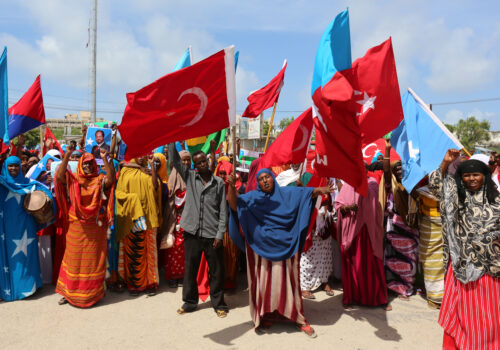
As a result of its decades-long presence, Turkey is now embedded in East African relations as a middle-power nation, sometimes interceding in regional conflicts. At times, Ankara has been the only mediator or international player. In 2011, President Recep Tayyip Erdoğan conducted a full ministerial visit to Somalia amid the worst drought in its history, and was the first non-African leader to visit in nearly twenty years.13“Somalia Famine: Turkish PM Erdogan Visits Mogadishu,” British Broadcasting Corporation, August 19, 2011, https://www.bbc.com/news/world-africa-14588960. “The tragedy going on here is a test for civilization and contemporary values,” Erdoğan stated on this visit, accompanied by aid and the renewal of a centuries-old relationship to the Horn.14Aanu Adeoye, Adam Samson, and Aditi Bhandari, “Turkey’s Expanding Leverage in Africa,” Financial Times, August 27, 2024, https://www.ft.com/content/6149698f-8192-425e-a6bc-07d1677b6029. Since then, Turkish firms and the government became among Somalia’s most engaged external partners, investing in varied infrastructure, including energy facilities and a military base, Turkey’s largest in Africa. In 2023, Somali and Turkish firms signed an agreement to develop a waste-to-energy power generation project in Mogadishu, among the earliest of Turkish investments in the Somali electric sector.
Finally, East Africa presents noteworthy categories for more involved US commercial cooperation. In Kenya, companies such as Kenya Electricity Generating Company (KenGen) have developed substantial geothermal expertise,15“Energy Generation – Geothermal,” KenGen, accessed January 10, 2026, https://www.kengen.co.ke/index.php/business/power-generation/geothermal.html. acting as potential partners for US geothermal firms. Regional utilities, often plagued by structural inefficiency, are also experimenting with reform: Ethiopia has previously considered unbundling elements of its state electric power company. US advisory firms have long provided expertise globally on power-sector unbundling, given the breadth of successes and failures in the restructuring of their own distinct power markets. And Zambia, in late 2025, launched a 300 MW solar-storage development project with local IPPs,16“Zambia Solar Energy: Impressive 300 MW Project Launched,” PV Know How, November 25, 2025, https://www.pvknowhow.com/news/zambia-solar-energy-impressive-300-mw-project-launched. providing an opportunity for new entrant design and engineering firms. In these cases, entrants will need leadership capable of managing Byzantine stakeholder relationships and establishing alliances that can successfully deliver projects.

EPC firms as partnership vehicles
Large-scale infrastructure projects are often the flagship initiatives of new governments, in any part of the world. Within any emerging market, EPCs function both as multinational conglomerates delivering infrastructure and trusted allies in building nations. Power-sector EPC firms have served as a vector of Turkish commercial engagement as African ministries and electric utilities invest in national infrastructure. These EPCs were among the earliest commercial entrants in Africa, along with the transport networks by Turkish Airlines, all building upon the initial diplomatic foundation. In recent years, Turkish conglomerates have led the construction of power plants, rail, and electric transmission projects across sub-Saharan Africa.
The EPCs follow Turkey’s middle-power model in Africa. They have a relatively patient, less transactional relationship compared with many North American or European counterparties. And for key national stakeholders in African nations, often Turkish EPCs can provide an alternate to Chinese consortia.
Within the power sector, renewables will increasingly be the focus of the Turkish EPCs. At TABEF 2025 in Istanbul, Alparslan Bayraktar, the minister of energy and natural resources, said, “I want to highlight that renewables are the #1 area for cooperation [with African nations]. In power and renewables, we can collaborate on regional grid planning stability and interconnections where we have a lot of experience. Turkish companies are ready to work on solar, wind, hybrid solution[s], micro grids, and storage.”17“Türkiye-Africa V Business and Economy Forum | Energy and Mining,” Dış Ekonomik İlişkiler Kurulu [Foreign Economic Relations Board of Turkey], YouTube video, November 4, 2025, www.youtube.com/watch?v=iPRgI36t8JE.
In an era of rapid geopolitical change, EPCs have effectively become vehicles for redefining diplomatic, commercial, and economic relationships. Thus, the EPC skill set is typically diversified: local political and labor relations, environmental permitting, development financing, and operational management over the lifetime of the project.
This need for a diversified skill set also offers avenues for partnerships. Electric-sector EPCs serve as the primary contractor for designing, procuring, constructing, and commissioning a power-generation facility or other electric-grid infrastructure. Moreover, skilled EPCs demonstrate an ability to consistently improve project bankability, minimize cost overruns, and deliver projects on schedule. Under a standard lump-sum turnkey (LSTK) contract, for instance, the EPC assumes primary responsibility to complete an operational power asset for a fixed price and completion date. This consolidates the various cultural, technical, scheduling, and regulatory priorities onto a single counterparty, simplifying the entire construction and commissioning phase. Under this mechanism, partnerships can take the form of critical subcontractors, with a focus on regional or technical priorities.
Most stages in an EPC mandate require highly skilled staff or subcontractors. In the initial engineering phase, EPCs develop front-end engineering and design (FEED) studies, which are subsequently converted into detailed technical specifications. This may include site investigations, geotechnical studies, electric-grid interconnection design, and permitting support with local authorities. By their nature, these tasks often require expert local partners. As the engineering design choices set the estimated asset cost and performance characteristics, this also presents an opportunity for technical or advisory engagements.
The procurement, construction, and commissioning phases follow from the initial engineering. Throughout the procurement and delivery phases, EPCs rely on global supply chains to source solar panels, gas turbines, boilers, transformers, control systems, and logistics providers (these are only a small slice of the full equipment list). Experienced contractors will often have an edge in procurement pricing and scheduling, especially in constrained equipment supply environments. In the construction and commissioning stage, EPCs and their subcontractors manage civil works, equipment installation, interconnections, and performance runs before handing over an operating facility. Throughout these elements of the EPC mandate, from conceptual stages through commissioning, new entrants must source and manage partners effectively, whether as the prime contractor or as major subcontractor.
Turkish positioning in energy transition commodities
As a middle power, Turkey’s transition-commodities posture is focused on energy security and industrial development. The 2017 National Energy and Mining Policy prioritized higher domestic renewable deployment, while the Twelfth Development Plan (2024–2028) sought to cut import dependence and secure supplies of minerals needed for the energy and digital transitions. These policies represent parallel paths to develop the domestic mining/regulatory regime while actively securing overseas resources, especially in sub-Saharan Africa.18Pia Beuter et al., “Mapping Africa’s Green Mineral Partnerships,” Africa Policy Research Institute, January 20, 2025, https://afripoli.org/mapping-africas-green-mineral-partnerships. The Twelfth Development Plan echoes the strategies of many other nations: “Exploration efforts at home and abroad will be increased in order to meet the raw material demands of the energy and industrial sectors, and within the framework of the prioritization, priority will be given to the exploration of strategic and critical minerals with high economic potential.”19Presidency of Republic of Türkiye, Twelfth Development Plan (2024–2028), Decision of the Grand National Assembly of Türkiye, Sec. 602., 140, https://www.sbb.gov.tr/wp-content/uploads/2025/03/Twelfth-Development-Plan_2024-2028.pdf.
Along with their execution in building operational power-generation facilities, Turkey has concluded mining agreements with a range of African states, signed between 2016 and 2024 and concentrated in North Africa, West Africa, and East Africa (especially the Horn of Africa). The pattern reflects abiding cultural ties in the north and Horn of Africa, alongside a newer push into West Africa. These agreements emphasize extensive governmental and commercial cooperation, including capacity building, investment promotion, and joint project development. In Ethiopia, Guinea, Niger, and Sudan, for example, they focus on early-stage geological exploration (e.g., mapping exercises, preliminary resource assessments).
This integration in the mining value chain is reinforced by state-linked vehicles and platforms. Turkish mining firms have carried out geotechnical site studies in countries such as Sudan and Niger (decidedly strategic given their uranium reserves and Turkey’s renewed interest in a nuclear-power asset base). As with power generation, convenings such as TABEF provide international fora for Turkey’s messaging about its mining-sector priorities.
Turkish commercial strategy in mining is a result of the prior years of diplomatic, logistics, and energy infrastructure development across sub-Saharan Africa. This has been coupled with a range of cultural and social programs (e.g., renewable energy training programs) and with presidential and ministerial visits (e.g., Erdoğan in Somalia in 2011). Thus far this approach to Turkish mining objectives in Africa appears to be effective and mirrors its approach for building commercial electric-sector relationships. It hews to an understanding of what counterparties expect now, rather than what worked for the prior incumbents thirty years ago.
Redefining power systems: Assessing electric-sector partnerships in Africa
Major North American and European electric-sector stakeholders are at a crossroads for building partnerships that will meet their international objectives in the coming decades.
At a national level, to maintain a resilient electric sector, North American and European economic powers must ensure reliable access to a span of energy-transition commodities, maintain electric-sector research and development capacity (principally world-class talent and funding), improve manufacturing capabilities, and maintain access to growth markets. For several decades, however, research expertise, capital investment, and manufacturing capacity throughout the energy transition supply chain have shifted abroad or lost entirely. This has left North American and European powers writ large exposed, particularly around energy-transition capacity and firm access to growth markets.
As part of a renewal in commercial energy diplomacy, firms and policymakers should prioritize emerging markets that can help in shared delivery of critical resources as well as expand their customer base. Partnerships with firms from middle-power nations, such as the Turkish EPC developers, provide a model to rebuild and expand this presence in sub-Saharan Africa.
Previous entry models for the sub-Saharan African market relied excessively on projects that were advanced in development, where many firms were not competitive to begin with, or were opportunistic, shaped by senior management with limited experience in complex settings. At the time, there were few commercial or multilateral options for African governments seeking to develop, finance, and build power assets, and critical minerals access risks were viewed as minimal.
An enduring approach in sub-Saharan Africa should prioritize the planning or conceptual stages of energy infrastructure development, especially for EPCs, project developers, and consultancies. The early and durable presence will earn trust with national stakeholders, from the ministerial level to local contracting firms. They want a counterpart they can count on over the long run. Moreover, early insights will improve market understanding, lower perceived risk, and provide firms with proprietary project access.
Given this status quo, the likely value for engagement with Turkish commercial entities in sub-Saharan Africa constitutes both profitably delivering energy projects and partnering with those with overlapping geopolitical interests. Managed effectively, there is mutual benefit for all parties: developing the electric sector for nations across sub-Saharan Africa, strengthening the partner nation’s commercial energy presence, and providing capital/technical expertise to middle-power’s conglomerates.
- Complementary capabilities: Expansion of a Turkish commercial presence from their status quo will require a larger capital base, capacity to procure at scale, and varied technological expertise. New entrant EPCs, project developers, and energy/infrastructure investors have long demonstrated expertise in advanced technologies (e.g., enhanced geothermal, grid services, nuclear) and capital deployment, especially in the expansive US capital markets. They may also be able to procure equipment on effective pricing and delivery schedules. Turkish firms provide a proven capacity to deliver projects and a durable base of sub-Saharan relationships.
- Overlapping geopolitical interests: Turkey has built alliances with many nations under an Africa engagement policy,20“Türkiye, Africa Embracing ‘Shared Vision’ to Expand Energy Co-op,” Daily Sabah, October 17, 2025,https://www.dailysabah.com/business/energy/turkiye-africa-embracing-shared-vision-to-expand-energy-co-op. yet in many cases remains at the earliest stages (e.g., MOU) rather than expansive energy-asset development. There may be natural limitations on going forward alone. This will especially be the case when competing with incumbents supported financially by much stronger nations with ambitious geopolitical objectives. Partnership-based commercial energy engagements with US firms would provide a balanced option with shared geopolitical interests to leadership across African nations.
Based on these drivers, several models for partnerships across the Turkish commercial footprint in Africa are outlined in table 2, including technology partnerships, early-stage project investment, and ministerial/utility advisory. These recommendations focus on the early stages of the project pipeline for firms (and less on managing multilateral development banks). At the earlier stages, new entrants have historically faced challenges in developing appropriate market insights, strong teams, and smart stakeholder relationships. In these approaches, simultaneously improving project bankability and managing regional stakeholders will be paramount.
Partnership guidelines for electric-sector firms and policymakers
While private-sector partnerships can be a compelling approach for North American or European energy-infrastructure engagement in sub-Saharan Africa, the implementation must now be cognizant of middle powers from all over the world. For instance, US operators no longer face a bipolar realm in sub-Saharan Africa, as existed in past competition with the USSR and had yielded distinct means of engagement in sub-Saharan Africa with governments, the private sector, and civil society. Moreover, the subsequent unipolar moment was brief. The next generation of North American or European private-sector operators must face a competitive, multipolar environment requiring cultural finesse for persuasive, long-term collaborations.
In this section, we consider a few guidelines specific to the US private sector and US policymakers, to assist with commercial energy diplomacy in sub-Saharan Africa. The principal opportunity is at the early stages: strategic advisory (e.g., integrated resource planning, utility modernization, market unbundling, ministerial planning), reprioritizing regions of national interest, identifying compelling partners, and allocating risk capital early in the infrastructure development process.
For the private sector: EPCs, project developers, and consultancies
- Proactively build relationships with both established and emergent firms active in Africa. These engagement teams should constitute both senior-level and operational US leadership, principally executives capable of operating within multipolar environments. This should also include building trust and a shared vision with national African leaders. This capacity would assist US firms in identifying the most effective partners.
- Bolster the presence of financial, technical, and legal advisory services (e.g., transactional advisory, utility modernization, ministerial planning) both independently and in collaboration with partners. Consultancies have a wide purview, attracting intellectual capital, market insight, and relationships on the ground. These firms will be among the first to understand, for example, which policy or political changes will improve the viability of corporate or project acquisitions in a particular country.
- Invest early, at the project-development stage or via growth equity in promising partners in Africa. This approach helps ensure project access, allows both US investors and technology vendors sufficient design leeway, and builds relationships between firms.
For US policymakers
- Ensure diplomatic and state-level stability: While there may be consensus between the public and private sector on the need for the United States to redefine energy and infrastructure policy, lack of stability and diplomatic consistency will slow down private-sector planning, including essential partnership development.
- Facilitate convenings and working groups to deepen cultural and institutional ties over the long term. These can be deployed as joint energy infrastructure working groups, either under existing trade or development frameworks or with supporting nongovernmental institutions. With consistent implementation, these are expedient and low-cost means to coordinate investment, regulation, and project pipelines.
- Support advisory engagement with ministries/utilities at the planning stages. Given the United States’ highly varied experience with electricity-market liberalization, US policymakers can engage with counterparts to enact effective power-market design and operations, grid-interconnection studies, power-pool expansion/operations, and regional transmission initiatives.
In these scenarios, the US private sector and policymakers should aim to maintain reliable commitments and avoid short-term opportunism. This disciplined approach will build credibility first and foremost with African partners and governments, and in turn the confidence of the full array of commercial partners.
Executing these multi-stakeholder processes in any emerging market will require US leadership/operational teams to already be accustomed to complex environments. They must also operate with more budgetary constraints, systems engineering mentalities, and a distinct competition from the past. Tactically, a middle power’s mentality may help: While overly transactional styles or culturally incurious counterparts were tolerated by local leadership when there were few options for energy partners, this has not been the case for many years and is unlikely to return.
Finally, for nations seeking to develop comprehensive electric-sector capabilities, bold-faced directives may be a good starting point. But they will not necessarily translate into results. Global economic powers must be willing to develop a lasting strategy and talent base to execute energy policy over decades, based around firms that can operate in difficult geopolitical conditions. To translate short-term announcements into long-term results, the ambitious entrants will need both internal expertise and partners with compelling ground experience.
Many North American and European firms already have profound technical expertise, R&D capacity, and a diversified, trainable talent base with the potential to engage on the ground. The capital markets are sufficiently broad and sophisticated, particularly in the United States, to administer emerging market opportunities. For renewed engagement within Africa, these firms may benefit from an examination of the electric-sector presence of Turkey across the continent, as they have translated diplomatic courtship into commercial reverberations that appear likely to continue in the years ahead.
About the author
Shaheer Hussam is an energy-sector advisor with experience in over forty nations on both sides of the Atlantic. Prior clients include Alphabet, World Bank Group, energy investors, and technology start-ups. Shaheer holds a bachelors of science in mechanical engineering from the Massachusetts Institute of Technology, where he was a Burchard Scholar of the Humanities. He is a partner at Aetlan, based in Helsinki and New York, and is originally from Centreville, Virginia.
Related content

Explore the program

Within the Atlantic Council’s longstanding commitment to strengthening the transatlantic relationship, the Atlantic Council Turkey Program conducts research, provides thought leadership, and offers a platform for strategic dialogue between the US, Turkey, and NATO allies to address the region’s toughest challenges and explore opportunities, including in the fields of energy, business & trade, technology, defense, and security.
Image: Silhouette of Mountain and Transmission Line Tower during Sunset in Mila Province, Algeria. Photo by Noureddine Belfethi.