Content

NATOSource

Oct 18, 2011

Why the US Explored “Cyber War” Against Libya, And Why It Backed Down

By Jason Healey, the New Atlanticist

From Jason Healey, the New Atlanticist:  [W]e should have been not just surprised but shocked if we’d heard that the US ruled out cyber capabilities without even considering them.

Cybersecurity
Security & Defense

New Atlanticist

Oct 18, 2011

Why the US Explored “Cyber War” Against Libya, And Why It Backed Down

By Jason Healey

We should not be surprised that, according to the New York Times, the Obama administration and military commanders considered “a cyberoffensive to disrupt and even disable the Qaddafi government’s air-defense system.” Indeed there are three key reasons why military leadership would be negligent if they did not ask about cyber options:

Cybersecurity
Security & Defense

New Atlanticist

Oct 18, 2011

Looking Ahead to The London Conference on Cyberspace

By William Hague

The advent and development of cyberspace is transforming our world and revolutionising our everyday lives. This may become a global challenge and require a global, co-ordinated response. However, until now, the debate around what form this response should take has been fragmented and lacked focus. The UK believes this must change. More international consensus is […]

Cybersecurity
Security & Defense

NATOSource

Oct 17, 2011

U.S. Debated Cyberwarfare in Attack Plan on Libya

By Eric Schmitt and Thom Shanker, the New York Times

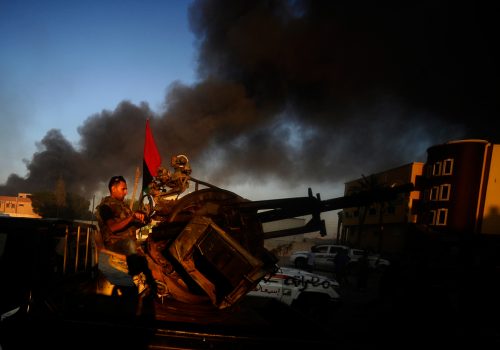
From Eric Schmitt and Thom Shanker, the New York Times:  Just before the American-led strikes against Libya in March, the Obama administration intensely debated whether to open the mission with a new kind of warfare: a cyberoffensive to disrupt and even disable the Qaddafi government’s air-defense system, which threatened allied warplanes.

Cybersecurity
Drones

New Atlanticist

Sep 28, 2011

Why No Cyber 9/11s Yet?

By Jason Healey

Fears of a catastrophic cyber attack against national infrastructure go back well before 2001, but the attacks of a decade ago have given this possibility a new name: a “cyber 9/11.” The feeling persists that a large-scale cyber attack is just around the corner. Yet, despite these fears, there have been no such catastrophic attacks.  […]

Cybersecurity
Security & Defense

Issue Brief

Sep 21, 2011

US Declaratory Policy and Striking Back in Cyber Conflict

By Jason Healey

In one of the year’s most poorly understood bit of cyber news, the United States has again announced it may use military force in response to a cyber attack. In a new publication, Jason Healey, Director of the Atlantic Council’s Cyber Statecraft Initiative, puts this cyber “declaratory policy” into the proper context, both how it fits […]

Cybersecurity
Security & Defense

New Atlanticist

Sep 15, 2011

The Reality of 9/11-Related Predictions of Cyber Attacks

By Jason Healey

After the 9/11 attacks a decade ago, it seemed that threats were waiting for us around every border, hiding in every cave, and ready to pounce from everywhere, including cyberspace. To be sure, some of those threats did in fact materialize against the United States, our allies and interests.

Cybersecurity
Security & Defense

NATOSource

Sep 15, 2011

Cyber threats added to US-Australia defense treaty

By Phil Stewart, Reuters

From Phil Stewart, Reuters:  The United States and Australia will take the rare step on Thursday of declaring the cyber realm as part of a mutual defense treaty, meaning that a cyber attack on one could lead to a response by both nations.

Cybersecurity
Security & Defense

New Atlanticist

Sep 14, 2011

Strategic Instability is Inherent in Cyber Conflict

By Jason Healey and Hannah Pitts

Strategic instability will be an inherent factor in cyber conflict for the foreseeable future, according to preliminary findings of a research effort by the Cyber Conflict Studies Association (CCSA), led by Greg Rattray and James Mulvenon.

Cybersecurity
Security & Defense

Issue Brief

Sep 13, 2011

Pursuing Cyber Statecraft

By Jason Healey

If the world is going to solve problems of cooperation and conflict in cyberspace, states and non-state actors alike must apply a wider range of tools.  Cyber statecraft will be an important way to discover and implement better set of such tools, writes Jason Healey, Director of the Atlantic Council’s Cyber Statecraft Initiative. Download the PDF

Cybersecurity
Security & Defense

Experts