Through our Rafik Hariri Center for the Middle East and Scowcroft Middle East Security Initiative, the Atlantic Council works with allies and partners in Europe and the wider Middle East to protect US interests, build peace and security, and unlock the human potential of the region.
Meet our blogs

All commentary & analysis

Event Recap

Mar 28, 2019

Roundtable with Iraqi Speaker of Parliament Mohammed al-Halbousi

By Atlantic Council

On March 28, 2019, the Atlantic Council’s Iraq Initiative hosted a private roundtable with Mr. Mohammed al-Halbousi, Speaker of the Council of Representatives of Iraq. Atlantic Council Board Director General David Petraeus moderated the conversation. Atlantic Council Executive Vice President Damon Wilson gave opening remarks. 

MENASource

Mar 21, 2019

The Khashoggi killing through Saudi eyes

By Stephen Grand

President Donald Trump famously bragged during his election campaign that “I could stand in the middle of Fifth Avenue and shoot somebody, and I wouldn’t lose any voters.” If the consensus of the US intelligence community is to be believed, Saudi Crown Prince Mohamed bin Salman may actually accomplish a comparable feat.

Saudi Arabia

MENASource

Mar 21, 2019

Sixteen years after regime change, Iraq needs to double down on its gains

By Dr. Abbas Kadhim

The 2003 US invasion of Iraq ushered in a new era in the country’s modern history, with many accomplishments and setbacks.

Iraq

SyriaSource

Mar 18, 2019

The heavy lift

By Frederic C. Hof

The declared top objective of the Trump administration for Syria is “the enduring defeat of ISIS [ISIL, Daesh, Islamic State].” Presumably this means not only killing the bogus caliphate in its physical and ideological dimensions, but keeping it dead. If the presumption is correct, the administration should prepare itself for a heavy and sustained political, diplomatic, developmental, and military lift in Syria; east of the Euphrates River. There is no sign it is preparing to do so.

Extremism
Syria

MENASource

Mar 15, 2019

Passage of SJR 7, better late than never

By Nabeel Khoury

The passage of Senate Joint Resolution 7 is a fresh rebuke for the Trump administration, that its support for the Saudi-led war on Yemen is unauthorized, illegal, and an immoral assault on the Yemeni people.

Yemen

SyriaSource

Mar 13, 2019

The horrors inflicted on Idlib: ongoing ceasefire violations

By Trevor Mace

The de-escalation zone in Syria encompassing Northern Hama and Idlib Provinces is witnessing ongoing and large-scale cease-fire violations by multiple parties. Recent escalations last night showed the first use of incendiary phosphorous attacks—a flammable chemical weapon—in almost a year and targeting the towns of al-Tamanah, Sarmin, and Khan Sheikhoun all located Idlib countryside; which several reports indicate through the use of Russian warplanes.

Syria

SyriaSource

Mar 12, 2019

Tokenism or empowerment? Syrian women and the SDF

By Feras Hanoush

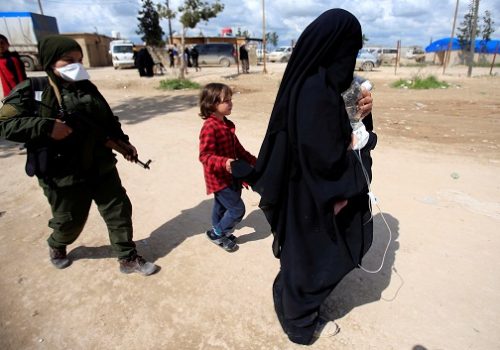
Although Raqqa and the areas east of the Euphrates were liberated from ISIS in 2017—by the US coalition and allied forces, the Syrian Democratic Forces (SDF), which now controls the area—it cannot be said that women’s circumstances in these areas improved significantly. Women now face oppression and challenges in different ways, but they are also able to take on new roles.

Arabic
Syria

SyriaSource

Mar 11, 2019

Syria and its armed rebellion, eight years on

By Burhan Nassir

Eight years of constant war have brought pain and destruction to the Syrian people and their country. What these years have also brought is a chaotic kaleidoscope of armed opposition groups (AOGs) fighting against the regime of Syrian President Bashar al-Assad. With various forms of foreign fighters, agenda-ascribed funding, and rising religious and ethnic extremism; almost all of the […]

Syria

SyriaSource

Mar 7, 2019

Eight years

By Frederic C. Hof

Eight years ago, a very quiet American peace mediation between Syria and Israel was showing promise. Territorial disputes long dividing the parties were being resolved. Security issues key to a genuine peace were being tackled. The fact that months of shuttle diplomacy had not leaked suggested the parties were serious. Had the mediation continued, both Israeli Prime Minister Benjamin Netanyahu and Syrian President Bashar al-Assad would likely have faced a choice by year’s end: inform their respective citizenries that mutually agreed terms of peace had been arrived at; or scuttle everything. Alas, we will never know what those choices would have been.

Syria

IranSource

Mar 7, 2019

UK’s Hezbollah Ban May Signal Tougher Stance on Iran

By David Daoud

Hezbollah’s Secretary-General Hassan Nasrallah once dubbed dividing his group into distinct political and military wings an “English innovation.” Yet, last week, the United Kingdom decided to end this mainstay of British policy. Shortly after Home Secretary Sajid Javid announced a total ban on Hezbollah, Parliament amended the UK’s Terrorism Act 2000 to proscribe the group “in its entirety.” London’s acknowledgment of Hezbollah’s unity […]

Iran
Middle East