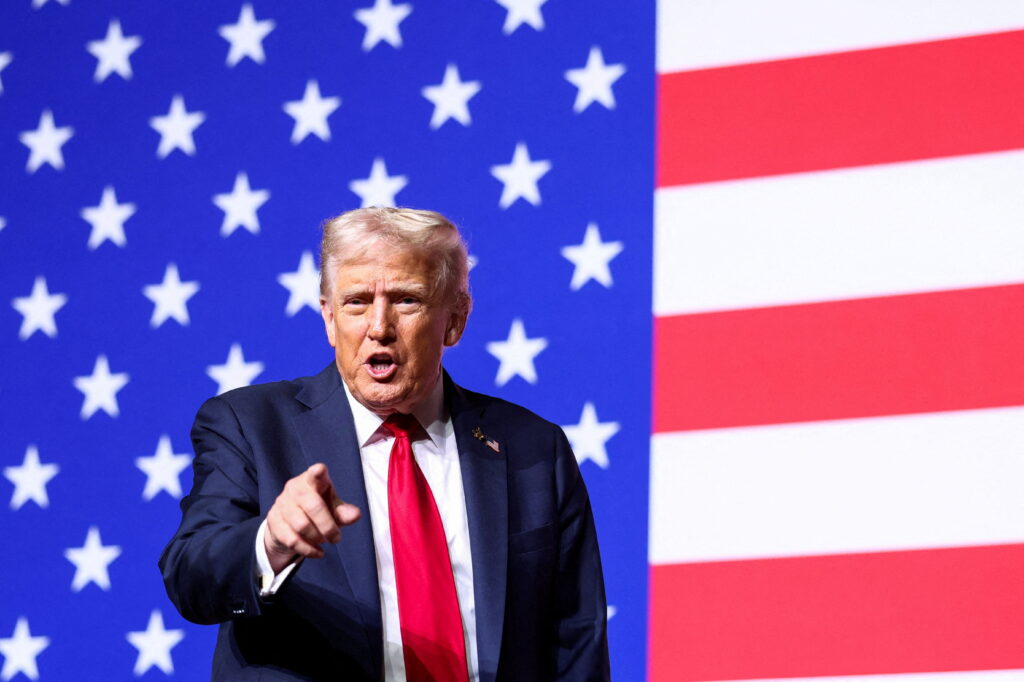
The Trump 2.0 worldview is now on paper for the world to see. Late Thursday, the Trump administration released its National Security Strategy (NSS), a twenty-nine-page document outlining its principles and priorities for US foreign policy. The document articulates what US strategy is—for example, a focus on the Western Hemisphere and a “Trump Corollary” to the Monroe Doctrine. And it addresses what US strategy isn’t: continued pursuit of a post–Cold War goal of “permanent American domination of the entire world,” which the NSS describes as a “fundamentally undesirable and impossible goal.”
Below, our experts dig into what the strategy includes and leaves out—and emerge with their biggest takeaways. This post will be updated as more contributions come in.
Click to jump to an expert analysis:
Matthew Kroenig: Where the NSS succeeds—and falls short
Jason Marczak: The NSS gives new insight into Trump’s Venezuela goals
Tressa Guenov: The NSS avoids taking on US adversaries’ goals
Daniel Fried: The NSS offers an inconsistent but workable set of elements
Torrey Taussig: The administration’s treatment of Europe undermines its own interests
Rama Yade: On Africa, the NSS emphasizes trade and a more interventionist security policy
Markus Garlauskas: The NSS sends clear signals to friends and adversaries in the Indo-Pacific
Thomas S. Warrick: An emphasis on national sovereignty and business interests
Caroline Costello: A major evolution in how Washington frames its competition with Beijing
Dexter Tiff Roberts: Trade and tariff policy is jeopardizing the strategy’s worthy goals
Where the NSS succeeds—and falls short
While they might not have conceived of it this way, the true challenge facing the authors of the United States’ new national security was how to update the country’s mostly successful eighty-year, post-World War II grand strategy for a new era. The new National Security Strategy’s greatest strengths, therefore, come when it doubles down on past principles that still work and identifies creative solutions to new problems.
The strategy is traditional in its strong support for nuclear deterrence and preventing hostile powers from dominating important regions. It calls for strong alliances in Europe and the Indo-Pacific—to be achieved in part by allies stepping up to do more for their own defense and greater coordination on economic security. The document prioritizes achieving freer and fairer terms for global trade and deeper economic engagement in most world regions.
It provides creative solutions for new challenges with a suite of policies to address the downsides of globalization (on border security, revitalizing domestic manufacturing, and so on) and by laying out a vision for US victory in the new tech arms race.
The document falls short where it rejects principles that have worked in the past (e.g., the pragmatic promotion of democracy and human rights) and where it fails to clearly identify and address new challenges before the country (the threat from revisionist autocracies and their interlinkages should have received much more attention).
—Matthew Kroenig is vice president and senior director of the Atlantic Council’s Scowcroft Center for Strategy and Security and the Council’s director of studies.
The NSS gives new insight into Trump’s Venezuela goals
The new NSS is clear: The Western Hemisphere is now the United States’ top priority. This is a long overdue and welcome shift, as US interests should begin close to home. The strategy captures on paper what we have seen from the Trump administration in action thus far, including the twin goals laid out of “Enlist and Expand.” This approach underpins efforts to control migration, stop the proliferation of drug cartels, reduce nonfriendly foreign influence, and secure critical supply chains. But also, and importantly, it includes incentivizing new waves of US investment, since strong domestic economies serve US interests.
The priorities laid out in the NSS—from a holistic perspective—dovetail with many of the interests of countries across the Western Hemisphere, such as security and economic growth, which have been the top concerns of voters in recent elections. There’s also a regional yearning for greater US investment, especially in infrastructure such as telecommunications, technology, and ports, all of which simply has not come at the desired scale. The NSS provides a blueprint for the broader US government to elevate its role in these critical sectors, and it underscores the need for a whole-of-government approach.
The strategy gives insight into the Trump administration’s ultimate goal in Venezuela. A country where Maduro and his cronies currently provide safe haven for criminal groups, profit from trafficking, and welcome the influence of foreign adversaries is a direct threat to US national security. Success in Venezuela, therefore, means ushering in a democratic government that’s a genuine US partner as part of the goal to “expand” US partnerships. And a US shift to the Western Hemisphere as part of the “Trump Corollary” to the Monroe Doctrine also signals that the redeployment of US forces to the Caribbean is not time-bound.
The NSS further details a multi-pronged hemispheric effort to counter the influence of external powers, including Russia and, especially, China. For China, this means addressing Beijing’s growing footprint across commerce, investment, soft diplomacy, military training, and more. What should we look at next? How will implementation be prioritized, and how will this strategy translate at the country level across the hemisphere?
—Jason Marczak is vice president and senior director at the Atlantic Council’s Adrienne Arsht Latin America Center.
The Western Hemisphere “Trump Corollary” is a logical focus on strategic geography
Trump’s NSS is a much-needed corrective to decades of “strategies” that, through their failure to force difficult choices about priorities and resource allocation, commit the United States to an overstretched conception of national strategy. This NSS is remarkably and refreshingly frank about the essential objectives of the United States: securing the homeland, which requires a secure Western Hemisphere, and preventing outside great power adversaries from exerting malign influence in the hemisphere. The “Trump Corollary” to the Monroe Doctrine, which seeks to guarantee US access to key hemispheric locations (think the Panama Canal, Greenland, and much of the Caribbean) will likely stand as an overt, twenty-first century statement of a logical and previously unexceptional focus on strategic geography. The Trump Corollary carries real security and economic implications for American interests and security in the homeland. This strategic focus is likely to encourage new resources dedicated to intelligence, military, law enforcement, and economic statecraft programs focused on the hemisphere.
The administration’s statement of intent for the Indo-Pacific is a consistent throughline from its 2017 NSS, but it also reflects evolving geopolitical realities. The NSS reiterates US commitment to preserving a free and open Indo-Pacific and strengthening regional partners and allies against China’s malign activity. It defines the region as the essential non-hemispheric theater for geopolitical competition. Importantly, the NSS seeks to draw a line between security in our hemisphere and deterrence of Beijing more broadly. This makes explicit a long-running reality of the US competition with China: Beijing seeks to distract the United States from maintaining the status quo in the Indo-Pacific by pursuing adversarial activities in the Western Hemisphere.
Finally, the NSS is a useful thematic reminder that US national strength stems from more than simply the military balance. The strategy is explicit on the need for a strong defense-industrial and manufacturing base to sustain that military balance, alongside dominance in technologies such as artificial intelligence (AI), quantum, and supercomputing. The NSS should be understood as a limiting document that seeks to more narrowly define US objectives globally, while also expanding the definition of US national power in a more comprehensive direction, building upon Trump’s long-stated belief that economic security is national security.
Taken together, these lines of effort reflect a coordinated, holistic approach to preserving US national power in the decades to come.
—Alexander B. Gray is a nonresident senior fellow with the GeoStrategy Initiative at the Atlantic Council’s Scowcroft Center for Strategy and Security. Gray most recently served as deputy assistant to the president and chief of staff of the White House National Security Council (NSC).
The NSS avoids taking on US adversaries’ goals
This NSS articulates key policy patterns into a declarative set of priorities for the administration. But it also leaves several strategic holes on how and whether the United States will address the effect that adversaries will continue to have on realizing the NSS’s goals.
On Russia, the strategy notes that Europe sees Moscow as an existential threat, but it does not contain any meaningful treatment about the threat Russia poses to the United States in terms of realizing its economic, soft power, or military projection—not just in Europe but around the world. The United States is cast more as an arbiter between Russia and Europe rather than the object of an almost singular focus by Russia on counteracting US influence and power projection. The strategy’s focus on Africa is welcome, but there is no acknowledgement that Russia and China continue to actively thwart nearly every US objective on the continent.
The strategy acknowledges Iran’s role as a major regional destabilizer, but the Tehran problem is largely set aside as bygone. Let’s hope that is the case. Still, the Middle East has continuously demonstrated to every successive US administration that the United States must always remain vigilant in the region. Iran’s influence in Lebanon, Syria, Yemen, Iraq, Gaza, and beyond must be closely monitored even as the administration pursues its investment-focused regional agenda. Similarly, North Korea is not explicitly named in the strategy, yet Pyongyang surely will have designs on global attention over the next three years.
The strategy’s muted treatment of adversary goals is likely intentional, a bid to signal a new chapter for the United States where it is less encumbered by the strategic irritants of the post-Cold War era and is free to pursue a bolder interest-based agenda. The reality remains that US adversaries do not want to see this NSS realized whether the United States names them or not. US strategy must continue to take those factors into account.
—Tressa Guenov is the director for programs and operations and a senior fellow at the Atlantic Council’s Scowcroft Center for Strategy and Security. Previously, she was the US principal deputy assistant secretary of defense for international security affairs in the Office of the Under Secretary of Defense for Policy at the US Department of Defense.
The NSS offers an inconsistent but workable set of elements
The newly released NSS seems to combine:
- an overlay of post-Iraq/Afghanistan weariness and reaction, a sort of right-wing version of the post-Vietnam “come home, America” thinking of the Democrats in the early 1970s;
- ideological posturing, particularly directed against Europe with a sharp partisan element of support for “patriotic” (presumably meaning nationalist and nativist) parties;
- a call for fortress America (the document refers to the “Trump Corollary to the Monroe Doctrine,” which seems to mean a desire to prevent outside powers such as China from establishing economic leverage in the hemisphere);
- a strong assertion of US interests in pushing back on Chinese economic coercion and distortion of global trade as well as Chinese expansionism. The section on Asia has good language about no change to the Taiwan “status quo” and lots about protecting the Western Pacific island chains;
- possibly workable language on economic policy, with emphasis on preventing foreign domination of critical resources and technologies and foreign exploitation of international trade, and;
- inconsistent, occasionally odd, and probably compromise language on Europe that combines partisan hostility to Europe’s mainstream politics with grudging but welcome recognition that the United States needs to work with Europe.
The NSS is weak on Russia, which is mentioned only in a European context. But it does call for a “cession of hostilities” in Ukraine that leaves Ukraine a “viable state” and terms this a “core interest” of the United States. That’s not sufficient, given Russian President Vladimir Putin’s refusal to engage in US efforts to end the war, but it is good enough to support a good-enough policy, if the Trump team decides to push Russia to achieve this core interest.
The strategy’s ideological hostility toward Europe combines with its implied bitterness over perceived US overextension and general disdain for “values” to drive US withdrawal from leadership of the free world—and even the concept of the free world itself. At the same time, the NSS elsewhere recognizes that the United States will need its friends, Europe included, to contend with its adversaries, especially China. This gives the NSS an internal incoherence. To a policy practitioner, the incoherence could provide an opportunity to build on the NSS’s better elements.
—Daniel Fried is the Weiser Family distinguished fellow at the Atlantic Council. He formerly served as special assistant and National Security Council senior director for presidents Bill Clinton and George W. Bush, ambassador to Poland, and assistant secretary of state for Europe.
The NSS is as much about economic statecraft as national security
The second Trump administration’s NSS is as much an economic statecraft strategy as it is a national security strategy, justifying US internationalism primarily based on economic interests, particularly in the Western Hemisphere, and, perhaps surprisingly for those concerned about the merger of the United States Agency for International Development (USAID) into the Department of State, reinforcing the importance of soft power.
It frames foreign policy around traditional economic statecraft objectives such as preserving secure supply chains, access to raw materials, protecting US export markets, and ensuring dominance of US technology and industrial capacity. International assistance is not dismissed, but it is also not presented as a tool of humanitarian obligation or for providing global public goods. Rather, assistance is considered meaningful when it helps protect or advance US interests.
While this may seem cold-hearted, it actually reflects what many in the Global South already assume to be the reality of all foreign assistance and is how this funding has been justified to the American people for decades. Even as the United States provides food aid, for instance, US leaders talk about it as helping US farmers or creating global stability to ensure Americans’ own safety and prosperity. The NSS also notes plans to scale up the use of two of the most important US government development tools, the Development Finance Corporation and the Millennium Challenge Corporation, particularly in the Western Hemisphere, reversing a Department of Government Efficiency (DOGE)-era assault on development in general.
—James Mazzarella is a senior fellow with the Atlantic Council’s Freedom and Prosperity Center. From 2017 to 2019, he served at the White House’s National Security Council (NSC) and National Economic Council, first serving as director of international development and then senior director for global economics and development.
—Kimberly Donovan is the director of the Economic Statecraft Initiative within the Atlantic Council’s GeoEconomics Center. She previously served as acting associate director of the Financial Crimes Enforcement Network’s (FinCEN) Intelligence Division, in the US Treasury Department.
The administration’s treatment of Europe undermines its own interests
Throughout 2025, the Trump administration’s purported aim in Europe has been to shift the burden of conventional defense onto the shoulders of European allies. The administration scored a win at the Hague Summit by pushing NATO allies to agree to an ambitious defense spending pledge of 5 percent of gross domestic product on defense by 2035. Unfortunately, the NSS does nothing to help further US national security interests, by the administration’s own definition, on the European continent.
By underplaying—and refraining from even referencing—the conventional threat Russia poses to transatlantic security, the NSS does not empower those nations that are working to take on greater defense responsibilities. Instead, the NSS seeks to embolden those nationalist and populist parties (such as the AfD in Germany) that would be the most likely to cut defense budgets and downplay the conventional threats that have traditionally fallen to a reliance on the United States. In this regard, the NSS is an own goal that undermines the administration’s stated objectives for what it seeks to achieve with European allies.
—Torrey Taussig is the director of and a senior fellow at the Transatlantic Security Initiative in the Atlantic Council’s Scowcroft Center for Strategy and Security. Previously, she was a director for European affairs on the National Security Council.
On Africa, the NSS emphasizes trade and a more interventionist security policy
On the Africa front, the paper is thin—a half page at the bottom of the strategy—and is not surprising. It repeats the key angles of the Trump administration’s approach to Africa as already outlined before Trump’s election by Project 2025 (with a clear refutation of “liberal ideology”) and after Trump’s election by Troy Fitrell, the State Department’s senior bureau official for African Affairs, in Abidjan and in Luanda.
Following the shutdown of the US Agency for International Development in July, the strategy shifts US–Africa relations from aid to trade and investment: the United States signals a stronger focus on commerce, mining (especially critical minerals), and energy investments in African countries. The United States plans to support private-sector growth and expand market access.
It is on security that the Trump administration has perhaps evolved the most, with a more interventionist policy. The administration started this shift in February with large strikes on Somalia against a leader from the local branch of the Islamic State of Iraq and al-Sham (ISIS). The strategy emphasizes that combating the “resurgent Islamist terrorist activity in parts of Africa” remains a priority. Because security is not far from commerce, the landmark peace agreemen signed yesterday at the US Institute of Peace between Rwanda and the Democratic Republic of Congo , with the goal of ending a three-decade war that has taken millions of lives, will also serve as a platform to advance US business interests. It seems the administration will next turn to Sudan and the ongoing genocide in Darfur.
The strategy does not say anything, though, about the two most remarkable developments this year with respect to US-Africa relations—the rising tensions with the two largest African economies, South Africa and Nigeria. These disputes seem more motivated by domestic considerations (protection of Christians, Afrikaners, and Israel) than the competition with China on African soil, reminding us that any Trump foreign activity is guided by the principle of “America first.”
—Rama Yade is the senior director of the Atlantic Council’s Africa Center.
The NSS sends clear signals to friends and adversaries in the Indo-Pacific
Public US government strategic documents are more meaningful for what they signal to friends and adversaries than for driving change in US actions. This NSS’s writing suggests a domestic audience, but its words are being parsed closely in the Indo-Pacific—where the time zone differences enabled publishing local first takes while Washington slept.
Language on China and Taiwan garnered the most attention. For example, some commentators are already opining that shifting from the last NSS’s wording of “oppose any unilateral changes” to the status quo in the Taiwan Strait, to “does not support any unilateral change” is a softening, despite the new NSS calling this a “longstanding declaratory policy.” Any worried readers should instead direct their attention to the NSS’s blunt imperative on “reinforcing U.S. and allies’ capacity to deny any attempt to seize Taiwan or achieve a balance of forces so unfavorable to us as to make defending that island impossible.” This is stronger language than any previous NSS on Taiwan’s defense. Even more important is the recent context: the president’s signing of the Taiwan Assurance Implementation Act and the announced $330 million package of advanced US arms sales to Taiwan.
Similarly, South Korean concerns that North Korea was mentioned seventeen times in the first Trump administration’s NSS, but not once this time, are misplaced. Pyongyang has obviously not been a high priority for Washington since the inconclusive Hanoi summit of 2019, but the United States is doubling down on its alliance with South Korea and remains steadfast in deterring threats from the North. North Korea’s Kim Jong Un might take solace that boilerplate language on denuclearization was absent, but Kim would be foolish to see this as a concession.
At least for the Indo-Pacific, friends and adversaries alike should read the clear signals in the NSS—the United States is committed to strengthening extended deterrence in the region, even as it reminds its Indo-Pacific friends that Washington expects them to increase their military contributions to such deterrence.
—Markus Garlauskas is director of the Indo-Pacific Security Initiative of the Atlantic Council’s Scowcroft Center for Strategy and Security. He served for two decades in the US government as an intelligence officer and strategist.
An emphasis on national sovereignty and business interests
As expected, the new National Security Strategy is a combination of traditional views of the importance of American power, but with an emphasis on national sovereignty and business interests as a driver of international engagement. For the first time in decades, the Western Hemisphere is given precedence, with the strategic goal of reducing mass migration. Border security is seen as a key element of national security―a proposition that most Americans would agree with, even if they disagree on how to handle immigration enforcement domestically. More paragraphs in the NSS are devoted to Asia (25) than Europe, the Middle East, and Africa combined (13, 7, and 3).
Counterterrorism, soon to be the subject of its own national strategy, is barely mentioned, but previews of the counterterrorism strategy show a vision of global terrorism reduced to a problem that governments can deal with on their own, with limited outside support needed. This would represent important progress and is a goal that would benefit the United States and its counterterrorism partners around the world.
—Thomas S. Warrick is a nonresident senior fellow in the Scowcroft Middle East Security Initiative and a former deputy assistant secretary for counterterrorism policy in the US Department of Homeland Security.
Trump’s energy- and technology-dominance goals will need more of a focus on resilience
The 2025 NSS clearly outlines ambitions for US energy, industrial, and technological dominance. However, to secure long-term success in those aims, I believe the document should place even greater emphasis on building resilience—both in infrastructure and in financial systems.
Resilient, modern infrastructure is the foundation of reliable energy and technological networks. Without robust power grids, supply chains, and communications systems, ambitions for advanced nuclear reactors, AI-driven innovation, and export leadership remain fragile. Supporting that infrastructure—and embedding redundant, disaster-resistant systems—gives real durability to the energy- and technology-dominance goals.
Likewise, broadening access to financial opportunities and capital—especially for infrastructure, clean energy, and emerging tech—would strengthen economic inclusion and mobilize domestic innovation at scale. A strategy anchored in resilience and financial empowerment would therefore bolster not just short-term gains, but enduring strength, capacity, and stability for decades.
—Jorge Gastelumendi is the senior director of the Atlantic Council’s Climate Resilience Center.
A major evolution in how Washington frames its competition with Beijing
It is striking that this NSS frames China as more of a potential economic partner than an adversary, pledging to pursue “a genuinely mutually advantageous economic relationship with Beijing.” The previous NSS described China as a values-based adversary seeking to “create more permissive conditions for its own authoritarian model.”
Why is China an adversary? There are, broadly speaking, two answers to this question: because China’s rise challenges US economic and security interests, and because Beijing is replacing the rules-based international system with one that favors its authoritarian model. This NSS makes it clear that the Trump administration views the US-China rivalry as an interest-based competition, not a clash of values.
The NSS neither denounces nor even mentions China’s authoritarianism. It also prioritizes deterring conflict over Taiwan for strategic and economic reasons, not to preserve its democracy. This represents a major evolution in how Washington frames its competition with Beijing. This is the first time since the 1988 NSS—published during a period of optimism toward China’s reform and opening to the world—that the NSS has neither condemned China’s governance system nor expressed an intent to promote democratic reform in China.
—Caroline Costello is an assistant director with the Atlantic Council’s Global China Hub.
NATO’s eastern flank must respond to shifting US priorities with greater self-reliance and European cooperation
The new NSS signals a major reordering of US global priorities. This will have important implications for all of Europe, including countries in Central, Eastern, and Southern Europe, a region that was named in one of the administration’s seven priorities for the continent. One clear message: Washington is urging European allies to take over conventional defense responsibilities while the United States retains a more limited role in the continent’s security, mostly as a nuclear backstop.
For states on NATO’s eastern flank, this recalibration raises legitimate concerns. Given the ongoing war in Ukraine and continued pressure from Russia, diminished US engagement could weaken the sense of reliability that underpins collective defense guarantees and NATO’s Article 5.
At the same time, the shift pushes Europe—including eastern flank nations—to reassess strategic autonomy. That means investing more in defense capabilities, strengthening regional cooperation, and possibly speeding up modernization and institutional reforms. For Romania, this aligns with the objectives laid out in its new national security strategy, which was presented by President Nicușor Dan and approved by Parliament last month.
But this transition comes with difficulty. Diverging threat perceptions between the United States and Europe regarding issues including Russia, China, migration, and climate change could strain alliance cohesion and reduce predictability.
This strategic pivot by the United States may force Romania and its neighbors into a period of heightened responsibility and adaptation. This will require greater self-reliance, deeper cooperation among European countries, and a reassessment of regional security dynamics—all while navigating uncertainty over long-term transatlantic security guarantees.
—Alex Serban is the Director for the Atlantic Council’s Romania Office and formerly a senior fellow in the Transatlantic Security Initiative at the Atlantic Council’s Scowcroft Center for Strategy and Security.
Trade and tariff policy is jeopardizing the strategy’s worthy goals
The Trump administration’s decision to frame the China challenge as one centered around economics is welcome. Indeed, successive US administrations have had a blind spot in recognizing how Beijing’s mercantilist practices have often hurt US industries and workers and allowed China to quickly narrow the technological gap with the United States. The focus on finding ways to better combat China’s state-directed subsidies and unfair trade practices, secure global supply chains, and trade more with the Global South, which the NSS correctly calls “among the greatest economic battlegrounds of the coming decades,” is also welcome. The fact that China doubled its exports to low-income countries between 2020 and 2024, which the NSS highlights, is indeed a challenge the United States should address. And the NSS’s declaration that the United States “must work with our treaty allies and partners,” whose economies, when combined with the United States’, account for half of global output, to “counteract predatory economic practices” (clearly referring to China), is on the mark, as well.
But the challenge, in large part of the White House’s own making, is that many US allies and partners are feeling less confident about economic and trade policy making in Washington than ever before. Much of that is due to the chaotic and possibly illegal tariff policy of the US president, which the Supreme Court is about to weigh in on in a case with potentially massive economic and diplomatic consequences. A Pew Research Center survey from earlier this year shows that most countries view China rather than the United States as the world’s leading economic power, with 41 percent choosing Beijing compared to 39 percent for Washington. This is a striking reversal from just two years earlier. What’s more, that survey was conducted before Trump’s “Liberation Day” announcement of sweeping, unprecedented global tariffs on April 2; since then, this sentiment is likely to have shifted even more in China’s favor. And this shift in perceptions is convincing some countries to strengthen economic partnerships with US rivals.
Take the example of India (mentioned only four times in the NSS, compared to twenty-one references to China). While for much of the past decade-plus it has been seen as a key counterweight to China and successive US administrations have worked to improve relations with New Delhi, that relationship is now at risk. The imposition of 50 percent tariffs on India, in part for purchasing Russian oil and gas while China was largely given a pass for purchasing even larger quantities of Russian energy products, has upset New Delhi and seems to be driving its recent efforts to improve relations with Beijing.
A high-profile leaders’ meeting in August between Chinese President Xi Jinping and Indian Prime Minister Narendra Modi during Modi’s first trip to China in seven years, is one sign of this shift. A closer relationship between China and India could also challenge Washington’s desire to see New Delhi contribute more to “Indo-Pacific security,” including through the Quadrilateral Security Dialogue (a grouping comprised of the United States, Australia, Japan, and India), another worthy goal the NSS highlights. And Modi’s warm welcome of Russian President Vladimir Putin in New Delhi this week is another warning sign of how a US national security strategy aimed at leaning on allies and partners to confront global threats is being undermined by US trade and tariff policy.
—Dexter Tiff Roberts is a nonresident senior fellow at the Atlantic Council’s Global China Hub and the Indo-Pacific Security Initiative, which is part of the Atlantic Council’s Scowcroft Center for Strategy and Security. He previously served for more than two decades as China bureau chief and Asia News Editor at Bloomberg Businessweek, based in Beijing.
To reach the NSS’s tech leadership goals, the administration needs to invest in research
The NSS rightly emphasizes that leadership on emerging technologies is central to US national security. It recognizes that national security depends not only on military might, but on a robust economic foundation. As such, the strategy places due emphasis on essential investments in the US economy, workforce, and research enterprise to enable US leadership in critical technologies and to sustain the country’s military advantage.
The strategy also acknowledges technology as an instrument for cooperation and influence, a strategy that China has skillfully employed across the globe. However, it falls short in articulating a clear framework for pursuing the level of technology export and capacity-building needed to counter Chinese influence at scale.
As the administration moves to implement the strategy, its proposed $44 billion cut to federal research and development spending threatens to undermine its own vision and erode the very foundations upon which technological leadership depends.
—Tess deBlanc-Knowles is the senior director of the Atlantic Council Technology Programs. She previously served as senior policy advisor on artificial intelligence at the White House Office of Science and Technology Policy.
Related Reading

Image: US President Donald Trump gestures after speaking during a meeting of senior military leaders convened by U.S. Defense Secretary Pete Hegseth, at Marine Corps Base Quantico in Quantico, Virginia, U.S., September 30, 2025. REUTERS/Kevin Lamarque