
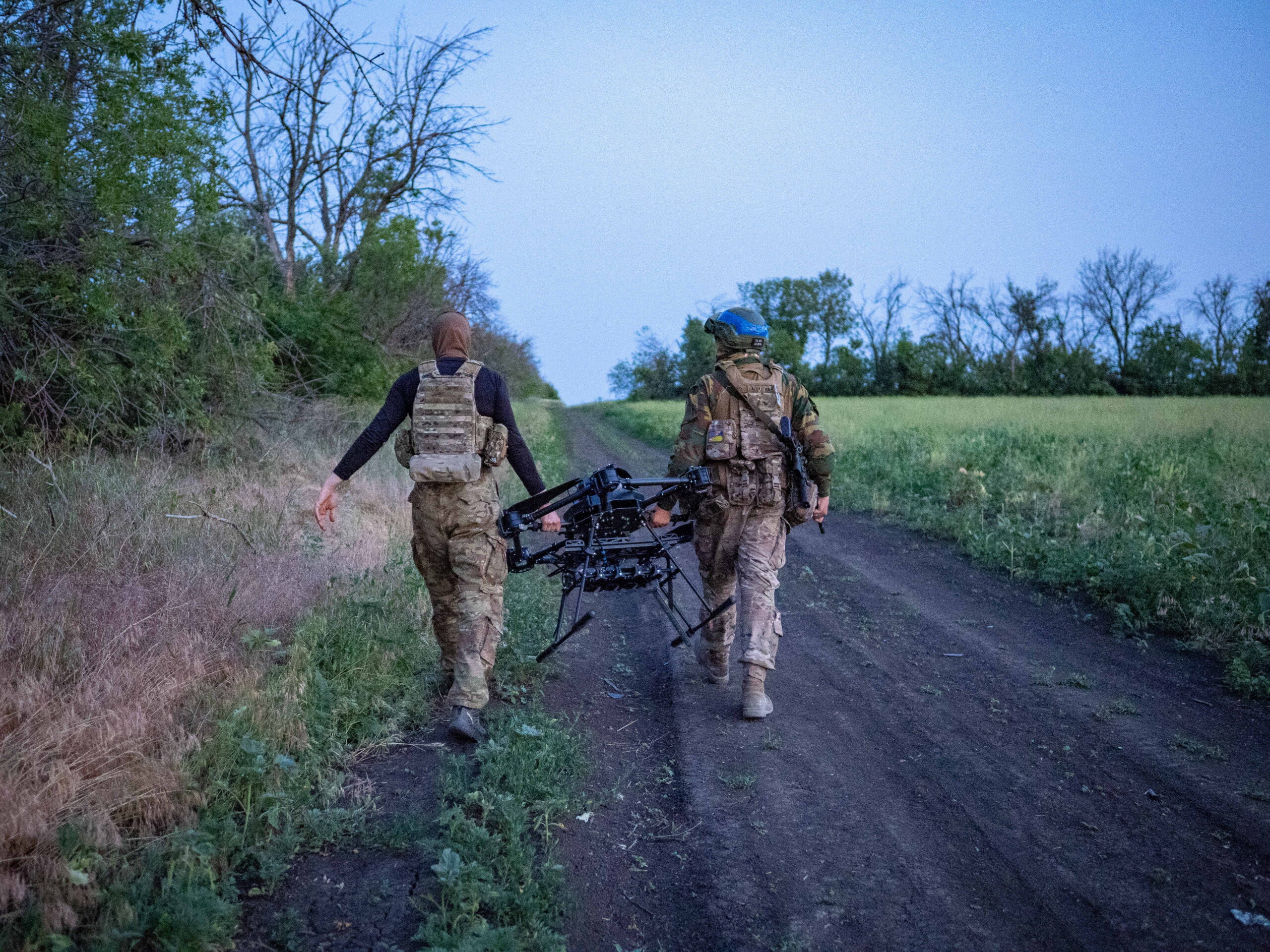
KYIV—In an age of global instability, the most important dimension is time. In Davos and throughout the continent in recent weeks, European leaders have spoken of the need for a common defense strategy. As European nations work to make this a reality, building joint investment processes in defense technology between Ukraine and the European Union (EU) is not merely desirable—it is strategically indispensable.
Europe is undergoing the deepest security reappraisal in the history of the EU. Since 2022, the continent has shed its illusions about a “stable order” and shifted into a phase of rapid rearmament. Over the past year alone, the EU has approved multiyear defense funds worth tens of billions of euros, launched new mechanisms for joint procurement and, for the first time, begun a serious conversation about defense autonomy.
This is hardly surprising: the United States continues to remind Europeans that they must be able to shoulder the burden of their own defense and rely on their own capabilities rather than await salvation from across the Atlantic. The question now is how Europeans can best accomplish this.
Europe is accelerating its defense industry but running into structural problems
Europe continues to be one of the key technological centers of the global defense industry and is actively investing in military innovation. The continent hosts both traditional defense giants and a new generation of defense-tech companies and start-ups. European states are investing in unmanned systems, cybersecurity, air and missile defense, space and sensor technologies, and artificial intelligence (AI)-driven military applications. The European Union also remains one of the world’s largest arms exporters—reaching sixty billion euros in 2024—underscoring the bloc’s industrial capacity and technological depth.
At the same time, several structural problems continue to hinder the development of Europe’s defense industry and its ability to meet new challenges. Three stand out in particular:
- Spending gaps. Against the backdrop of constrained credit and fiscal rules, EU member states together spend roughly half as much on defense as the United States does. At the same time, moving toward spending 5 percent of gross domestic product on defense would represent a genuinely revolutionary shift for Europe. A series of statements by European leaders in 2025 have made it increasingly clear that such a change in approach is becoming politically unavoidable. Securing funding is, in effect, Europe’s primary political homework assignment.
- Fragmentation of production, technologies, standards, and procurement. In his 2024 report on European competitiveness, former European Central Bank President Mario Draghi highlighted one of the EU’s core strategic weaknesses: fragmentation. By preserving the sovereignty and autonomy of member states, the EU has produced a kaleidoscope of defense approaches. Member states operate under different procurement policies and lack unified standards. This problem can’t be solved by simply increasing spending. Without common policies and standardization, Europe risks achieving lower levels of efficiency compared with other major military powers even with nominally comparable levels of expenditure.
- Heavy dependence on foreign suppliers, especially the United States. As Draghi noted in his report, “The choice to procure from the US may be justified in some cases because the EU does not have some products in its catalogue, but in many other cases a European equivalent exists, or could be rapidly made available by the European defence industry.” This dependence constrains Europe’s strategic autonomy, and it slows the development of its own industrial and technological base.
Europe’s rearmament will cost hundreds of billions of euros. Yet the critical question is not only how much money is spent or what is bought today or tomorrow. What matters most is the speed of the defense-industrial system whose development these funds are intended to support.
What is missing? Speed.
Europe still lacks an adequate answer to Russia’s drone technologies, honed through years of war. In September 2025, the intrusion of nineteen Russian drones into NATO airspace forced the scrambling of F-35 fighter jets to shoot them down, an absurdly expensive response. When unidentified drones disrupt air traffic around European capitals, nobody is certain how to react. Inevitably, attention turns east—to Ukraine, which has learned to survive in a modern drone war, repel incursions of more than seven hundred airborne targets in a single night, and strike back. All this has been achieved through military innovation. As Danish Prime Minister Mette Frederiksen said in October 2025, “The only expert right now in the world when it comes to anti-drone capacities is Ukraine, because they are fighting the Russian drones almost every day.”
Many now argue that Ukrainian unmanned technologies are precisely what Europe needs—and could become the continent’s trump card in its hybrid confrontation with Russia. “Ukraine is already helping us and teaching us how to fight the wars of tomorrow. Ukrainian drones destroy 80 percent of targets on the ground,” said Andrius Kubilius, the EU’s defense commissioner, at the Conference on Ukraine’s European Future in November 2025.
Ukraine is often described as a drone superpower: It produces four million drones a year (the United States makes less than one hundred thousand a year), fields hundreds of systems and models, and has logged thousands of confirmed drone strikes on Russian targets. With drones, Ukraine has crippled Russia’s Black Sea Fleet, damaged its strategic aviation, and now threatens one of the foundations of Russia’s power: its oil infrastructure. The low cost of Ukrainian drone technology compared with conventional weaponry greatly impresses political leaders who must approve defense budgets. But the real issue runs deeper.
Defense technologies are constantly evolving: No matter what new weapons appear on the battlefield, none of them remains decisive for long. Within months, adversaries develop countermeasures—new tactics, new technologies. Wars are won not by those with the largest arsenals or the most soldiers but by those who win this race. Europe’s true strategic problem is slowness. The main thing Europe can learn from Ukraine’s defense sector is speed.
At the strategic level, Europe can win any war or technological race—if it buys itself a faster engine.
The Ukrainian precedent: Frontline research and development as a model
This is the first war in which dual-use products—such as agricultural drones and open-source software platforms—are often more lethal than conventional weapons. It has also made one thing clear: Preparation for war must involve not only professional armies, but the entire nation. During the war, millions of civilians joined in the defense of Ukraine, bringing their own approaches and fundamentally transforming the process of developing defense innovations.
Drone production in Ukraine resembles a vast open-source frontline research and development lab. Volunteers, private firms, military units and government agencies all test, iterate, and refine designs on a weekly basis. Strike videos circulate on social media; experts debate performance; thousands of chats buzz with feedback; ideas are exchanged in kitchens, workshops, and smoking areas. This may appear absurd from the perspective of traditional military rules and procedures, but it works.
There are almost no examples of drones built by defense giants remaining effective on the battlefield for long. The reason is the slow pace of adaptation and evolution. Ukrainian drones also do not last long on the battlefield—but the best of them evolve faster than the adversary can adapt to them.
No wonder NATO Secretary General Mark Rutte remarked in October 2025 that Ukraine is “a powerhouse when it comes to innovation, insights, for example, when it comes to anti-drone technology [and] anti-cyber threats.”
European militaries do not operate this way. Yet Europe possesses a strategic advantage of its own—one it can put to powerful use.
Europe’s slow money and Ukraine’s speed
Ukraine and Europe have opposite superpowers.
- Europe is slow but has cheap, long-term capital. Slowness is, in fact, a form of trust: Investors know the rules will not change and their rights will be protected. This is precisely what Ukraine has long lacked.
- Ukraine is fast and unpredictable, but its capital is always expensive. Speed means risk, which means a high cost of capital.
Combining Europe’s capital with Ukraine’s speed and innovation would create a unique dynamic.
Investment is not merely capital; it is a way to synchronize Europe’s pace with Ukraine’s school of fast-evolving combat systems.
Europe’s future hinges on integrating Ukraine into its defense ecosystem
Europe has entered an era of rapid military evolution. Ukraine is the country of the free world that best understands what modern war looks like. This is why European Commission President Ursula von der Leyen now speaks of a new drone alliance between Ukraine and Europe. “Before the war, Ukraine had no drones. Today, Ukrainian drones are responsible for over 23 percent of Russian equipment losses, highlighting the impact of human ingenuity in open societies,” she said in September 2025.
Europe is already entering a phase of practically implementing Ukrainian defense technologies and more closely cooperating with Ukrainian defense-tech companies. This is reflected both in joint manufacturing projects and in the integration of Ukrainian solutions into European rearmament programs—from cooperation on unmanned systems and counter-drone technologies to the creation of joint research and development teams. Notable examples include initiatives to establish joint ventures with Ukrainian manufacturers, as well as growing interest from European defense-tech players in Ukraine’s combat-tested experience with AI- and network-centric solutions.
The process has already begun. Many announcements have been made about joint investments and co-development of unmanned systems between European and Ukrainian firms. More will follow. It is part of a broader shared strategy.