
Belarus dictator Alyaksandr Lukashenka released 250 political prisoners on March 19 in exchange for US sanctions relief as Washington’s efforts to revive diplomatic ties with Minsk continued. This was the latest in a series of similar agreements brokered by US President Donald Trump’s Special Envoy for Belarus John Coale, who traveled to the Belarusian capital personally to meet with Lukashenka.
“Today’s release of 250 individuals is a significant humanitarian milestone and a testament to the President’s commitment to direct, hard-nosed diplomacy,” Coale commented. In a further indication of the Trump administration’s interest in warmer bilateral relations, Coale stated that Lukashenka may soon visit Washington.
The removal of US sanctions on three major Belarusian fertilizer industry companies comes at a time when the Iran war is driving up fertilizer prices and posing threats to the global agriculture industry. Officials also discussed the possible reopening of the US Embassy in Minsk.
Lukashenka’s decision to release 250 detainees was widely welcomed. Many of those freed had been in prison since the crackdown that gripped Belarus following the country’s 2020 presidential election, which sparked unprecedented nationwide protests amid allegations of massive voter fraud. The released prisoners included Valiantsin Stefanovich and Marfa Rabkova of Belarusian human rights group Viasna, along with journalist Katsyaryna Andreyeva.
Stay updated
As the world watches the Russian invasion of Ukraine unfold, UkraineAlert delivers the best Atlantic Council expert insight and analysis on Ukraine twice a week directly to your inbox.
Under President Trump, the United States has sought a thaw with Minsk. These efforts have so far led to the release of hundreds of political prisoners and an easing of US sanctions against Belarus.
Increased engagement between the US and Belarus represents a significant change in strategy following years of growing tensions between Minsk and Western capitals. Western governments have expressed alarm over Lukashenka’s repressive domestic policies, along with his involvement in Putin’s hybrid war against Europe and his complicity in the Russian invasion of Ukraine.
The Trump administration initiative to reengage with Lukashenka has brought clear humanitarian benefits and has had a life-changing impact on released prisoners along with their families. Nevertheless, concerns remain that the current US approach risks creating incentives for the Belarusian authorities to imprison more domestic opponents.
Despite a number of large-scale releases over the past year, human rights groups claim there are still almost one thousand political prisoners in Belarus, with new names regularly being added to the list as arrests continue. Activists have likened this process to a “revolving door” of repression, with new political prisoners regularly detained as others are pardoned and released.
Eurasia Center events
Beyond the humanitarian dimension, the US diplomatic outreach to Minsk is seen as an attempt to counter Lukashenka’s near complete dependence on Moscow. Since the 2020 protest movement that almost ousted the Belarus dictator, he has been heavily reliant on Russia for his political survival. In exchange for its support, the Kremlin has sought to expand its grip on neighboring Belarus. This has led to what some have labeled as a “creeping annexation.”
Trump has sought to restart dialogue with Minsk against a backdrop of faltering US-led peace efforts to end the Russia-Ukraine War. So far, however, there is little indication that Lukashenka may be prepared to downgrade his backing for Putin’s invasion or offer any assistance to advance negotiations.
The Belarusian ruler has been a key Russian ally throughout the invasion. This support has included allowing Putin to use Belarus as a gateway for Russia’s initial attempt to seize Kyiv in 2022. More recently, Lukashenka has agreed to host Russian nuclear weapons. He is also accused of aiding Moscow’s drone attacks on Ukraine and partnering with China to produce ammunition for the Russian army.
Lukashenka may now be on track to join Putin among the criminal suspects wanted by the International Criminal Court in The Hague. On March 12, the ICC officially opened an investigation into alleged crimes against humanity committed by Lukashenka and his security apparatus against political opponents. In March 2023, the ICC issued a warrant for Putin’s arrest in connection with his alleged involvement in the large-scale deportation of Ukrainian children.
The latest Belarusian prisoner releases are an indication of improving relations between Washington and Minsk. However, it remains to be seen whether the benefits of this diplomatic outreach will extend beyond humanitarian goals and lead to broader gains in the security sphere. Lukshenka is no doubt ready to offer more pardons in exchange for economic incentives, but he has yet to demonstrate a willingness to decrease domestic repression or distance himself from the Kremlin.
Mercedes Sapuppo is a fellow at the Atlantic Council’s Eurasia Center.
Further reading

The views expressed in UkraineAlert are solely those of the authors and do not necessarily reflect the views of the Atlantic Council, its staff, or its supporters.
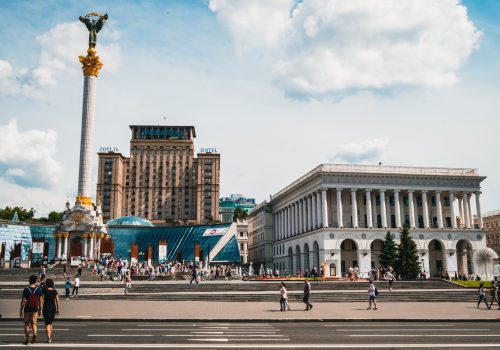

The Eurasia Center’s mission is to enhance transatlantic cooperation in promoting stability, democratic values, and prosperity in Eurasia, from Eastern Europe and Turkey in the West to the Caucasus, Russia, and Central Asia in the East.
Follow us on social media
and support our work
Image: A prisoner released from Belarus, Valiantsin Stefanovic, gestures after arriving in Vilnius, Lithuania, March 19, 2026. (REUTERS/Janis Laizans)
