
The US should rethink Iran as a Southwest Asia challenge
For decades, US policymakers have treated Iran as a Middle East problem. This made sense when Iran’s most consequential behaviors—sponsoring Hezbollah, arming the Houthis, backing Shia militias in Iraq, threatening Israel—projected toward the Levant and the Arabian Peninsula. But as Operation Epic Fury reshapes the political and security landscape inside Iran, Washington should shift its analytical lens. The better framework for understanding Iran’s future may not run west toward Baghdad, Beirut, and Damascus, but east toward Islamabad and Kabul.
This is not to deny Iran’s deep entanglements in the broader Middle East. Tehran spent decades cultivating proxy forces and predatory relationships throughout the region, and those relationships will take years to fully unwind. But on many fronts, Iran shares far more with Pakistan and Afghanistan than it does with the Arab states it has long sought to influence.
The ties between these countries are cultural: Farsi and Dari are mutually intelligible, and Persian civilization has historically extended deep into Central and South Asia. The ties are also structural: Iran’s governance is following a trajectory in which the Islamic Revolutionary Guard Corps (IRGC) is increasingly becoming the true locus of political, economic, and military power behind a clerical facade. That bears a striking resemblance to Pakistan, where the military has long dominated national life behind a civilian veneer. Additionally, the ties between these three countries are geographic: Iran’s restive eastern borderlands share more in common with the tribal peripheries of Pakistan and Afghanistan than with anything in the Arab world.
Reframing Iran as part of a Southwest Asia strategic problem, alongside Pakistan and Afghanistan, carries three major implications for US national security.
First, treating Iran as part of a Southwest Asia problem would help the United States update its assessment of the terrorist threat emanating from Iran. Iran is entering a prolonged period of internal weakness—politically, economically, and regarding its security. The degradation of central authority will create ungoverned spaces that foreign terrorist organizations will seek to exploit. Groups that once feared Iran’s security forces may now seek refuge in the country’s rural and border areas, much as al-Qaeda exploited Pakistan and Afghanistan’s tribal peripheries for decades. Iran’s restive peripheries—for example, Sistan and Baluchestan, Khuzestan, and Kurdistan—could become a contiguous arc of instability and an invitation for foreign interference.
At the same time, the terrorism threat emanating from Iran is likely to diversify. For decades, analysts largely understood the potential global terrorist threats from the IRGC’s Quds Force and Iran’s proxy network. A degraded IRGC may no longer be capable of directing sophisticated attacks abroad, but it also will not serve as the gatekeeper it once did. Iran’s security services historically worked to prevent al-Qaeda and other Sunni extremist groups from using Iranian territory as a base for external operations—not out of goodwill, but to maintain control. The security apparatus may simply stop performing that function as it reprioritizes regime survival. As Aaron Y. Zelin of the Washington Institute has written, al-Qaeda leaders, reported to be in Iran, could exploit this shift to support regional terrorist “startups” which are facing less interference than they have in years. The result: a terrorism landscape far more reminiscent of the Afghanistan-Pakistan tribal belt than of the proxy networks Washington has traditionally confronted in the Middle East.
Second, adopting a Southwest Asia framing of Iran could offer Washington lessons on how to address a weakened Iran’s nuclear ambitions. Preventing nuclear proliferation will remain a defining US interest in Iran. This is where the comparison to Afghanistan is less appropriate; however, the comparison to Pakistan becomes even more so. For several decades, US leaders from both sides of the aisle have worked to manage the challenge posed by nuclear weapons that sit in the hands of a military-dominated, politically unstable state with Islamist currents running through its security services. From addressing the A.Q. Khan proliferation network to contingency planning for loose nuclear material, the Pakistan nuclear problem has demanded a US response with a unique blend of pressure and engagement. If a weakened, IRGC-dominated Iran retains nuclear ambitions, Washington will face a dilemma Pakistan has long posed: how to constrain a nuclear program inside a fragile state resistant to traditional nonproliferation tools.
Third, treating Iran as a Southwest Asia problem would help Washington clarify the geostrategic risks of China’s ties to the region. The Iran-Afghanistan-Pakistan corridor will continue to be a critical theater of competition between the United States and China. Beijing has made deep economic investments in Pakistan through the China-Pakistan Economic Corridor, cultivated diplomatic ties with the Taliban in Afghanistan, and maintained significant energy trade with Iran. These relationships vary in character and depth, but together, they represent a potential Chinese sphere of influence along the western edge of the Belt and Road Initiative.
The United States must prioritize preventing the consolidation of these relationships. The goal need not be pulling these three countries into Washington’s orbit. That is unrealistic. Rather, the United States should work to strengthen factions within the governing elite that question or even doubt whether Beijing is a genuine partner or a predatory creditor. There are some signs this has already begun in all three countries. Ensuring that the relationships between China and these countries remain transactional rather than broadly strategic serves US interests.
None of this means abandoning the Middle East framing entirely. Iran’s sectarian influence, its relationships with Shia communities across the Arab world, and its long confrontation with Israel will remain relevant for years. But the conventional instinct to treat Iran as another Iraq or Yemen risks misallocating resources and missing the real challenges ahead. Iran’s future governance, its security threats, and its role in great power competition all point east. US policy should follow.
Mike Schoengold Beatty is a business operations lead at Palantir Technologies and a former director for Afghanistan on the US National Security Council. This article reflects views expressed by the author in his personal capacity.
Related Reading


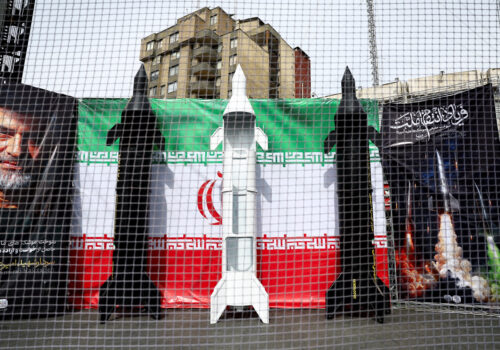
Image: Banners are displayed on a street, amid the US-Israeli conflict with Iran, in Tehran, Iran, on March 23, 2026. Photo by Majid Asgaripour/WANA (West Asia News Agency) via Reuters.