
Syria needs a trustworthy digital ecosystem to support its revival
The median age in Syria is just twenty-three. And yet, 64 percent of the population is offline. This disconnected youth population represents a massive, untapped engine for the country’s future prosperity. As it continues to reemerge from the wreckage of the Assad era, Syria now has the chance to rebuild its digital infrastructure in a way that protects users, increases access, and lays the foundation for economic and social growth.
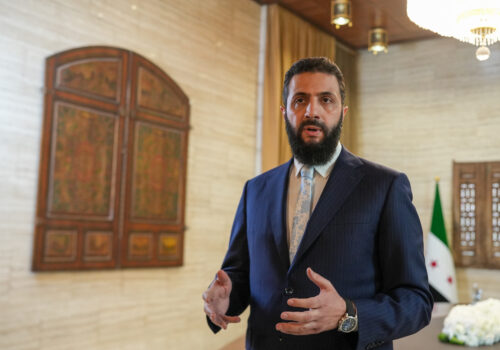
Syria’s transitional government, led by President Ahmed al-Sharaa, has been in power for a little over a year, and high-income global economies are now focusing on economic opportunities to engage in Syria. This engagement in Syria’s economic rebuild must include the development of a digital infrastructure—specifically, a reliable and accessible internet.
This is an urgent task: rebuilding a national infrastructure that connects Syria to the world, supports new industries, creates a safe environment for users, and is inclusive and accessible. In 2026, this is no longer a nice-to-have; it’s a necessity for any country hoping to grow economically.
In 2025, the lifting of major international sanctions led to the beginning of Syria’s digital revitalization. This recovery was highlighted by the return of global technology leaders such as Nokia, which partnered with the government to modernize national networks and launch trial 5G services. The recovery is anchored by the BarqNet nationwide broadband initiative and the $800 million SilkLink fiber-optic project led by Saudi Arabia’s stc Group. Furthermore, Syria’s integration into the Medusa Submarine Cable System and the Ugarit 2 link to Cyprus significantly boosted the nation’s international bandwidth and connectivity. This era is transitioning Syria from the restrictive, surveilled network of the Assad regime toward a globally integrated digital economy that will drive foreign investment and support a burgeoning domestic startup scene.
As reported in Wired, Syria’s digital fragility was exposed this year by two major incidents. In February, a wave of cyberattacks crippled the nation’s electrical, water, and communication infrastructure, slashing internet services by 75 percent and disrupting vital utilities. This was followed in March by breaches of official government accounts on X—including the central bank and presidency—which may have revealed a critical “single point of failure” in the state’s digital hygiene, as Wired put it, due to a centralized unit or shared third-party tool managing multiple government accounts. Together, these incidents demonstrate that robust digital infrastructure, digital literacy, and cybersecurity are no longer luxuries for high-income nations but fundamental requirements for national stability and economic resilience.
Trust is the primary currency of the digital age. To continue to grow economically, Syria must transition from a model of centralized control to one of distributed resilience to ensure that bad actors—whether foreign entities or ones inside the government—who hope to take advantage of, surveil, or control the Syrian people cannot paralyze the country’s trajectory toward development, economic recovery, and national stability.
Digital infrastructure is not just about cables, data centers, and cell towers; reliable, trustworthy, and accessible internet is the foundation of modern economic growth and human security, supporting national security and regional stability. To move beyond a landscape of fragmented connectivity and systemic insecurity, Syria must replace its monopolistic, surveillance-heavy framework with a decentralized, rights-based approach that prioritizes private-sector investment and data protection to foster a secure, globally integrated digital economy. While the following recommendations provide a roadmap for institutional and infrastructural reform, the integrity of any infrastructure remains contingent on the transparency of its procurement process and the safety of the technology it is built on.
Decentralize and improve access: A realistic way for Syria to transition to a distributed digital resilience model is by deploying a community-centered connectivity effort that will eliminate the single-point-of-failure risks inherent in centralized systems. The efficacy of community networks and cooperatives lies in their localized governance structures and use of context-appropriate technologies. By utilizing flexible sustainability models that prioritize local socioeconomic needs, these initiatives ensure that the digital infrastructure remains responsive to the specific priorities of the communities.
This technical decentralization must be matched by a regulatory framework that incentivizes public-private partnerships to extend safe, secure, high-speed fiber and 5G infrastructure into rural areas and refugee returnee hubs, while utilizing shared infrastructure models to allow secondary users to access spectrum that primary, large-scale operators are not using. These kinds of policies will ensure that economic recovery is inclusive around the country while building trust between the government and local communities. To safeguard this growth, Syria should adopt open-source, diverse, and interoperable hardware standards to prevent technological dependency on any one foreign vendor while simultaneously reintegrating into the global security architecture through formal intelligence sharing with international cybersecurity bodies such as the International Telecommunication Union and Forum of Incident Response and Security Teams.
Ensure trustworthy digital governance: Syria’s Electronic Personal Data Protection Law, which came into effect in January 2025, claims to protect Syrian user data, but in practice, some of the language inhibits Syria’s potential. First, there are the law’s broad “national security” exceptions and data retention mandates, which allow the government to access private information without robust independent oversight. Syria has a long history of using a State of Exception to exercise government overreach, and therefore, the new government must ensure a thoughtful balance between privacy and security. Furthermore, the inclusion of vague clauses criminalizing content that “undermines the prestige of the state” creates a form of digital self-censorship that stifles human rights, innovation, and, therefore, investor confidence. To remedy this while still protecting national security, Syria’s government should support the creation of an autonomous digital commission to oversee data privacy and prevent government internet shutdowns. Additionally, the country must legally protect the use of end-to-end encryption to safeguard privacy and intellectual property, including for journalists and civil society. Harmonizing local data laws with international standards will create a de-risked environment that will encourage global tech firms to invest.
Create capacity through digital literacy: Syria’s relatively young population can drive economic renewal if the country can develop the necessary capacity. The international community and Syrian leadership must prioritize and support the establishment of community-based digital centers—integrated into existing local institutions such as libraries and mosques—that offer basic training in computer operation, artificial intelligence, and internet safety, and that integrate basic terminology and use into schools. Further, international donors and investors should work toward long-term investments in digital capital, specifically by funding large-scale technical-vocational training programs in cybersecurity, computer science, and coding, and by integrating these subjects into university curricula. The Syrian diaspora and its organizations are eager to support these efforts and have already begun engaging with Damascus, including lobbying for US-made tech. By ensuring that young entrepreneurs are protected from both cyber threats and arbitrary state interference, Syria can transform its young population from a group at risk of brain drain into the primary engine of a sophisticated, export-oriented digital economy.
Resilient digital infrastructure now serves as the foundational nervous system for any competitive emerging economy. For Syria to rejoin the global market, it must build a network that the world—and its own people—can trust.
Nadia Farra is a nonresident senior fellow for the Syria Project in the Atlantic Council’s Middle East programs. She is a director for digital safety at KPMG and previously served as director for human rights at the National Security Council, focusing primarily on the Middle East.
Further reading

Wed, Mar 11, 2026
Is Syria on the right path?
Report By
In the year since the ouster of the Assad regime in December 2024, Syria has undergone a massive transformation. How has this played out so far?

Thu, Feb 12, 2026
A year into its post-Assad era, Syria needs a ‘rules-first’ reset
Freedom and Prosperity Around the World By Ibrahim Al-Assil
In Syria, relief coexists with unease about what comes next. How can Ahmed al-Sharaa restore a state devastated by a quarter century of authoritarianism, corruption, and civil war? Building a government and economy that work for all Syrians is the only way forward.
Thu, Jan 29, 2026
Why Syria’s government must turn inward in 2026
MENASource By Gregory Waters
Necessary domestic reforms include continued security reforms, economic development, and writing a new constitution.
Image: Recreational and educational activities offered for child visitors at the Damascus International Fair, the first edition held after the fall of the Assad regime. Photo by Mohammad Bashir Aldaher via Reuters Connect.