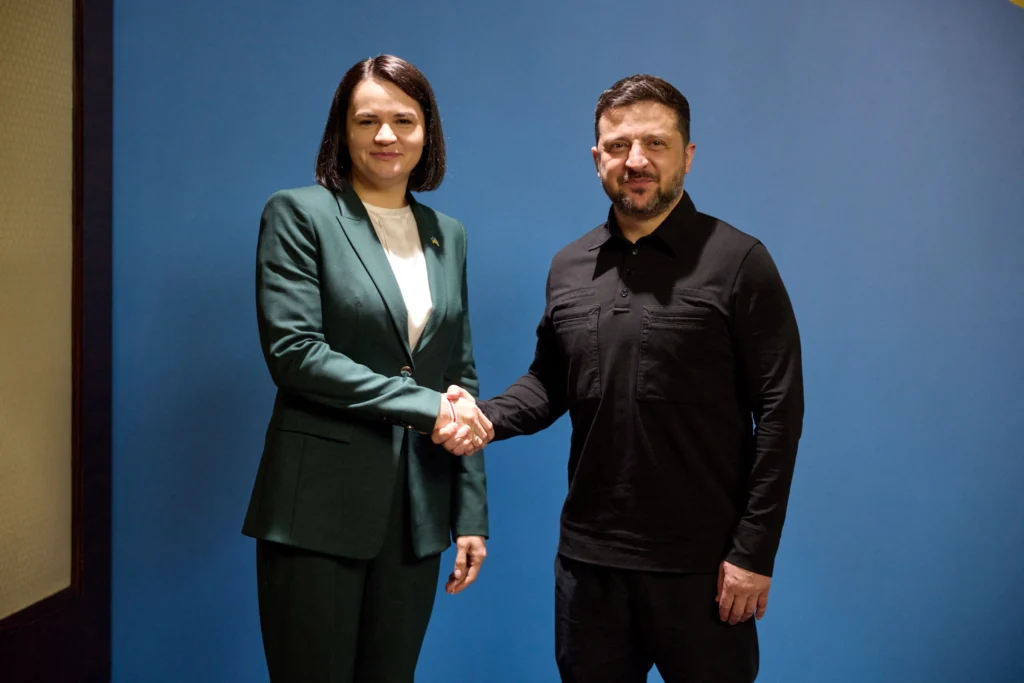
Belarusian opposition leader Sviatlana Tsikhanouskaya arrived in Ukraine this week on her first trip to the country since the onset of Russia’s full-scale invasion more than four years ago. Tsikhanouskaya’s visit represents an important milestone in Ukraine’s evolving approach toward Belarus as Kyiv monitors the country’s northern border amid concerns that Moscow is seeking to push Minsk further into the war.
“We all support the aspirations of the Belarusian people to rid themselves of Russian interference, and we know that Russia is currently trying to drag Belarus even deeper into this war against Ukraine,” commented Ukrainian President Volodymyr Zelenskyy following his meeting with Tsikhanouskaya in Kyiv.
During her visit, the Belarusian opposition leader underlined her support for Ukraine and emphasized the importance of Ukrainian victory for the wider region. “Ukraine is fighting not only for itself, but for all nations that for too long have lived under the shadow of empire. It is fighting for the right to live freely, peacefully, and with dignity. And the fate of Belarus depends on Ukraine’s success,” she stated.
Stay updated
As the world watches the Russian invasion of Ukraine unfold, UkraineAlert delivers the best Atlantic Council expert insight and analysis on Ukraine twice a week directly to your inbox.
For much of Russia’s full-scale invasion, Ukrainian policy toward Belarus has remained cautious and has been defined by immediate security concerns. Kyiv has focused on deterrence, reinforcing its northern border and avoiding any steps that could push Belarusian dictator Alyaksandr Lukashenka toward direct military involvement. As a result, engagement with the Belarusian democratic opposition has been limited and informal.
Tsikhanouskaya’s visit is a clear signal that Ukraine is now adopting a different approach. Kyiv is becoming more willing to publicly distinguish between the current Belarusian regime led by Lukashenka and the country’s aspirations for a democratic future. The Ukrainian authorities increasingly view Belarus not only as a security threat tied to Russia’s war, but also as a political space where engagement with democratic forces serves Ukraine’s long-term interests.
Several developments have since pushed Ukraine toward this new stance. Crucially, Belarus is now playing a growing role in the invasion of Ukraine and becoming more deeply embedded in Russia’s military infrastructure. Kyiv has recently accused Belarus of aiding Russian drone attacks inside Ukraine, while also warning of military preparations in the border area. Meanwhile, the Belarusian defense industry is expanding cooperation with Russia and supplying Putin’s army. Last week’s joint nuclear exercises in Belarus underscored the role of the Lukashenka regime in Russia’s saber-rattling.
European leaders are now cautioning Belarus over any moves toward more direct participation in the war. On Sunday, French President Emmanuel Macron called Lukashenka for the first time since the start of Russia’s full-scale invasion. The French leader “underscored the risks for Belarus of allowing itself to be dragged into Russia’s war of aggression in Ukraine,” according to officials in Paris.
Eurasia Center events
By engaging with the democratic Belarusian opposition, Ukraine is signaling that the country should not be written off as a Kremlin ally. This strategic shift has been underway for some months. Earlier this year, Zelenskyy and Tsikhanouskaya held their first formal bilateral meeting. Kyiv then imposed sanctions on Lukashenka, later expanding them to Belarusian defense firms and members of his inner circle.
Most recently, Ukraine appointed Yaroslav Chornohor as ambassador-at-large for engagement with Belarusian democratic forces. This appointment creates a more formal basis for relations with the Belarusian opposition that reflects Ukraine’s changing stance toward the country’s northern neighbor. While Kyiv remains focused on monitoring Lukashenka’s support for Russia’s invasion, the Ukrainian authorities are also looking ahead to a potential future democratic transition that would have major implications for regional security.
If Ukraine wants this new approach to work, it needs to invest time and resources into building the relationship. The ambassador-at-large mechanism should be reinforced through coordination across diplomacy, sanctions enforcement, security institutions, and information policy. Kyiv should also continue to draw a clear and consistent distinction between the Lukashenka regime and Belarusian society.
Ukraine is central to the region’s future, but Belarus also has a crucial role to play. A democratic Belarus would fundamentally change the geopolitical landscape across Eastern Europe. Kyiv appears to understand this. The question now is whether that awareness can lead to a sustained policy shift amid the pressures of war.
Hanna Liubakova is a journalist from Belarus and nonresident senior fellow at the Atlantic Council.
Further reading

The views expressed in UkraineAlert are solely those of the authors and do not necessarily reflect the views of the Atlantic Council, its staff, or its supporters.

The Eurasia Center’s mission is to enhance transatlantic cooperation in promoting stability, democratic values, and prosperity in Eurasia, from Eastern Europe and Turkey in the West to the Caucasus, Russia, and Central Asia in the East.
Follow us on social media
and support our work
Image: Belarusian opposition leader Sviatlana Tsikhanouskaya and Ukraine's President Volodymyr Zelenskiy shake hands while posing for a picture during their meeting, amid Russia's attack on Ukraine, in Kyiv, Ukraine. May 26, 2026. (Ukrainian Presidential Press Service/Handout via REUTERS)