
How global authoritarians sustain inequality
This issue brief is part of the Freedom and Prosperity Center’s “Voices of the Future” series, which highlights how graduate students are using the Freedom and Prosperity Indexes to explore pressing governance and development challenges across the world.
Introduction
As the world moves into the third decade of the twenty-first century, the connections between freedom and prosperity have become widely perceived as an unwritten norm. However, the common belief of the 1990s that an open market would lead to an open and free world where life would be happier and more prosperous is becoming increasingly blurred as residents of Singapore and China express high life satisfaction despite their countries’ authoritarian nature, and as citizens of Chile and Tunisia claim that life has gotten worse since democracy “opened up” society. While not fully reflecting the truth, this phenomenon exposes the existence of deeper causes, which are more than pure isolation and propaganda. This paper suggests inequality in developing states is romanticized by oppressive regimes using a “pioneer mentality” approach and enforced through existing traditionalist structures to prevent the benefits of the open market from reaching the entire public.
Defining pioneer mentality
During his famous speech to kick-start the “Reform and Openness” campaign in China, Premier Deng Xiaoping announced that the key to the plan was to “let some part of the population get rich first, which would serve as an ‘engine’ to fuel the prosperity of the society entirely.” His words echoed the “trickle-down” remark made by US President Ronald Reagan and reflected a significant aspect of elitist thinking in economic development. Those who became “richer first” were the explorers of the new “Wild West” of the twenty-first century. The new elites created by this process, thus, constructed a new social class of “pioneers.” To combat the reality of their representing the increasing economic inequality of their given states, the story surrounding these pioneers was urgently romanticized, even if that required reframing the country’s cultural traditions.
Case studies: Strategies for romanticizing pioneer mentality
People’s Republic of China
Public resentment against wealth inequality is understandable, common, and natural. An old Chinese saying warned ancient kings not to “worry about universal poverty, but the inequality in your kingdom.” Modern China opened its market and unleashed greater potential after joining the World Trade Organization in 2001, and the rapid growth of the capitalistic economy generated massive income inequality, while causing huge divisions among regions. While fancy cities like Shanghai and Shenzhen appeared on the global stage as rising urban stars, inland cities like Datong and Herbin were abandoned by progress and often fell victim to heavy pollution, unemployment, and domestic brain drain. Economic inequality soon turned into mounting political pressure. Throughout the 2000s and 2010s, China saw a sharp increase in politically motivated court cases and frequent civilian-police clashes over various grievances related to social safety, bureaucratic, and environmental issues. Both trends are considered by the regime to be an immediate threat to its survival.
In combating such threats, the regime implemented responses from two dimensions: psychological and structural. First, adding on to the promise that the growth would soon benefit more people, the Chinese state propaganda machine started framing the country’s emerging oligarchies as fighters against the Western monopoly of the market, a war against foreign imperialism, and a fight for national glory. Or in President Xi Jinping’s words, “a campaign toward the great rebirth of the Chinese nation.” Under such an ideology, the inequalities are justified as a temporary difficulty, a hardship that some people have to endure for the greater good, which will disappear once the Chinese development mode eventually lifts all citizens out of poverty. The voices that yell against the suffering are framed as breaking the harmony, a conspiracy of the West to sabotage China’s national success. The unscrupulous interpreters like Ren Zhengfei, Meng Wanzhou, or Jack Ma are pronounced national heroes; Their blatant ignorance of labor laws and mistreatment of employees melted into the overwhelming strength of the regime’s national patriotism melody.
In addition, the Chinese regime embedded the pioneer mentality through structural design. China is one of the few countries that keeps a household registry system, or what they call hukou. The system requires citizens to apply to the state administration for approval before they can move from their current address. The approval process is long and hard and often discriminates against the lower-income population. Cheap labor continues to flow into major urban areas for job opportunities generated by boosting infrastructure projects, but these people can never own a house and become city residents, even if one day they become rich enough to, at least not without official approval by hukou. For decades, hukou has effectively locked farmers to their lands and eliminated true social mobility. In other words, China has enjoyed a population de facto segregated based on region and socioeconomic condition, but successfully waived the responsibility to meet the extra demands generated by it.
Singapore
As a city-state, Singapore has long been praised for its fast development, social safety, and prosperity. However, these attributes also empower the regime to use the successful story of its development to overshadow the issue of inequality within society. Among the three most populous ethnic groups in Singapore, the minority Indians and Malays have long experienced disadvantage as well as a lack of opportunities embedded in a system designed around the Chinese demographic majority. The “CMIO” framework, which assigns every Singaporean at birth to one of four racial categories (Chinese, Malay, Indian, or other), encodes this majority into every public policy domain, from housing allocation to school placement to electoral constituencies, such that structural advantage accrues to the majority without requiring intentional discrimination by individuals. Job advertisements routinely required “Mandarin-speaking” candidates until very recently, and landlords openly refused to rent to minorities. However, the efforts of these groups to mobilize and voice their concerns are often put down by the regime’s forces in the name of maintaining social order, which has even found a supporter base within the minority groups; the desire for social stability in this case easily outweighs the pursuit of fairness.
At the same time, to showcase the benefits of order, Singapore carries out similar housing policies to those of mainland China, but under the cover of social welfare. The Ethnic Integration Policy (EIP) requires each public housing program in Singapore to adhere to racial quotas which reflects the country’s overall population mix. The EIP arrangement has made it difficult for minority groups to form communities and unite their voices in advocacy efforts. The selection pool remains limited for minorities when purchasing real estate, depressing property resale values and generating a direct economic penalty for minority groups. At the same time, the arrangement has constructed ethnic minority also as a political minority in each constituency, making it arithmetically harder to elect minority representatives, which reinforces majority political dominance without overt gerrymandering. Most importantly, however, it adds a persuasive cause to Singapore’s law-and-order narrative, which has delayed fairer distribution by recasting structural inequality as a problem of individual productivity rather than deliberate state policy.
Tunisia
In some cases, the free market’s pure liberating power appears to be/is no match for traditional social structures. In the case of Tunisia, a constitutional democratic government was successfully formed following the fallout of the Arab Spring. However, economic disparities persisted through the long-standing divisions between secular urban elites and the predominantly rural, deeply religious population. While urban areas embraced the growth and new vibe created by the opening market, the social division kept fueling irreconcilable debates in parliament and significantly killed the government’s ability to govern. Urban elites struggled to keep power and motivate the state to progress toward what they believed to be the right direction for all citizens. At the same time, the majority of the population struggles with meeting daily expenses, those who were supposed to benefit the most from the freedom were captured by the narratives of conservative, religious parties seeking to restore traditional power. The urban “pioneers” of Tunisia looked down on the rural population, reflected in the conflict between the secular party and the religious party in parliament, creating a constant source of division and resentment. Society remained polarized, with key elements like education seeing a high level of disparity, creating two almost parallel realities. The mission of freedom to bring prosperity to the state was incomplete. Eventually, it came to an unfortunate end when Kaies Saied, a rising authoritarian populist supported by the rural population, effectively dismantled the constitution in 2021.
This example shows that the transitional view of the free market’s reforming power may overestimate such power while overlooking the capacity for traditional structures to resist, especially when such structures are institutionalized and have deep historical and cultural roots in a given society, as is the case with the Islamic religious structure in Tunisia.
Chile
Finally, in the case of a relatively successful transition toward democracy and a free market, it appears that significant impediments can still be spotted that obstruct the public from receiving free-market benefits. Several historically focused research studies have touched on the stubborn resistance of the legacy of the Hispanic colonial land system, where land ownership is privatized and concentrated within a small, elite class of landowners. Monopoly of land impedes general productivity and prevents industrial investment. Under the leadership of Frei and Allende, significant efforts were taken toward land reforms and ending the legacy of colonial land monopolies. The democratic bargaining system that Chile has, however, in this case, enabled the formation of landowner interest groups to lobby against land reform efforts in the elected assembly. These elite mobilizations eventually became part of the fuel for the coup that took Allende’s life and brought General Pinochet into power. The landowners’ ownership of resources can be easily transferred into reputation and power. Scholars pointed out that the political leaders who ended the military junta, who have long been reframed and decorated as key fighters against colonialism and the “pioneering” open-minded reformers, have also trapped themselves in an “incomplete democracy”, where traditional economic elites that sided with Pinochet still largely retained their socioeconomic status. The Chilean democracy redistributed resources gained from market liberalization, not necessarily among the population in need, but based on the socioeconomic status of the population. The ineffectiveness of the democratic structure in fundamentally reforming the outdated structures, like the land ownership system, has interrupted the process of natural growth under a free market economy.
Deconstructing the “pioneer gap” using the Freedom and Prosperity Indexes
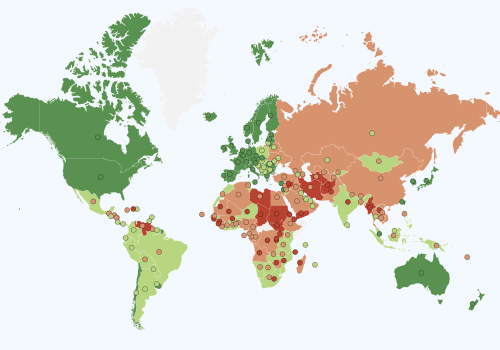
As reflected in the Atlantic Council’s Freedom and Prosperity Indexes, while a strong positive correlation is demonstrated where a higher level of freedom leads to a more prosperous state, in three of the cases above, there is a moderate yet notable gap between the countries’ Freedom Index and Prosperity Index scores. Singapore is an exception to the trend, as the city-state is able to profit from its unique geographical location, benefiting hugely from the international sea navigation tax from the Strait of Malacca, thus neutralizing its internal structural deficiencies.
In Chile, this gap is 8 (75.1 in prosperity and 83.1 in freedom); in Tunisia, 11.1 (67.2 in prosperity and 56.1 in freedom); and in China, a rather stunning 20.5 (63.4 in prosperity and 42.9 in freedom). Although these gaps are not sufficient to deny the correlation suggested by the entire Freedom and Prosperity Indexes, they do, once again, raise the question of whether the correlation can be reversed: Could prosperity then fully lead back to improvements in freedom, and do all types of freedom translate into healthy growth?
Digging deeper into the indexes for Chile, Tunisia, and China, one finds the footprints of structural “pioneer mentality,” which can be simply translated into persisting inequality. For all three cases, their inequality and minority scores are the “shortest boards” among all subcategories, and are hurting their overall index scores the most. For China, the inequality score is 56.5 compared with an income score of 68.7. In Tunisia, the minority score is the lowest of the six subindexes, at 56.1. The case of Chile is the most dramatic, where an inequality score of 47.9 stands alone, far from the average of 80.6 for the other five subindexes (73.5 in income, 93.5 in health, 76.6 in environment, 73.9 in minorities, and 85.5 in education).
The data here suggest the absence of a necessary additional mechanism within these countries where the structural inequality gap can be closed or at least reduced. When the Openness and Reform campaign began, Deng Xiaoping referred to the slogan, “the pioneers who become rich first will lead the rest to be richer later.” After four decades, the slogan remains an empty promise, as the pioneers have shown little to no intention of contributing to society with their wealth, but rather a strong desire toward solidifying their privilege.
Lessons from autocrats’ pioneer propaganda: Move beyond gross domestic product
One common observation from all four cases—China, Singapore, Tunisia, and Chile—is that they all enjoyed faster growth in gross domestic product on paper after embracing open market and economic liberalization policies. However, their experiences, as explained above, show that the growth data have not directly and naturally translated into public satisfaction, nor the “prosperity” of the state and people. While the so-called pioneers of the free market have benefited from their might, they have often grown detached from the rest of the public. This division fuels anger, distrust, and disillusionment. One key finding from these cases is that one must not automatically assume that freedom and prosperity result from open-market reforms. The reality on the ground appears to be more dynamic than anticipated by the liberation policy supporters of the 1990s during the Washington Consensus. As decades go by, it appears that the necessity of certain interventions to redistribute wealth and social resources has not yet been lost. It is crucial to realize that “there is a difference between regulation and control.”
Conclusion: Shenzhen’s European headache
In 2024, the tech companies in Shenzhen encountered a hard time after the European Union passed legislation requiring European companies to stop cooperating with foreign companies that do not abide by the labor laws of their originating states. Companies in China soon started, although unwillingly, adopting grand labor protection reforms, resulting in a great reduction in labor exploitation. This case proves that it is possible for an international commitment to be reached by balancing the gap between economic growth and economic equality with a certain level of intervention from respective authorities.
Developing markets around the world are at a crucial moment of state transformation, and they should not be required to choose from a US development model or a European one. Instead, they should adjust based on both, with the help of both.
about the author
Deng Liu is a visiting fellow at the Atlantic Council’s Freedom and Prosperity Center and a graduate student in the Democracy and Governance program at Georgetown University.
explore the data
stay connected
explore the program
The Freedom and Prosperity Center aims to increase the prosperity of the poor and marginalized in developing countries and to explore the nature of the relationship between freedom and prosperity in both developing and developed nations.
Image: South Bridge Road, Buddha Tooth Relic Temple, Singapore. March 22, 2021. Bing Hui Yau/UNSPLASH.

For the latest updates, follow us on social media with #FutureOfDemocracy