
With its foreign assistance review, the Trump administration has thrown the fate of the Millennium Challenge Corporation, a critical US foreign-development-aid agency, into uncertainty.
But the fact of the matter is that the MCC works, particularly because of its unique model, in which it uses scorecards to select countries for financing. Such scorecards ultimately incentivize countries to make reforms that are in the US interest. I’ve seen it with my own eyes when I was the US ambassador to Côte d’Ivoire.
To be eligible for an MCC grant program, known as a compact, a country must receive a passing grade on MCC’s annual scorecard. Such scorecards have typically consisted of twenty indicators of good governance, but newly updated scorecards measure countries against twenty-two such indicators. The information that is used to determine each indicator comes from third parties, so it’s not enough for a regime to have good bilateral relations with Washington. And a country can never rest on its laurels: To pass an indicator, a country must not only reach a certain absolute score, it must also do better than half of its comparator countries. Thus, it is possible to pass an indicator one year, then improve one’s absolute score the next year and still fail the indicator because other countries improved even more.
Then to secure a compact, an eligible country must present a compelling proposal. Such grants can amount to hundreds of millions of dollars over five years, tailored by the host country in close consultation with MCC to have a transformative impact on the economy.
Whether or not a country secures a compact, passing the scorecard makes a country a better place and more attractive to investors in general. It should be self-evident that it is in the interest of the United States for countries around the world to be governed on a sound basis and be more prosperous, better able to afford American goods and services.
When I was ambassador to Côte d’Ivoire between 2019 and 2023, I witnessed how the MCC inspires improved governance. President Alassane Ouattara has a PhD in economics from the University of Pennsylvania and had served previously as deputy managing director of the International Monetary Fund. He understood very well that in order to progress, a country needs investment, and that investors will only consider spending their money if they are optimistic that the future will be bright enough that their expenditure will yield dividends in years to come. A bright future, as wise leaders understand, depends on political and social stability, as well as predictability and fairness in the legal system.
When Ouattara officially took office in 2011, Côte d’Ivoire was nowhere near being able to pass the MCC scorecard. But Ouattara made it a priority for his government to pass the scorecard. It did so within just a few years, such that by the time I arrived, Côte d’Ivoire had not only attained eligibility but succeeded, through painstaking negotiation, in obtaining a compact whose budget ceiling eventually rose to more than $536 million over six years. (A one-year extension was granted due to the worldwide disruptions caused by the COVID-19 pandemic.)
During my tenure as ambassador, I watched Côte d’Ivoire graduate from lower-income to lower-middle-income status. This put it in a more competitive group, so it was no surprise that in its first year in that group, it did not pass the scorecard. MCC proved very understanding, keeping faith with its partner, and Côte d’Ivoire rose to the challenge, soon passing the scorecard at this more demanding level.
In my interactions with successive prime ministers and ministers responsible for managing the relationship with MCC, I emphasized that perceptions matter, whether you agree with them or not. Scorecard results are publicly available and are a handy resource for potential investors. Tempting as it may be to quibble with subjective evaluations of indicator performance, it is more fruitful to address the country’s perceived deficiencies. To their credit, my interlocutors took the point.
For example, in 2021, I pointed out to a senior Ivoirian official with direct access to the president that, despite gaining dozens of places in Transparency International’s Corruption Perceptions Index since Ouattara took office, Côte d’Ivoire was still not in the top one hundred countries (it was 105th, up from 130th in 2012). I know that sank in, because about half-an-hour later, toward the end of our conversation, the official repeated it back to me. And less than two years later, just as I ended my tour, Transparency International published its annual ranking, with Côte d’Ivoire ranked ninety-ninth. In the latest index, Côte d’Ivoire had risen to seventy-sixth.
There is no question that Côte d’Ivoire’s success over the last fifteen years has been aided by the guidance and incentive provided by the MCC scorecard; senior Ivoirian leaders readily acknowledged that to me. And now, despite the Trump administration’s scaling back of the MCC, Côte d’Ivoire has secured another compact with potential funding of up to $300 million. The Trump administration and its successors should continue to make good use of the MCC globally, given its proven effectiveness as a valuable tool of foreign policy.
Richard K. Bell is a nonresident senior fellow with the Atlantic Council’s Africa Center. He served as the US ambassador to Côte d’Ivoire from 2019 to 2023.
Related Reading
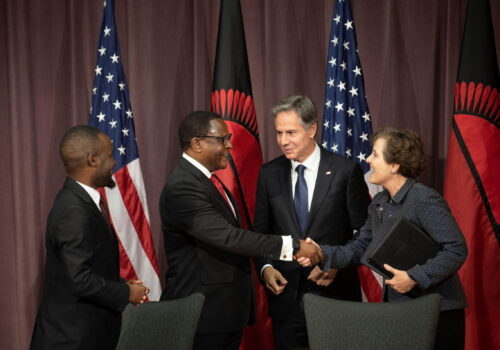

Image: US Millennium Challenge Corporation CEO Jonathan Nash and President of the Ivory Coast Alassane Ouattara sign a new compact at the US Department of State in Washington, DC on November 7, 2017. Photo by IMAGO/piemags via Reuters Connect.