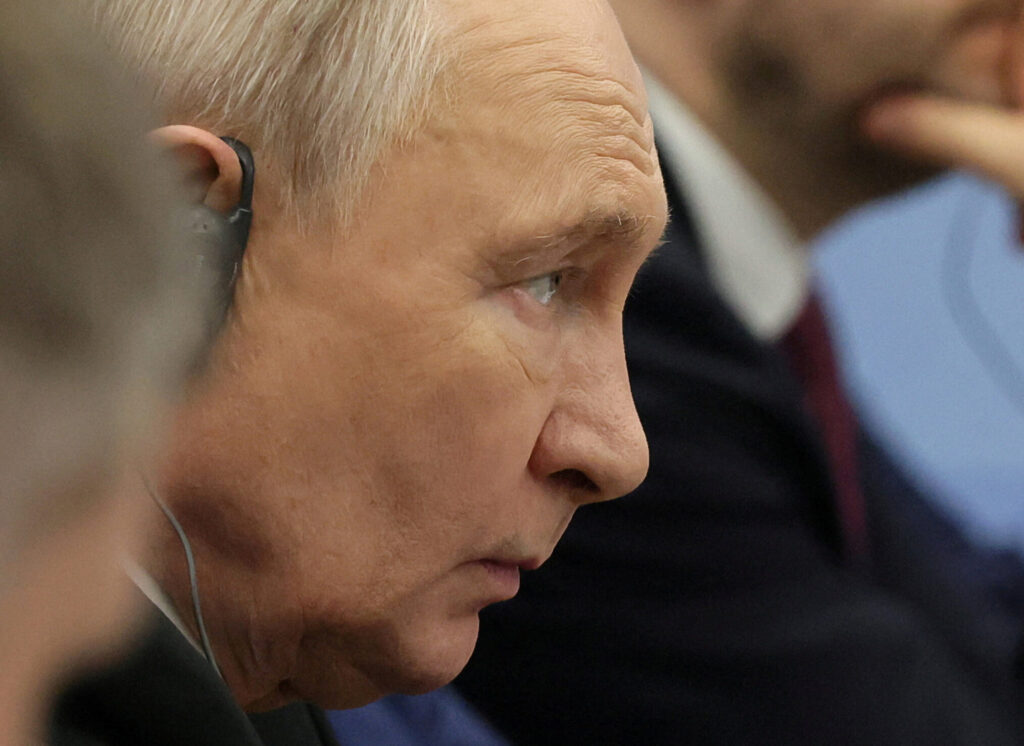
While Western leaders continue to speculate over a possible compromise peace between Moscow and Kyiv, Russian President Vladimir Putin makes no secret of the fact that he remains fully committed to the so-called “denazification” of Ukraine. Speaking at Russia’s flagship St. Petersburg International Economic Forum in early June, Putin once again expressed confidence that all of Russia’s war aims in Ukraine would be achieved, including the “denazification” of the country.
Putin’s determination to “denazify” Ukraine makes a mockery of efforts to portray the Russian invasion as a mere land grab. It also helps to explain why there has been no meaningful progress toward a negotiated settlement to end the war despite more than a year of US-led peace initiatives. While US President Donald Trump has at times approached the peace process as a geopolitical real estate deal, it should by now be obvious that Putin is not fighting for additional territory in Ukraine and seeks to erase Ukrainian statehood altogether.
Russian attempts to smear Ukrainians as “Nazis” are not new and can be traced directly back to the Kremlin’s World War II propaganda depicting Ukrainian anti-Soviet fighters as fascists. This trend continued throughout the Cold War period and became deeply embedded in the Russian public consciousness, with the “Nazi” slur routinely applied to anyone advocating for an independent Ukrainian state or opposing the comprehensive russification that took place in Ukraine under Soviet rule.
Putin has resurrected the “Nazi Ukraine” myth in the modern era and has used it as convenient cover for his escalating crusade to extinguish Ukrainian independence. During the early years of Putin’s reign, he appears to have reached the conclusion that the reconquest of Ukraine was essential in order to reverse Russia’s imperial retreat and reclaim the superpower status that had been lost amid the humiliations of the Soviet collapse.
Ever since, the Kremlin propaganda machine has relentlessly demonized Ukrainians as Nazis and equated Ukrainian patriotism with fascism in order to delegitimize independent Ukraine and set the stage for the subsequent subjugation of the country. When columns of Russian tanks rolled across the Ukrainian border on February 24, 2022, Putin duly proclaimed “denazification” as the primary goal of the invasion.
Stay updated
As the world watches the Russian invasion of Ukraine unfold, UkraineAlert delivers the best Atlantic Council expert insight and analysis on Ukraine twice a week directly to your inbox.
The true meaning of Putin’s “denazification” soon became all too apparent. In the weeks following the onset of the full-scale invasion, a number of articles appeared in the Kremlin-controlled Russian state media spelling out the chilling reality that “denazification” actually meant “de-Ukrainianization” and the disappearance of Ukraine as an independence nation. This was a logical continuation of Putin’s own frequently voiced insistence that Ukrainians are Russians (“one people”), and his claim on the first day of the invasion that Ukraine is an “inalienable part” of Russia’s own history, culture, and spiritual space.
On the ground in Ukraine, the actions of Russia’s invading army have closely mirrored Putin’s genocidal anti-Ukrainian language. In areas of Ukraine seized by the Kremlin since 2022, the Russian occupation authorities have systematically sought to erase all traces of Ukrainian statehood, language, culture, and national identity, while detaining and imprisoning anyone who may potentially object. United Nations investigators have classified these mass arrests as a crime against humanity.
Putin’s “denazification” narrative has been widely embraced by domestic Russian audiences, but the international community has been notably less enthusiastic. Politicians and academics alike have denounced the Kremlin’s efforts to hijack memories of the World War II struggle against Adolf Hitler, while institutions including the Auschwitz Museum and United States Holocaust Memorial Museum have publicly condemned Russia’s claims as false.
Even Putin’s most vocal supporters in the West have been reluctant to endorse the “Ukrainian Nazis” narrative. In the wake of his 2024 interview with Putin, US media personality Tucker Carlson dismissed the Russian ruler’s talk of Ukrainian Nazis as “one of the dumbest things I’ve ever heard.” Carlson is well known for uncritically amplifying Kremlin propaganda, but he clearly felt obliged to distance himself from Putin’s Nazi slurs. “It’s a way of calling people evil. I thought it was childish,” he commented.
Eurasia Center events

The Kremlin’s attempts to portray modern Ukraine as a Nazi state are not supported by anything approaching credible evidence, and have instead focused almost exclusively on World War II collaboration between Ukrainian insurgents and invading German forces. In reality, the available data confirms that far-right political parties have never been popular among Ukrainian voters. A cursory examination of the country’s last election cycle prior to the full-scale invasion of 2022 makes this abundantly clear.
The presidential and parliamentary elections of 2019 took place at a time when Ukraine had already been at war with Russia for five years. Thousands had been killed and millions displaced, with the Russian threat looming large over the entire campaign. Despite these extreme conditions, Russian-speaking Jewish candidate Volodymyr Zelenskyy won the presidency by a landslide.
The fate of the country’s nationalist candidates is even more revealing. Frustrated by years of ballot box rejection, Ukraine’s many far-right political parties agreed to form a coalition for the summer 2019 parliamentary elections and attempted to campaign under a unified banner. Despite this unprecedented consolidation, they received just 2.15 percent of the vote and fell well short of the threshold to enter parliament.
The consistent electoral failure of Ukraine’s far-right politicians has created a major propaganda challenge for the Kremlin. How do you depict your enemies as Nazis when they vote overwhelmingly for the Jewish candidate and reject nationalist parties? Moscow has responded by cranking up the propaganda and plunging deeper into the unsavory world of anti-Semitic conspiracies.
In the spring of 2022 as the world struggled to digest the sheer scale of Russia’s invasion, Italian journalists asked Russian Foreign Minister Sergei Lavrov how it was possible for Ukraine to be a Nazi state if the country had a popularly elected Jewish leader. Lavrov replied to this logical question by claiming that Hitler also had “Jewish blood.” His shameful response provoked international outrage and required Putin’s personal intervention to repair relations with Israel. This embarrassing incident served to highlight the absurdity of Moscow’s efforts to justify a war of aggression based on groundless claims of an imaginary Nazi threat.
There are many reasons for concluding that Putin has no interest in peace. His endless stalling tactics during US-led negotiations are an obvious giveaway, as are his frequent attempts to introduce new demands and his periodic suggestions that Zelenskyy lacks the legitimacy to sign any peace deal. But the clearest signal of all is Putin’s continued insistence that Ukraine must be “denazified.”
Anyone with even basic knowledge of Russian sensibilities will confirm than no Kremlin leader could hope to make peace with opponents they had first branded as Nazis. On the contrary, the repeated use of this extraordinarily inflammatory language is an unmistakable declaration of a holy war that by definition must be fought to a victorious conclusion. Putin’s undiminished commitment to “denazifying” Ukraine reflects his implacable opposition to Ukrainian statehood and his conviction that Russia must regain control over the country in order to revive its own greatness. Until he is forced to abandon these imperial ambitions, any talk of a compromise peace is delusional.
Peter Dickinson is editor of the Atlantic Council’s UkraineAlert service.
Further reading


The views expressed in UkraineAlert are solely those of the authors and do not necessarily reflect the views of the Atlantic Council, its staff, or its supporters.
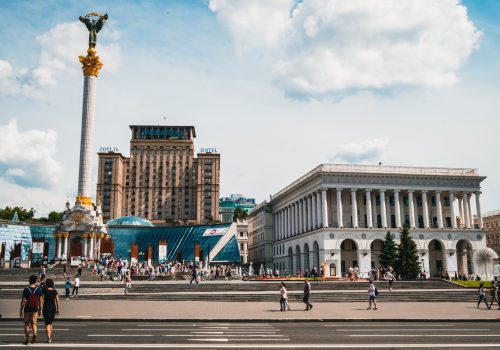

The Eurasia Center’s mission is to enhance transatlantic cooperation in promoting stability, democratic values, and prosperity in Eurasia, from Eastern Europe and Turkey in the West to the Caucasus, Russia, and Central Asia in the East.
Follow us on social media
and support our work
Image: Russia's President Vladimir Putin attends a meeting with Timor-Leste's Prime Minister Kay Rala Xanana Gusmao on the sidelines of the Russia-ASEAN Summit in Kazan, Russia. June 18, 2026. (REUTERS/Anastasia Barashkova/Pool)