In February 2022, Russian President Vladimir Putin thought the full-scale invasion of Ukraine would be a short, victorious war. More than four years on, he now finds himself confronted by a formidable and innovative adversary capable of striking back deep inside Russia. An invasion that aimed to “demilitarize” Ukraine has instead transformed the country into one of Europe’s leading military powers.
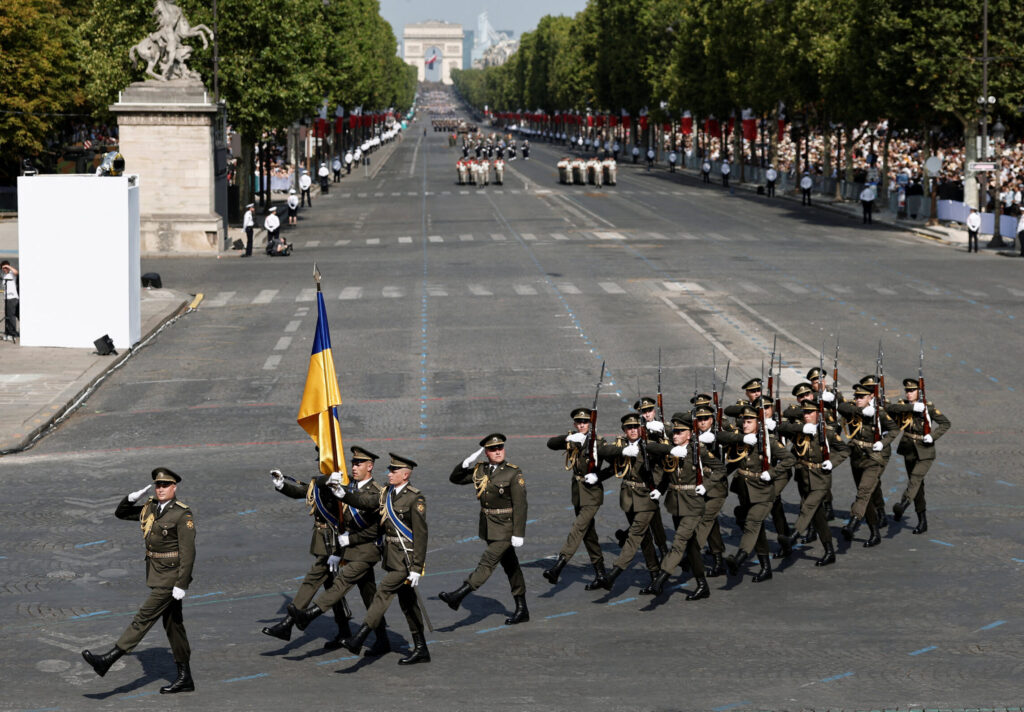
This new security reality was evident on July 14 in Paris as Ukrainian troops took part in the annual Bastille Day parade for the first time. The Ukrainian contingent received the loudest cheers of the day from the French public at an event that aimed to underline Ukraine’s status as Europe’s first line of defense.
Ukraine’s remarkable rise to military prominence confirms the old adage that necessity is the mother of invention. Unable to compete with Russia’s overwhelming advantages in terms of manpower and conventional firepower, Ukraine has spent the past four years pioneering a range of new tactics and technologies that are changing international understanding of how modern wars are fought.
Throughout this period, Ukrainian innovations have made it possible to maintain a technological advantage over the country’s far larger enemy, forcing Russia to adapt repeatedly. In many cases, Moscow has copied Kyiv’s battlefield tactics, but Russia’s highly centralized military bureaucracy has meant that Putin’s army often struggles to innovate at the same pace.
In contrast, Ukraine has fostered a startup culture throughout the country’s vibrant and rapidly expanding defense tech sector that benefits from close cooperation with front line military units. This has made it possible to dramatically cut development cycles. Danish Prime Minister Mette Frederiksen is one of multiple European leaders to acknowledge that Ukraine is now producing weapons “faster and cheaper” than anywhere else in Europe.
Stay updated
As the world watches the Russian invasion of Ukraine unfold, UkraineAlert delivers the best Atlantic Council expert insight and analysis on Ukraine twice a week directly to your inbox.
Ukraine’s innovative use of drones has been the single most striking aspect of the country’s military transformation. Just four years ago, Ukraine possessed only a handful of domestic drone manufacturers. Today, it is rapidly becoming the world’s largest producer of combat drones.
Independent estimates cited by the Kyiv Post indicate that Ukraine will manufacture between five and six million drones in 2026. Ukrainian President Volodymyr Zelenskyy has said the country aims to produce around ten million drones annually, while other Ukrainian officials believe production capacity could eventually reach twenty million with sufficient investment.
Drones are now the dominant force on the battlefield, accounting for more than three-quarters of all Russian losses. At sea, Ukrainian marine drones have forced the Russian Black Sea Fleet to retreat from occupied Crimea, leading to talk of a new era in naval warfare. Ukraine is also increasingly fielding an army of robots to support ground operations and reduce the risk to front line troops.
A growing arsenal of domestically produced long-range drones is enabling Kyiv to wage a strategic bombing campaign deep inside Russia targeting the Kremlin war machine. Meanwhile, a new generation of AI-enabled drones are allowing Ukraine to engage targets with increasing autonomy while bypassing Russian electronic warfare capabilities.
Eurasia Center events

Ukraine’s emergence as a drone superpower is making the country an important contributor to transatlantic security. In recent months, Kyiv has established a series of joint production agreements for drones and ground robots with allies across Europe and beyond. Ukrainian specialists are also training NATO armies on the realities of drone warfare.
This represents a major shift in the relationship between Ukraine and the country’s Western allies. For years, Ukrainian military personnel looked to NATO for instruction and sought to adopt standards established by the Alliance. Today, these roles have undergone a partial reversal. Indeed, during the past year, Ukrainian drone units participating in joint military exercises have repeatedly exposed the vulnerability of NATO forces to drone warfare.
In addition to drones, Ukraine’s advantages include advanced software and an unrivalled collection of raw data covering everything from battlefield operations to air defense activity. This is helping accelerate the adoption of artificial intelligence tools across the Ukrainian military, with over two hundred Ukrainian companies currently working on AI-related drone tech.
AI-enabled battlefield software now integrates intelligence, weather, flight planning, and air defense information into a constantly updated operational picture. This allows commanders to learn from every mission and adapt rapidly to the fast-changing realities of the modern battlefield.
The Ukrainian military is one of only two armies in the world today with years of experience fighting a large-scale conventional war in conditions of constant drone surveillance. The other is the Russian army. This underlines the importance of Ukraine for the future defense of Europe. As European leaders prepare for a long-term confrontation with the Kremlin while adjusting to a reduced US security commitment, drone superpower Ukraine has an obvious and critical role to play.
David Kirichenko is an associate research fellow at the Henry Jackson Society.
Further reading


The views expressed in UkraineAlert are solely those of the authors and do not necessarily reflect the views of the Atlantic Council, its staff, or its supporters.


The Eurasia Center’s mission is to enhance transatlantic cooperation in promoting stability, democratic values, and prosperity in Eurasia, from Eastern Europe and Turkey in the West to the Caucasus, Russia, and Central Asia in the East.
Follow us on social media
and support our work
Image: A contingent of Ukrainian soldiers march during the annual Bastille Day military parade on the Champs-Elysees avenue in Paris, France. July 14, 2026. (REUTERS/Benoit Tessier)