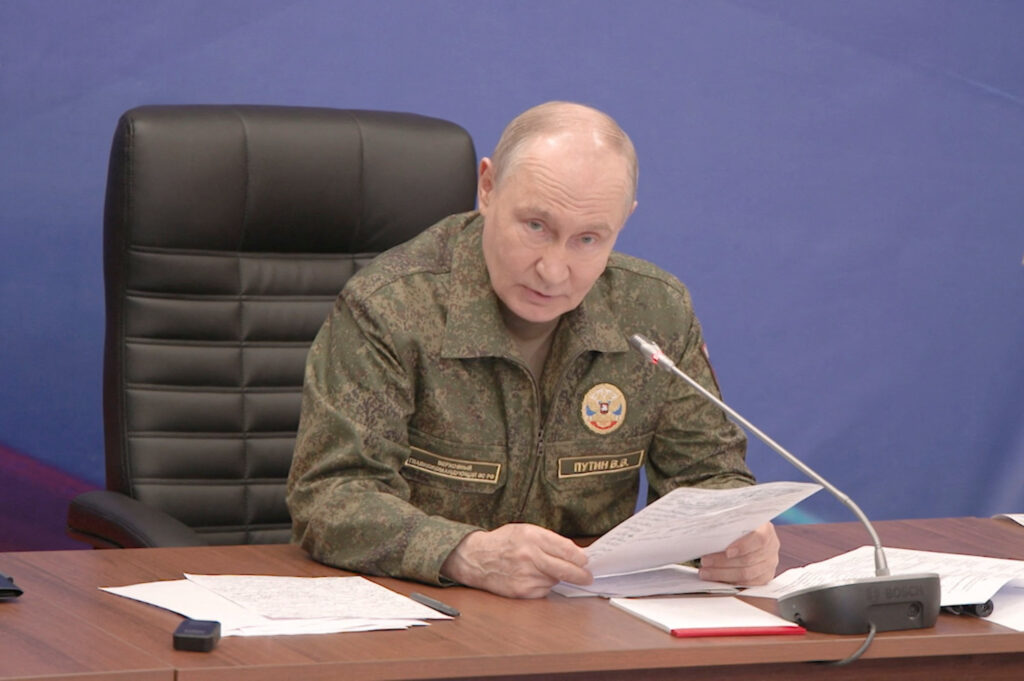
In recent months, it has become increasingly apparent that the tide may be turning in the Russia-Ukraine War. On the battlefield, Russia is struggling to advance while suffering heavy casualties. Beyond the front lines, innovative Ukrainian drone tactics are disrupting the logistics of the invasion, blockading Russian-occupied Crimea, and sparking a major fuel crisis inside Russia itself.
Meanwhile, Moscow is now also struggling to maintain the steady flow of volunteers it needs to replenish the depleted ranks of the Russian army in Ukraine. Faced with these mounting difficulties, Russian President Vladimir Putin is reportedly mulling a mass mobilization as he seeks to regain the initiative and rescue his invasion.
A mass mobilization would be a huge gamble for Putin. Since the start of the full-scale invasion more than four years ago, he has worked hard to shield ordinary Russians from the impact of the war. In exchange, Putin has expected them to refrain from opposing or criticizing his invasion. Any attempt to conscript large numbers of Russians would shatter this unspoken social contract and could potentially destabilize the home front.
Stay updated
As the world watches the Russian invasion of Ukraine unfold, UkraineAlert delivers the best Atlantic Council expert insight and analysis on Ukraine twice a week directly to your inbox.
Putin is well aware of the risks involved. He knows that disgruntled Russian conscript soldiers were instrumental in the unrest that led to the fall of the Tsarist Russian Empire in 1917, and personally witnessed how anger over Soviet conscript losses in Afghanistan during the 1980s contributed to the collapse of the USSR.
With this in mind, Putin has sought to make sure that those fighting and dying in Ukraine arouse minimal public sympathy. Initially, this meant focusing Russian military recruitment efforts among ethnic minorities and prison inmates. More recently, the Kremlin has concentrated on attracting volunteers by offering exceptionally large enlistment bounties and high salaries.
These policies have proved very effective but may no longer be enough. With volunteer numbers dwindling and the supply of prisoners virtually exhausted, Putin now finds himself in a challenging position. He knows that unless Russia can somehow maintain its manpower advantage on the battlefield, the invasion of Ukraine will devolve into a bloody quagmire. However, he continues to dismiss any talk of concessions and refuses to lower his political ambitions. Everything therefore points to a large-scale mobilization in the coming months.
Mobilization is not the only option currently available to the Russian leader. However, alternatives such as an attack on NATO or some other form of unconventional escalation are arguably even riskier. With his invasion now in very real danger of failing, the one thing Putin can no longer afford to do is kick the can down the road and delay difficult decisions.
Eurasia Center events
Many of the technical requirements for a mass mobilization are already in place. In recent years, Russia has established a comprehensive electronic registry of those eligible for military service and can theoretically send out draft notices immediately following any decision from the Kremlin.
Official confirmation of a mass mobilization is unlikely to come before Russia’s September 2026 parliamentary elections. While the outcome of these elections is a foregone conclusion, Putin has a record for using rigged votes to set the stage for unpopular public announcements.
There is little doubt that a mass mobilization would be deeply unpopular. The response to Putin’s earlier mobilization in September 2022 was overwhelmingly negative, with up to a million military-age men fleeing the country. At a time when war-weariness is already on the rise in Russia, any new mobilization would almost certainly be met by widespread criticism and resistance.
None of this will be sufficient to dissuade Putin. The Russian dictator has tied his entire legacy to the invasion of Ukraine and remains committed to erasing Ukrainian statehood altogether. He has underlined this uncompromising stance by repeatedly rejecting proposals for a negotiated peace settlement, despite the Kremlin-friendly terms suggested by US President Donald Trump.
Ultimately, the most important question is not if a mass mobilization is imminent, but whether it could actually succeed in winning the war. Any Russian mobilization would prolong the invasion and lead to more bloodshed. This would suit Putin, who believes he has no choice but to fight on while hoping for an eventual collapse in Western support for Ukraine.
However, even Putin must realise that adding more men to his invasion force will not be enough to regain the initiative. The war between Russia and Ukraine is the most technologically advanced military confrontation in history, with a battlefield increasingly dominated by drones and robots. It cannot be won simply by throwing more bodies into the meat grinder.
In reality, any Russians mobilized to join Putin’s invasion in the coming months face the prospect of becoming cannon fodder for Ukrainian drones. A mass mobilization will cause more death and devastation, but it is unlikely to decide the outcome of the war.
Mykola Bielieskov is a research fellow at the National Institute for Strategic Studies and a senior analyst at Ukrainian NGO “Come Back Alive.” The views expressed in this article are the author’s personal position and do not reflect the opinions or views of NISS or Come Back Alive.
Further reading

The views expressed in UkraineAlert are solely those of the authors and do not necessarily reflect the views of the Atlantic Council, its staff, or its supporters.

The Eurasia Center’s mission is to enhance transatlantic cooperation in promoting stability, democratic values, and prosperity in Eurasia, from Eastern Europe and Turkey in the West to the Caucasus, Russia, and Central Asia in the East.
Follow us on social media
and support our work
Image: Russian President Vladimir Putin visits a command post of Russia's joint force grouping, in the course of the Russia-Ukraine conflict, at an unidentified location, in this still image taken from video released July 3, 2026. (Kremlin.ru/Handout via REUTERS)