Russian dictator Vladimir Putin no longer holds the initiative in the war against Ukraine, Ukrainian President Volodymyr Zelenskyy told Fox News during last week’s visit to the United States. Numerous fellow European leaders seem to share Zelenskyy’s optimistic assessment. “Ukraine’s position is stronger than ever since the war began,” Finnish President Alexander Stubb commented in recent days.
Ukraine’s progress offers a rare window of opportunity to increase the pressure on Putin and create the conditions for a negotiated end to Europe’s largest war since World War II. However, this window is likely to prove temporary. Kyiv’s European partners must therefore seize the moment and demonstrate that they are capable of acting decisively on the international stage by increasing support for Ukraine.
The last real chance for Ukraine to end the war came in the final weeks of 2022. The success of Ukraine’s Kharkiv counteroffensive and the liberation of Kherson had allowed Kyiv to gain the battlefield initiative, leaving Putin’s retreating army in a state of demoralized disarray. The war appeared to be entering a decisive phase, with Ukraine poised to defeat Russia’s invasion. At this critical moment, Kyiv’s Western partners lost their nerve. Their fear of escalation handed Putin a lifeline.
Western caution meant that Russia was able to regroup, mobilize additional manpower, expand defense production, and construct extensive fortifications. By the time Ukraine launched a major offensive the following summer, Russia had recovered and the chance had passed. As the tide of war turns once again in Ukraine’s favor, European leaders must now avoid repeating the mistakes of 2022.
Stay updated
As the world watches the Russian invasion of Ukraine unfold, UkraineAlert delivers the best Atlantic Council expert insight and analysis on Ukraine twice a week directly to your inbox.
Since the start of the current year, there have been growing indications that the initiative has passed from Russia to Ukraine. Along the front lines of the war, the Russian army has struggled to advance throughout 2026 while suffering record casualties. Although Moscow can still call on significant manpower reserves, Putin is currently believed to be losing more men in Ukraine than he can realistically recruit without ordering a politically risky mass mobilization.
Ukraine’s position is also visibly improving beyond the battlefield. The country’s rapidly evolving domestic drone industry has made it possible to launch a highly effective campaign of mid-range strikes against Russian logistics. This is disrupting the invasion and isolating occupied Crimea.
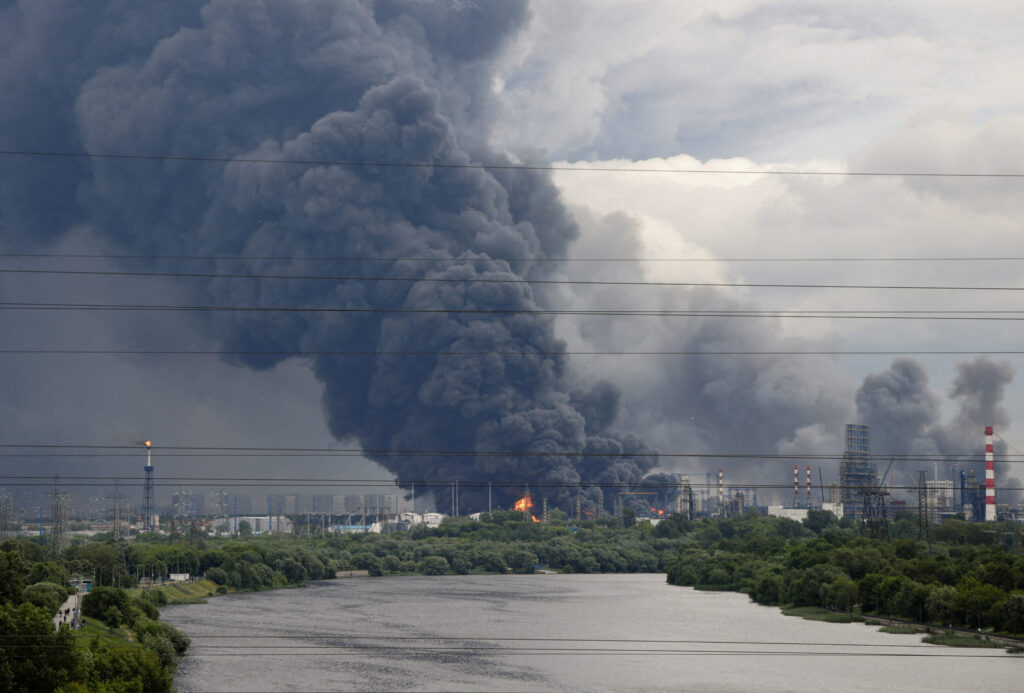
In parallel, expanding long-range Ukrainian drone strikes against military and industrial targets deep inside Russia have sparked a fuel crisis and brought the invasion home to the Russian public. Reports of new attacks and images of burning Russian refineries have become a routine feature on Russian social media. Ukraine is also targeting Russian shipping with increasing success in a bid to starve the Kremlin of vital export revenues.
Together with the cumulative effect of international sanctions, these Ukrainian strikes are creating mounting difficulties for the Kremlin war effort while also threatening to destabilize the domestic situation inside Russia. This has led to increasingly upbeat assessments of Ukraine’s prospects. In order to take full advantage of Putin’s current predicament, however, Ukraine will need more support from the country’s allies.
Eurasia Center events

The United States under President Trump remains an indispensible partner, particularly in terms of intelligence sharing and advanced technological support. However, it has been clear since early 2025 that the current US administration is no longer prepared to carry the primary burden for sustaining Ukraine’s war effort. Instead, Europe must continue to increase support.
Priorities include addressing Ukraine’s manpower constraints. European governments should reconsider longstanding restrictions on financing military personnel costs. With Ukraine’s national budget under extraordinary strain, meaningful reforms aimed at improving military recruitment, retention, and mobilization require substantial additional resources to fund competitive salaries and incentives for service.
Supporting these costs should be viewed as an investment in European security rather than as budgetary assistance to Ukraine alone. Additional funding for expanded training missions, specialized programs for drone operators and electronic warfare specialists, rehabilitation initiatives, and battlefield medical support would all further strengthen Ukraine’s military position.
Another crucial element is support for Ukraine’s defense sector. Rather than relying primarily on weapons transfers from existing stockpiles, European governments should expand the use of EU mechanisms to provide predictable, long-term funding for Ukrainian defense production. Ukraine has already demonstrated its ability to innovate and manufacture at speed, but still lacks sufficient resources to scale up output.
Europe should also grant Ukraine privileged access to critical technologies including advanced electronics, cloud-computing infrastructure, artificial intelligence tools, and communications systems. In many cases, the obstacle is not technological scarcity but regulatory barriers and export control regimes designed for peacetime conditions rather than a major European war.
Industrial integration is equally important. Ukrainian defense companies should be incorporated into European procurement frameworks, joint ventures, research programs, and supply chains. Combat-proven Ukrainian systems should gain accelerated access to European markets through streamlined certification procedures. Europe clearly has much to offer Ukraine, but Ukraine also has much to offer Europe.
Psychological resilience should also become part of Europe’s support strategy. After more than four years of full-scale war, combat stress, trauma, and post-traumatic stress disorder are no longer individual challenges but strategic issues. Europe possesses world-class expertise addressing mental health and rehabilitation. Integrating these capabilities into Ukraine’s military recovery system would strengthen the long-term resilience of the country just as surely as ammunition or equipment supplies.
Finally, Europe must preserve political unity while increasing the cost of aggression for Moscow. That means stronger enforcement of existing sanctions, tighter controls on sanctions circumvention networks, and a more coordinated effort to counter Russian influence operations abroad.
It also requires a serious information strategy. Europe possesses enormous analytical, media, and technological resources, yet Russian disinformation continues to undermine public support for Ukraine. Europe must not only defend itself against hostile narratives, but actively challenge the legitimacy of Russian aggression and the narratives that sustain it, both inside and outside Russia.
Taken together, these measures would amount to something more significant than support for Ukraine. They would represent European strategic agency. For years, European leaders have spoken about strategic autonomy and Europe’s emergence as a serious security actor. The coming months may provide the clearest test yet of whether those ambitions are realistic.
Lesia Ogryzko is director of the Sahaidachnyi Security Center in Kyiv.
Further reading


The views expressed in UkraineAlert are solely those of the authors and do not necessarily reflect the views of the Atlantic Council, its staff, or its supporters.

The Eurasia Center’s mission is to enhance transatlantic cooperation in promoting stability, democratic values, and prosperity in Eurasia, from Eastern Europe and Turkey in the West to the Caucasus, Russia, and Central Asia in the East.
Follow us on social media
and support our work
Image: Thick plumes of smoke with flames rise from an oil refinery following a Ukrainian drone attack in the course of Russia-Ukraine conflict, in Moscow, Russia, June 18, 2026, in this picture obtained from social media. (SOCIAL MEDIA/via REUTERS)