Russian President Vladimir Putin’s hopes of capturing eastern Ukraine’s Donbas region have been dealt a major blow in recent months by a groundbreaking Ukrainian offensive that has reversed over a year of Russian territorial gains. This latest battlefield success has served to showcase the Ukrainian military’s tactical innovations and continued mastery of drone warfare.
Ukraine’s counteroffensive, dubbed “Operation Vivaldi,” has focused on the Lyman sector of the front in the east of the country. This area has seen some of the most intense fighting of the entire invasion as Putin looks to achieve his minimal war aim of seizing Ukraine’s Donbas region. For the past year, Russia has been attempting to conduct a giant encirclement of the fortress belt cities that make up the remaining Ukrainian-held territory in the region. However, Ukraine’s recent success has now effectively blunted the northern wing of this attempted pincer movement.
Stay updated
As the world watches the Russian invasion of Ukraine unfold, UkraineAlert delivers the best Atlantic Council expert insight and analysis on Ukraine twice a week directly to your inbox.
Details of Ukraine’s progress have only been made public in recent weeks, reflecting the strict operational silence that has surrounded the months-long offensive. While reports of Ukrainian advances had been circulating online for some time, official confirmation did not come until September 15. Since then, Ukrainian commanders have been carefully rationing the release of further information about the ongoing operation.
A picture is now emerging of a sophisticated Ukrainian offensive that offers important insights into the rapidly evolving nature of combat operations in an era of drone warfare. Maintaining an element of surprise was crucial. Ukrainian forces claim to have created what commanders describe as an electronic warfare “curtain” that managed to prevent Russian reconnaissance drones from penetrating key areas of the front while concealing Ukrainian movements.
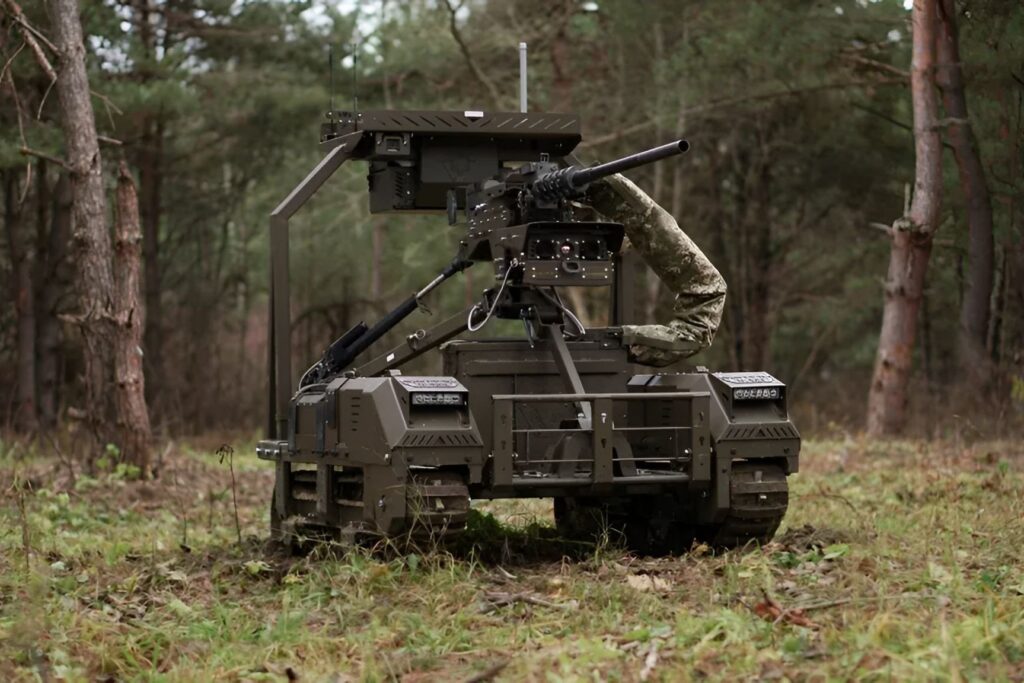
With Russia’s battlefield surveillance capabilities significantly reduced, Ukraine was able to deploy large bomber drones to transport unmanned ground vehicles (UGVs) behind enemy lines. These remote-controlled robots were armed with heavy machine guns or loaded with explosives, causing havoc deep in the Russian rear and creating the conditions for infantry advances. In many cases, Russian forces appear to have been taken completely by surprise, with one officer in an intercepted conversation expressing his disbelieve that Ukrainian robots had been able to penetrate so far.
Ukraine also extensively employed mid-range drone strike capabilities to isolate targeted Russian units and cut logistics routes supplying front line positions. In early September, Ukrainian officials claim to have forced a unit of Russia’s elite Rubicon drone formation to retreat after inflicting heavy casualties and destroying drone launch sites, ammunition depots, and logistics.
In addition to shaping offensive operations behind the Russian lines, Ukrainian forces have also employed unmanned ground vehicles in de-mining operations to clear pathways and prepare the ground for coming advances. This has made it possible to protect lives at a time when the Ukrainian military faces severe manpower strains while defending against a far larger adversary.
Eurasia Center events

Ukraine’s counteroffensive has been inadvertently assisted by the tendency of Russian commanders to exaggerate their front line progress, with the success of Operation Vivaldi exposing the gap between these overly optimistic reports and battlefield realities. Russian commanders routinely falsify reports to their seniors in order to gain favor or avoid reprimand, leading to a culture of dishonesty that creates a distorted picture of the combat zone and often leaves Russian troops dangerously exposed.
This problem was illustrated in early September when Putin publicly announced the capture of Sviatohirsk on the Lyman front. Within days, Ukraine had posted video evidence demonstrating that the city remained firmly in Ukrainian hands and was in fact far behind the front lines. This embarrassing episode has sparked heated debate among Russian war bloggers over the need for more honest reporting among front line officers.
The effectiveness of the tactical and technological innovations employed during Operation Vivaldi have undermined earlier assumptions regarding the impracticality of large-scale offensive operations amid the rise of drone warfare. If the lessons learned on the Lyman front can be scaled and implemented across the Ukrainian army, this could provide Ukraine with a model for restoring limited maneuver across drone-dominated battlefields.
Ukraine’s robot offensive is not a decisive breakthrough, but it has succeeded in significantly disrupting Putin’s plan to complete the conquest of the Donbas. Crucially, Operation Vivaldi also sends a powerful message to Moscow and to Kyiv’s partners that the highly innovative Ukrainian military remains capable of defeating Russia on the battlefield.
David Kirichenko is an associate research fellow at the Henry Jackson Society.
Further reading


The views expressed in UkraineAlert are solely those of the authors and do not necessarily reflect the views of the Atlantic Council, its staff, or its supporters.


The Eurasia Center’s mission is to enhance transatlantic cooperation in promoting stability, democratic values, and prosperity in Eurasia, from Eastern Europe and Turkey in the West to the Caucasus, Russia, and Central Asia in the East.
Follow us on social media
and support our work
Image: DevDroid/Cover Images via Reuters Connect