
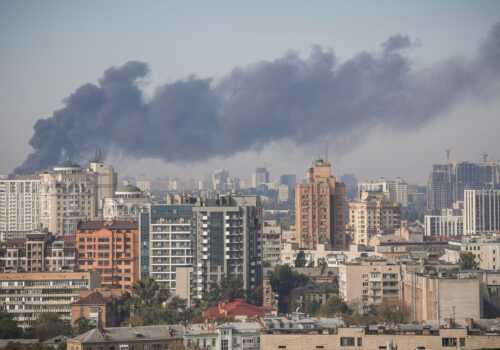
Bombing civilians does not win wars. Striking non-military targets creates humanitarian disasters and severely damages the perpetrator’s international standing, but it also cannot typically secure victory. And yet since the onset of Russia’s full-scale invasion of Ukraine in 2022, the Russian military has repeatedly targeted everything from schools, hospitals, and residential buildings, to shopping centers and power plants.
Russian attacks on the Ukrainian civilian population have escalated significantly during 2026. According to the latest United Nations data, 2,570 Ukrainian civilians were killed and 15,211 injured during the first nine months of 2026. This represents a 59 percent increase on the figure for the previous year.
There may be military reasons behind this expansion of Russian attacks on Ukraine’s civilian population. The front lines of the invasion have barely moved since the start of 2026, with Ukraine actually regaining territory in certain sectors. In contrast to the first years of the invasion, the Kremlin’s own territorial gains have been tiny, even as the costs have ticked higher. With little prospect of a battlefield breakthrough, escalating attacks on civilian infrastructure could seem like the most realistic strategy to break Ukraine’s national resistance.
The diplomatic situation is similarly stalemated. While Ukraine has offered a number of concessions including acceptance of the current front lines as the basis for a future settlement, Kyiv refuses to hand over additional land that Moscow has so far been unable to seize militarily. With this in mind, the Kremlin may view strikes on civilian targets as a tool to increase the diplomatic pressure on the Ukrainian authorities.
Ukraine is certainly suffering from Russia’s mounting missile and drone bombardment. These attacks kill and injure large numbers of Ukrainian civilians, and cause significant economic damage, forcing businesses to shutter, preventing ports from operating, and closing down entire industrial plants. However, this strategy is not without costs. Russia is currently depleting its own missile and drone stockpiles in a campaign that has done nothing to change the territorial balance or force Ukraine to capitulate.
Why, then, does Moscow continue to expand a strategy that appears to deliver so little toward Russia’s overall war aims? While the decision to bomb civilian targets may stem from military or diplomatic calculations, there could also be a domestic dimension to Russia’s air offensive. By bombing Ukrainian civilians, Russia can create the illusion of military progress for a domestic audience that expected a quick victory and is instead confronted by a brutal war of attrition.
Stay updated
As the world watches the Russian invasion of Ukraine unfold, UkraineAlert delivers the best Atlantic Council expert insight and analysis on Ukraine twice a week directly to your inbox.
On the surface level, the way the Russian leadership describes the rationale behind airstrikes on Ukrainian cities is rather straightforward. Attacks are framed either as retaliation or as preventative strikes on targets that can in some way be linked to the Ukrainian military.
Nevertheless, the current bombing campaign often raises more questions than answers. Some members of Russia’s vocal online war blogger community have expressed confusion about how targets are selected, calling the process “a real mystery” and suggesting decisions are based on the principle of “well, we have to hit something.”
A closer look at how these strikes are portrayed and discussed across Russia’s traditional and social media landscapes suggests that attacks on civilian targets may strengthen key Kremlin messages. Strikes on civilian infrastructure can cause highly visible damage, which is then touted in Russian news and media sources as evidence of military might. Mainstream media and social media platforms frequently echo and amplify each other.
Government accounts also play an important role. Throughout August, the official Telegram channel of Russia’s Defense Ministry made a series of posts celebrating the bombardment of Ukraine’s cities and civilian infrastructure. Typical messages included “there are enough missiles and drones for everyone.” These posts were widely shared on Russian social media.
One prominent recent Russian Defense Ministry post mockingly promised to “freeze” the war during the coming winter months, a direct reference to Russia’s attempts to spark a humanitarian crisis by bombing Ukraine’s heating and power networks ahead of the cold season. This messaging, which unambiguously endorsed the targeting of Ukraine’s civilian population, proved extremely popular with Russian social media users; the post was viewed more than 650,000 times and attracted tens of thousands of approving responses.
Eurasia Center events

While there is no way to determine beyond doubt the exact motivation behind Russia’s bombing campaign against Ukrainian civilians, furnishing visual evidence of military strength is clearly an important element of the country’s political and military culture. In the current context, attacks on Ukrainian cities help to maintain the impression that Russia retains the initiative, while also supporting the narrative of “inevitable victory” promoted by Russian President Vladimir Putin.
This has become even more important over the past year as Ukrainian drones have begun reaching Moscow, St. Petersburg, and cities deep inside Russia with growing frequency. Footage of smoke billowing over Russia’s biggest cities following Ukrainian attacks has undermined Kremlin attempts to portray the invasion of Ukraine as a success. Meanwhile, fuel shortages across the country have highlighted Ukraine’s ability to bring the war home to Russia, leading to grumblings of discontent.
Against this troubling backdrop of limited battlefield progress and expanding Ukrainian strikes inside Russia, the bombing of Ukraine’s cities serves a domestic political purpose even if it does little to turn the tide of war. Russia is therefore likely to continue escalating the current campaign of attacks on Ukraine’s population and civilian infrastructure. This will create the spectacle of military agency while also undermining the basis for everyday life in Ukraine’s major cities.
Russia’s bombing campaign is causing extreme distress and hardship to the Ukrainian civilian population, but it appears unlikely to prove militarily decisive. The full impact of Russian drone and missile strikes on civilian infrastructure will only be possible to assess in the years to come, when today’s war will hopefully be long over. For now, the attacks allow the Kremlin to terrorize ordinary Ukrainians and render much of the country unlivable, while serving a propaganda purpose on the home front.
Anton Ponomarenko is a Nonresident Kelly Fellow at Pacific Forum and an Emerging Scholar Fellow at the Stimson Center’s 38 North. His research focuses on Russia’s foreign policy, and his work has appeared in War on the Rocks, 38 North, The Diplomat, and more. Dr. Syrus Solo Jin is the Elihu Rose Scholar of Modern Military History at New York University and a historian of US foreign policy and military affairs, with a forthcoming book on US global power military activities in Cold War Asia.
Further reading


The views expressed in UkraineAlert are solely those of the authors and do not necessarily reflect the views of the Atlantic Council, its staff, or its supporters.


The Eurasia Center’s mission is to enhance transatlantic cooperation in promoting stability, democratic values, and prosperity in Eurasia, from Eastern Europe and Turkey in the West to the Caucasus, Russia, and Central Asia in the East.
Follow us on social media
and support our work
Image: Emergency services carry a casualty on a stretcher as they work to rescue residents from under the debris at the site of an apartment building which was hit by a Russian missile strike in the town of Pryluky, amid Russia’s attack on Ukraine, in the Chernihiv region, Ukraine. October 7, 2026. (REUTERS/Valentyn Ogirenko)