
US President Donald Trump renewed calls for a change in Ukraine’s leadership on Monday as his war of words with Ukrainian counterpart Volodymyr Zelenskyy continued to intensify. “I think it’s time for somebody else to negotiate on behalf of Ukraine,” Trump stated in Washington DC following criticism from Zelenskyy over the US leader’s decision to ease sanctions pressure on Russia.
These latest comments followed on from Trump’s recent accusation that Zelenskyy “doesn’t want to end this war,” and his suggestion that Ukraine should get a new president “who can make a deal.” Many of Trump’s most prominent supporters have backed his hardening stance toward the Ukrainian leader. “And so the slaughter continues. Time for Zelenskyy to go,” Elon Musk wrote on October 15.
The US President’s attacks on Zelenskyy closely mirror Russia’s own position. Speaking last week in Moscow, Kremlin spokesperson Dmitry Peskov said Russia was “in complete agreement” with Trump regarding the Ukrainian head of state. Days later, Russian Foreign Minister Sergei Lavrov declared that Zelenskyy “obviously has no desire even to move towards reaching an agreement.”
This is nothing new. Since the early stages of the invasion, Moscow has consistently sought to position Zelenskyy as an obstacle to peace, with Russian dictator Vladimir Putin repeatedly questioning the legitimacy of the Ukrainian president and pointing to the absence of democratic elections in wartime Ukraine. “You can negotiate with anyone, but because of his illegitimacy, Zelenskyy has no right to sign anything,” Putin stated last year.
Stay updated
As the world watches the Russian invasion of Ukraine unfold, UkraineAlert delivers the best Atlantic Council expert insight and analysis on Ukraine twice a week directly to your inbox.
It is not difficult to debunk portrayals of Zelenskyy as the main obstacle to peace. In reality, the Ukrainian leader has agreed to every single ceasefire proposal put forward by the American side, while Moscow has rejected them all. Crucially, he has offered major territorial concessions that would allow Russia to retain control over almost a quarter of Ukraine. Zelenskyy has also repeatedly declared his readiness to meet face-to-face with Putin anywhere in the world to negotiate an end to the war, only for the Russian ruler to firmly decline. It should be clear to any objective observer that Ukraine’s wartime leader is actively seeking pathways to peace.
Trump and Putin’s over-emphasis on Zelenskyy’s personal role in the Ukrainian war effort reveals a fundamental failure to grasp what Ukrainians are actually fighting for. Many in the White House and the Kremlin appear to believe that the removal of Zelenskyy would somehow pave the way for a Russia-friendly peace. This is delusional. Ukrainians are not fighting for Volodymyr Zelenskyy. They are fighting for national survival.
Recent polling indicates strong Ukrainian public support for Zelenskyy, suggesting that he would be very likely to win a wartime election. But even if Zelenskyy was ousted, it is virtually impossible to imagine any replacement emerging with a mandate to make peace on Russian terms. While most Ukrainians favor a negotiated settlement of some kind, surveys indicate strong opposition to any peace deal that fails to provide Ukraine with long-term security or potentially sets the stage for further Russian aggression.
This uncompromising stance reflects widespread Ukrainian perceptions of the current war as an existential struggle that will determine whether Ukraine continues to exist as a state and as a nation. Most Ukrainians are in no doubt that Putin ultimately intends to destroy their country, and regard Western talk of limited Russian territorial ambitions as hopelessly naive. They have grown accustomed to the genocidal anti-Ukrainian messaging that dominates wartime Russia’s public discourse, and take it for granted that the Kremlin’s end goal is a Ukraine without Ukrainians.
Eurasia Center events
Ukrainians have reached this chilling conclusion based on years of bitter experience. Long before Putin launched the invasion of Ukraine with the 2014 seizure of Crimea, he was already notorious for insisting that Ukrainians were in fact Russians (“one people”). Since the outbreak of hostilities, Putin’s rhetoric has grown ever more extreme. On the eve of the full-scale invasion, he published a 5,000 word history essay that read like a declaration of war against Ukrainian statehood. He routinely describes the occupied regions of Ukraine as “historically Russian lands,” and boasted last year that “all of Ukraine is ours.”
Putin’s obsession with the destruction of Ukraine has set the tone for the entire invasion. Wherever Russian troops have established control, the occupation authorities have sought to erase all traces of Ukrainian language, history, culture, and identity. For the past two years, international human rights watchdog Freedom House has ranked Russian-occupied Ukraine as “the least free place on earth.”
Throughout the occupied regions, thousands of Ukrainian civilians have been detained and imprisoned in a campaign of mass arrests that UN officials have classified as a crime against humanity. Those who remain face ruthless russification in every sphere of daily life and are forced to accept Russian citizenship. Meanwhile, a whole generation of Ukrainian schoolchildren living under occupation are being stripped of their nationality and indoctrinated to celebrate the invasion of their own country.
Ukrainians know what is happening in the occupied territories and are under no illusions about the fate that awaits them if Russia is not stopped. Twenty percent of Ukraine is already being subjected to a form of brutal national identity erasure that may qualify as genocide. If Putin is able to extinguish Ukrainian independence and install a puppet regime in Kyiv, there is every reason to assume that the Kremlin’s actions in the remaining 80 percent of the country will be just as severe.
This understanding of Russia’s genocidal intentions is one of the key factors driving Ukraine’s much-hyped resilience. Ukrainians are not superheroes with special powers of endurance. They are ordinary people who recognize that they are facing an extraordinary threat.
After almost five years of staggering sacrifice and unimaginable trauma, most Ukrainians are utterly exhausted. And yet somehow they fight on. Putin’s well-documented determination to wipe Ukraine off the map leaves them with no real choice but to keep resisting until the Russian dictator is finally forced to acknowledge the impossibility of conquering their country.
Trump and Putin are deeply mistaken if they think replacing Zelenskyy would change anything. Ukraine’s struggle for national survival reflects the will of millions and does not depend on any one man. This struggle will continue, regardless of who holds the office of the presidency.
Peter Dickinson is editor of the Atlantic Council’s UkraineAlert service.
Further reading


The views expressed in UkraineAlert are solely those of the authors and do not necessarily reflect the views of the Atlantic Council, its staff, or its supporters.
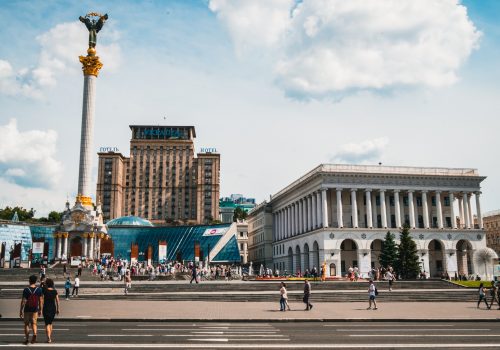

The Eurasia Center’s mission is to enhance transatlantic cooperation in promoting stability, democratic values, and prosperity in Eurasia, from Eastern Europe and Turkey in the West to the Caucasus, Russia, and Central Asia in the East.
Follow us on social media
and support our work
Image: October 16, 2026, Donetsk Region, Ukraine: A soldier from a separate task force rifle battalion of the National Police of Ukraine in the Zaporizhzhia region holding a remote controller stands in the field near a GARA UAV in the Donetsk region, Ukraine, October 16, 2026. The GARA drone is a Ukrainian fixed-wing unmanned aerial vehicle with vertical take-off and landing (VTOL) capability, equipped with artificial intelligence features. It is used for aerial reconnaissance, fire adjustment, and as a strike UAV. (Credit Image: © Dmytro Smolienko/Ukrinform via ZUMA Press Wire)