In the Iran crisis, the IMF’s voice is urgently needed
Three weeks into the most significant disruption to global energy markets since the 1973 oil embargo, the International Monetary Fund (IMF)—the institution created to safeguard the stability of the international monetary system—has yet to provide a clear, comprehensive view of the economic fallout.
Policymakers around the world, market participants, and the general public would all benefit from the IMF’s insights into the unfolding Iran crisis and the consequences of Tehran’s de facto blockade of the Strait of Hormuz. After all, the institution has unmatched access to financial markets, central banks, and finance ministries around the world.
So far, however, the Fund has issued only a few statements. On March 3, it said that it was “closely monitoring developments,” and Managing Director Kristalina Georgieva—speaking during a trip to Asia—urged countries to “think about the unthinkable and get ready for it.” Yesterday, an IMF spokesperson provided estimates for the impact of oil prices should they remain elevated for a year and raised concerns about economically vulnerable countries.
Real-time shocks, delayed insights
To be fair, IMF staff may already have shared preliminary analyses with the IMF Executive Board, which includes both a US and an Iranian representative, and they are now busy rewriting the World Economic Outlook (WEO) to account for recent developments.
However, this highlights a structural challenge.
The IMF’s multilateral surveillance is constrained by its standardized reporting frameworks. By the time the WEO and the Global Financial Stability Report (GFSR) are published in mid-April, their forecasts will already lag behind unfolding developments. An alternative forecast derived from quantitative macro models was helpful after the April tariff announcements last year, but policy recommendations often remain too broad to inform decision-making amid fast-moving crises like the Iran war.
The IMF’s current model leans toward achieving a consensual point forecast, which makes it more difficult to anticipate sudden turning points. The WEO, for instance, not only underestimated the 2022 inflation surge—as did the Fed and other major institutions—but also overestimated the pace of the post-COVID recovery.
From rearview mirror to forward radar
The developments in the Strait of Hormuz underscore the need for the IMF to pivot toward real-time, scenario-driven foresight that anticipates shocks and guides coordinated responses.
This is not only due to geopolitical uncertainty. Geoeconomics itself has moved to center stage, as economic dependencies are increasingly weaponized by conflict parties. At the same time, global repercussions may also push them toward negotiations if the indirect costs become too painful even for the aggressor to bear.
The IMF should therefore reorient its surveillance around scenarios, financial transmission maps, and actionable policy options—delivered when needed, not on a semiannual schedule. This should be accompanied by regional, if not country-specific, vulnerability assessments, policy toolkits for affected economies, and analysis of how shocks ripple through real and financial channels, along with an assessment of mitigating factors.
Simultaneously, the IMF should expand its capacity to identify material dependencies, supply chain vulnerabilities, and geoeconomic chokepoints.
This would transform the Fund from a recorder into a radar, scanning for spillovers before they cascade. The budgetary resources for this shift exist; what’s needed is redeploying or rehiring analytical talent, as headcounts in the IMF’s macroeconomic workstreams have dwindled in recent years.
Producing analysis within days, not weeks
In a world where economic and geopolitical shocks move at the speed of missile strikes and oil futures, this will require the IMF to move beyond its traditional reporting framework. It should develop a rapid-response, integrated surveillance capacity capable of producing and publishing reports within days of a major disruption, not weeks.
Moreover, the teams producing the WEO and GFSR should be fully integrated—a long-standing point of contention within the IMF. The October 2025 WEO projected steady global growth of 3.3 percent in 2026, highlighting the resilience of the AI-driven investment boom and the fading drag from US tariffs. By contrast, the October 2025 GFSR cautioned that “beneath the calm” significant vulnerabilities remain: stretched asset valuations, sovereign bond market pressures, growing interconnectedness between banks and nonbank financial institutions, and the opacity of a shadow banking sector that now holds roughly half the world’s financial assets.
While analyzing the same global economy, the WEO saw resilience and the GFSR saw fragility. The integrated picture—that a geopolitically triggered energy shock could simultaneously slash growth forecasts and trigger disorderly financial corrections—was left for the reader to piece together.
Similarly, no single IMF product currently connects the dots between oil supply shocks, emerging-market inflation, risk repricing, strain on leveraged nonbank intermediaries, and feedback into sovereign and banking systems. But such integrated analysis is exactly what the Fund’s 190 member countries should expect.
A moment tailored for the IMF
Beyond operational reforms, IMF shareholders should allow space for candid analysis of developments in systemically important economies and the global economy as a whole. They should hold management accountable for protecting the independence of its technical staff and enable swift Executive Board discussion of staff analysis, allowing only factual corrections.
Members with direct Executive Board representation bear special responsibility. Many represent systemic economies and must lead by example, refraining from influencing country teams and avoiding interference with specific risk assessments or policy recommendations
They would do well to heed the recommendations of several recent US administrations to have the IMF focus on “core macroeconomic issues” in line with its original mandate. An oil shock that threatens to reignite global inflation and tip energy-importing developing countries into crisis is exactly the kind of macroeconomic issue the institution should be able to handle.
The IMF was founded in the wreckage of a world war, by statesmen who understood that economic instability and geopolitical conflict feed on each other. Eighty years later, a new war is producing exactly the type of economic shock the institution was built to diagnose and mitigate. The IMF’s staff have the expertise do so—and its member countries have a strong interest in timely analysis.
The Executive Board should therefore encourage—and management should aim to provide—a comprehensive, integrated macrofinancial assessment of the Iran war’s economic fallout and likely scenarios, with clear and actionable policy recommendations well before the April meetings. The world cannot afford to wait.
Martin Mühleisen is a nonresident senior fellow at the Atlantic Council’s GeoEconomics Center and a former International Monetary Fund (IMF) official with decades-long experience in economic crisis management and financial diplomacy.
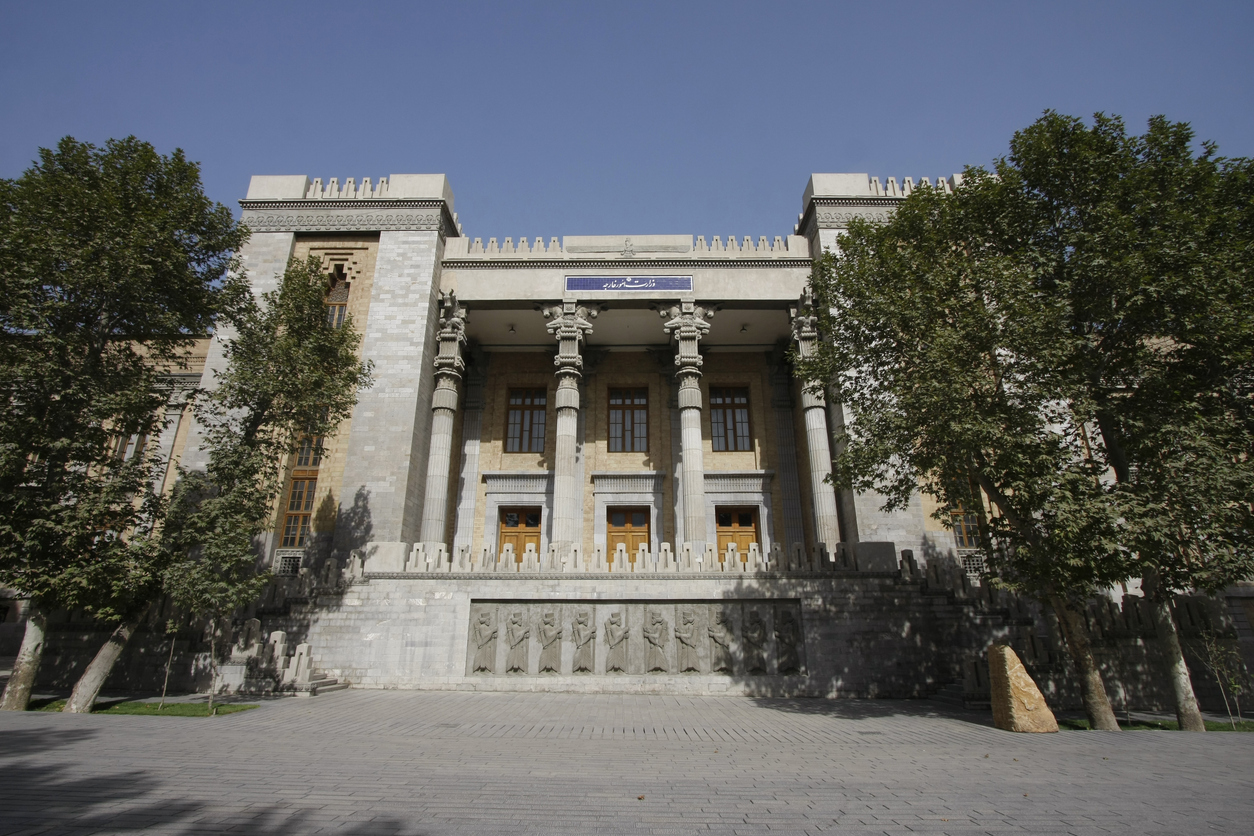
Image: Building of the MFA in Tehran was completed in 1939. Source: iStock.