This year’s International Women’s Day arrived amid geopolitical fragmentation, shrinking aid budgets, and growing skepticism about multilateralism. Yet important progress and a shift in one sphere is underway: middle powers are quietly shaping the next playbook for gender-equal growth. Their approach is pragmatic and coalition-minded, anchored in the conviction that gender-equal growth is not just a moral good—it is macro-critical to competitiveness, development, security, and resilience.
Available data still demonstrate the scale of the challenge ahead. The World Bank’s latest Women, Business and the Law (WBL) report finds that women globally hold only two-thirds of the legal rights that men enjoy when it comes to participating in their national economy. Meanwhile, the systems that implement those rights lag even further, with the average score on the supportive frameworks index sitting at just 47 out of 100 and the enforcement perceptions index at 53.
Yet the same data highlight a major growth opportunity that middle powers are already seizing: each one‑point improvement in the legal score is associated with a 0.6‑point increase in women’s labor force participation—a tangible growth multiplier for economies seeking to boost productivity and expand fiscal space. The evidence is clear: better rules, backed by institutions, deliver real empowerment dividends.
In this era of great-power rivalry, middle powers are increasingly pairing domestic reforms with multilateral leadership to overcome global gridlock. They innovate at home, align domestic priorities with international engagement, and scale what works through foreign policy and development cooperation and finance: coalitions and platforms such as BRICS, the G20, regional blocs like ASEAN, multilateral development banks (MDBs), and the United Nations (UN). Their comparative advantage is not necessarily dominance, but agility and legitimacy—the ability to gain traction at home and diffuse ideas and implementation abroad.
Momentum, models, and the hardest hurdles
Between 2023 and 2025, the World Bank’s WBL benchmarking project tracked 113 reforms across sixty-eight economies, and middle powers account for many of the most substantive advances (a sampling of examples cited in Annex 3A of the report are included below). Their leadership on gender equality is grounded in domestic reforms that deliver results at home and credibility abroad. Many—including Sweden, Spain, Germany, Canada, and Mexico—are advancing feminist foreign or development policies. These strategies show why middle-power countries often outperform larger powers on gender equality: they prioritize high‑return reforms, back them with implementing institutions and enabling technologies, and share what works through regional and global cooperation.
They are also targeting the most binding constraints identified by widespread research and as highlighted in the WBL—each with digital and systemic dimensions—shaping women’s economic participation and, by extension, growth:
- Safety remains the lowest‑performing WBL dimension globally, with enforcement ineffective in roughly 80 percent of cases. Middle powers are working to close this “last mile” gap by pairing comprehensive statutes with integrated service ecosystems—hotlines, shelters, and survivor‑centered justice pathways. The United Kingdom and Brazil, for example, enacted legislation on cyberharassment, including criminal penalties for such conduct. They are also elevating these models in G20 and UN processes, where safety increasingly intersects with peacebuilding, digital governance, and climate resilience. In doing so, they help shape broader commitments, financing, and peer learning.
- Care—especially childcare—remains one of the most underbuilt forms of productive infrastructure. In low‑income economies, only about 1 percent of the enabling mechanisms for quality, affordable care are in place. Middle powers are increasingly reframing care as core economic infrastructure, developing standards, financing mixed provision, and designing policies that raise women’s labor force participation and productivity. Spain’s childcare benchmarks, Oman’s pension credits for caregiving, and South Korea’s paid leave for fathers illustrate practical models with macroeconomic payoff—approaches middle powers can share through South-South and triangular cooperation.
- Entrepreneurship also remains constrained: ninety-one economies still lack non-discrimination protections in access to credit, gender‑responsive procurement is limited, and small and medium-sized enterprise finance remains underdeployed for women‑led firms. Here, too, middle powers are making measurable progress—expanding women’s market access through governance reforms and procurement tools, while development finance institutions (DFIs) in the Nordics and sovereign wealth funds in Gulf states deploy blended finance to de‑risk lending and unlock capital, including for women entrepreneurs, and Ireland is among several middle powers prescribing gender quotas for corporate boards. This blend of technical cooperation, policy reform, and catalytic finance—an area where middle powers excel—has direct and scalable impact.
The multilateral multiplier
International influence is also a key aspect of middle-power leadership in this space. Recent G20 presidencies—Indonesia in 2022, India in 2023, Brazil in 2024, and South Africa in 2025—have kept inclusive growth, human capital, and sustainability at the center of consensus documents, normalizing gender equality as a macroeconomic priority rather than a social sideline. At the UN, for example, the CANZ countries—Canada, Australia, and New Zealand—have used sustainable development negotiations and general debates to advance gender-responsive financing, data, and governance standards essential for tracking progress on gender equality.
As BRICS continues to enlarge, it adds financing heft via the New Development Bank to mainstream gender‑smart infrastructure and services—such as safe transport, childcare, and digital public goods. This is what middle‑power leadership looks like: leveraging platforms, aligning agendas, and moving from principle to practice. At its Global Forum last week, the European Investment Bank—home to several middle-power member states—pledged to maintain its gender investments and renew its action plan.
Taken together, the middle-power approach—practical, institution‑focused, and coalition‑driven—is helping redefine what effective, gender‑responsive economic governance and cooperation looks like in today’s geopolitical landscape.
Toward a portable playbook for gender-equal growth
From these middle-power experiences, a replicable set of actions is emerging—steps that a committed government can adopt and partners can support:
- Legislate the high‑return basics: guarantee equal pay for work of equal value; enact comprehensive anti‑discrimination; remove job bans; and implement robust anti-violence legislation, including cyber provisions.
- Invest in the systems and institutions that make rights real: inspectorates, survivor services, specialized courts, digital infrastructure, childcare standards and financing, skilling, and sex‑disaggregated data architecture.
- Mobilize capital at scale: use DFIs, pooled funds, and guarantees to finance care, women’s health, safe transport, water, and digital public infrastructure; crowd in private capital—especially for women entrepreneurs—through gender‑responsive procurement and disclosure; and leverage financial technology to expand access.
- Align trade and investment tools: embed gender parity and safety standards in procurement, trade facilitation, and investment promotion to create durable market incentives.
- “Multilateralize” the model: deploy G20 and UN platforms and processes, the Organisation for Economic Co-operation and Development, MDBs, and regional organizations to champion gender equality, standardize indicators, share tools, and scale financing and replication.
Why does this matter now? Because when it comes to women’s economic participation, the growth math is decisive. Closing gender gaps in the labor force could lift GDP by between 15 and 20 percent in many economies—and by up to 50 percent in the MENA region and South Asia. For aging OECD and East Asian societies, women’s economic participation is a macroeconomic stability imperative. For youthful regions, it is the difference between a demographic dividend and a demographic drag. Middle powers straddle both realities and are translating evidence into institutions at a time when credibility is currency. Trust in global governance may be fragile, but results are within reach. By grounding reforms in evidence, investing in institutions, and scaling through coalitions, middle powers are building the next playbook for gender‑equal growth and development. And in doing so, they remind us that influence and impact are not necessarily about size—they are about what works.
Nicole Goldin is nonresident senior fellow at the Atlantic Council’s GeoEconomics Center and head of equitable development at United Nations University-Centre for Policy Research.
At the intersection of economics, finance, and foreign policy, the GeoEconomics Center is a translation hub with the goal of helping shape a better global economic future.
Further reading

Fri, Mar 8, 2024
Investing in women accelerates prosperity and peace
New Atlanticist By Nicole Goldin
Expanding opportunities for women is essential for economic resilience and recovery during and after conflicts.
Fri, Mar 7, 2025
Charting the path for women’s economic security in the G20
Econographics By Alisha Chhangani, Jessie Yin
For International Women's Day this year, here are five charts about gender gaps in the G20. Closing these gaps would boost economic benefits for everyone.
Wed, Sep 10, 2025
Jordan is building scalable startups—without chasing unicorns
MENASource By
Despite challenges, in the world of privately held startups valued at $1 billion plus—the country has produced several resilient companies.
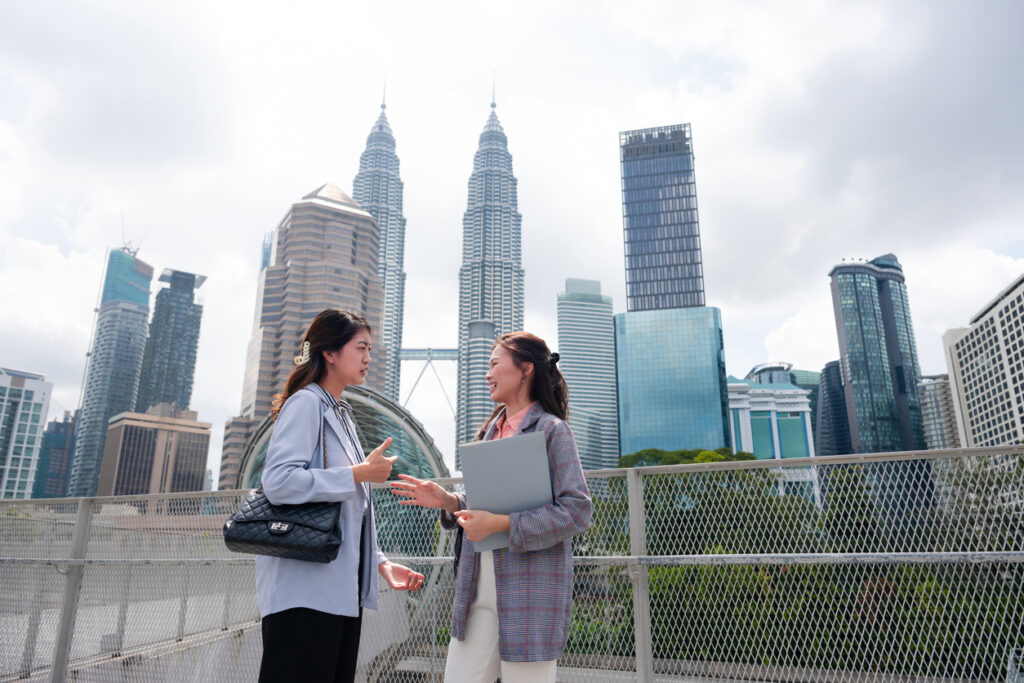
Image: Two young Asian female entrepreneurs engage in a business discussion while standing at the famous Saloma Bridge landmark in the city of Kuala Lumpur, Malaysia. Source: iStock