With a dramatic spike, the price of crude oil climbed back above $95 per barrel today. It is yet another indication that this oil shock—which has seen prices surge past $119, their highest level since 2022, due to the Iran war and the de facto blockade of the Strait of Hormuz—could be different from previous price spikes.
That suspicion had already begun to creep in right at the start of the Iran crisis, when the price of crude oil soared faster than in other conflict-driven crises in recent history.
But why is today different from, say, the Iraq war of 2003? For one, the steeper rise may be explained by the concentration of energy exports through the Strait of Hormuz combined with ongoing disruptions from Russia’s war in Ukraine. From an energy perspective, we have not seen such a concentration of output affected by conflicts in over eighty years.
At present, the eleven countries openly engaged in major global conflicts—whether in the Gulf or in Ukraine—account for 51 percent of global crude oil production and 56 percent of global gas production. The closest modern comparison is the First Gulf war, when countries involved in conflict accounted for 45 percent of global energy production.
While there are more alternative supply routes and energy sources today that didn’t exist thirty years ago, the world still heavily depends on oil—and according to OPEC’s estimates, demand for crude will only increase. This year, global output of crude oil is set to reach an all-time high, exceeding one hundred million barrels per day. The Strait of Hormuz already saw a flow of around twenty million barrels per day last year.
Saudi Arabia and the United Arab Emirates have built pipelines to bypass Hormuz, but most countries, including Iran, are still heavily dependent on the waterway. The consequences of this conflict—particularly if the strait remains closed—could be substantial, with wide-ranging implications for global markets.
The implications, however, will differ for exporting and importing countries. Some large importers, such as China and Europe, have recognized their oil dependency and have pursued efforts to electrify their economies. Yet both remain highly reliant on imports. Additionally, more than 80 percent of the oil leaving the Strait of Hormuz is exported to Asian countries, many of which have limited capacity to shield themselves from prolonged price instability.
To cushion the shock to the global economy, coordinated short-term stabilization efforts have been implemented. These include the release of four hundred million barrels of emergency oil reserves, the US administration’s loosening of restrictions on the purchase of Russian oil, and US President Donald Trump’s sixty-day waiver of the Jones Act, opening up domestic shipping routes to foreign-flagged vessels. Most of these measures, however, are limited in both scope and feasibility.
At the beginning of 2026, a barrel of crude oil averaged around $60. Since the onset of the US-Israeli strikes against Iran, prices have averaged above $90. All the while, it remains unclear whether markets have fully grasped the scale of what is unfolding—or whether the United States is adequately prepared to manage the impact of a prolonged conflict on the global energy market.
Going forward, continued volatility in oil markets is to be expected. The question now is whether this volatility will spill over into global equity markets.
Josh Lipsky is chair of international economics at the Atlantic Council and the senior director of the Council’s GeoEconomics Center.
Bart Piasecki is an assistant director at the Atlantic Council’s GeoEconomics Center.
Jessie Yin is an assistant director at the Atlantic Council’s GeoEconomics Center.
This post is adapted from the GeoEconomics Center’s weekly Guide to the Global Economy newsletter. If you are interested in receiving the newsletter, email JYin@atlanticcouncil.org.

At the intersection of economics, finance, and foreign policy, the GeoEconomics Center is a translation hub with the goal of helping shape a better global economic future.
Further reading

Wed, Mar 11, 2026
Twenty questions (and expert answers) about the Iran war
Dispatches By
As the US-Israeli war against Iran reverberates across the Middle East and the globe, Atlantic Council experts bring clarity to the fast-moving events.
Thu, Mar 12, 2026
Energy under attack: What the Gulf can learn from Ukraine and Iraq
Dispatches By
In their successes and shortcomings, Iraq and Ukraine are cases worth studying by countries currently under attack from Iran.
Thu, Mar 12, 2026
By threatening the Strait of Hormuz, Iran turns geography into a global economic weapon
Econographics By
Iran’s threat to attack vessels in the Strait of Hormuz has effectively shut down one of the world’s most critical energy shipping routes, turning geography into a powerful economic weapon.
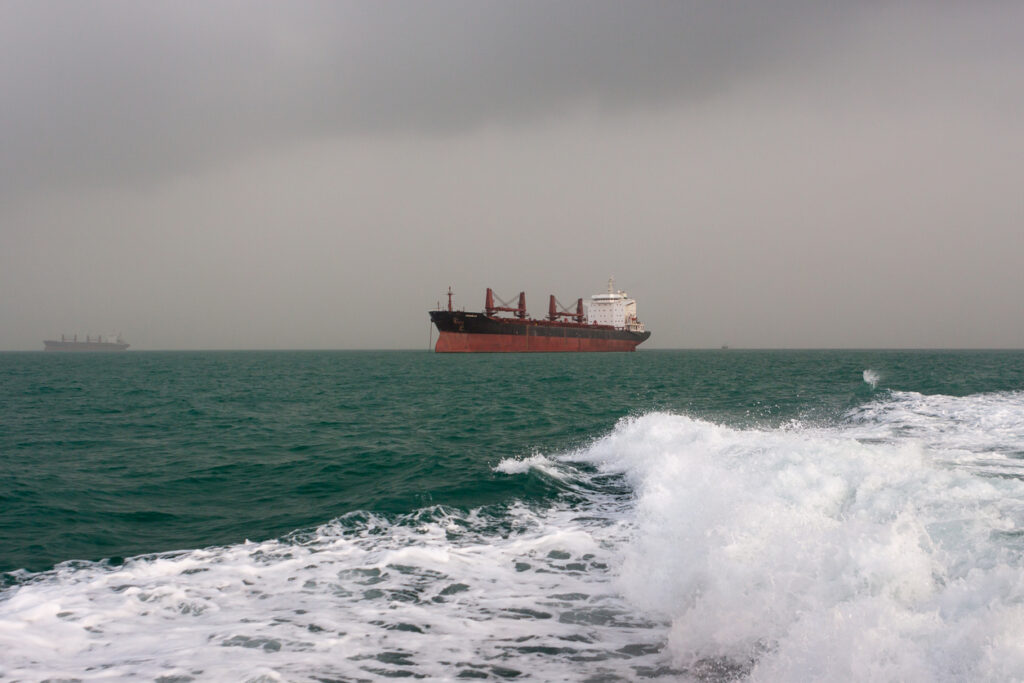
Image: Cargo ship in Persian Gulf. Big cargo ship in open waters with white wave spatters on the foreground.