
This week, the US House of Representatives passed the DOMINANCE Act, a bipartisan measure aimed at reducing the United States’ energy vulnerability. For US Representative Young Kim (R-CA-40)—who introduced the bill—the bill’s progress was especially timely.
From China’s imposition of critical-mineral export restrictions last year to Iran’s clutch on the Strait of Hormuz, “we saw the vulnerability,” she explained at the Atlantic Council’s Global Energy Forum on Wednesday.
But for US Representative Ami Bera (D-CA-6), who introduced the bill alongside Kim, “the real wake-up call was the pandemic,” which caused a “massive supply chain disruption”—even if no “economic coercion” was involved. “We realized our total dependence on a single nation, in this case, China.”
The DOMINANCE Act, which now heads to the Senate, focuses closely on critical minerals, which play a crucial role in American energy technologies. The Senate, meanwhile, is working on the Energy Security Pacts Act, which would establish tools to coordinate US foreign investments in partner countries’ energy systems.
Senator Chris Coons (D-DE), who introduced the bill alongside Senator Pete Ricketts (R-NE), also spoke on the Global Energy Forum stage. He explained that when it comes to reducing the US reliance on its competitors for energy and critical minerals, “we cannot move fast enough, but we can move faster.”
Below are more highlights from the conversation, moderated by Atlantic Council Executive Vice President Jenna Ben-Yehuda, in which the three lawmakers talked about the reasons behind Congress’s push to bolster US energy security and the role US partners and allies will play in the effort.
The challenge
- Unpacking the current critical-mineral challenge in the United States, Bera explained that the United States actually has “plenty” of rare earth elements—but “it’s the refining capacity that is a real challenge.”
- “You’re talking about billions of dollars of investment to build … the processing and refining capacity,” he said.
- He credited this processing and refining gap to US companies being squeezed out, the reason being that “Beijing subsidizes this industry.”
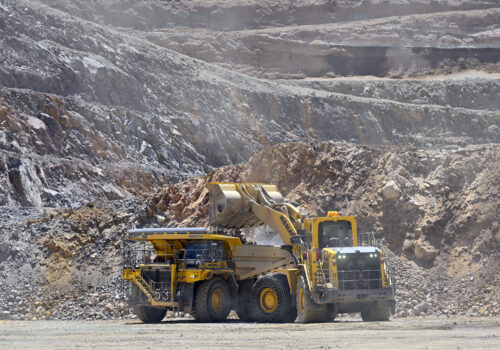
- Kim reflected on a conversation she had with the leader of a US mining company working in Peru, who had said that while there are opportunities in the United States, “the permitting is just ridiculously long.” It takes on average twenty-nine years to bring a mine online (most of that time being spent on permitting).
- While lawmakers want to fix that, she said, “it takes time.”
The message
- The DOMINANCE Act would create a Bureau of Energy Security and Diplomacy within the State Department to coordinate the US energy and critical mineral strategy. “Our allies need one command center with one strategy, so we can all work together, and this is creating that,” Kim argued.
- Kim added that the DOMINANCE Act aims to provide “long durable certainty” to the private sector and also to US partners and allies about the United States’ energy aims, so that these US partners “can look at the United States as a partner of choice” on energy projects.
- Coons agreed, saying that with these measures, lawmakers are trying to “build structures that transcend any particular administration,” which is particularly important for critical-mineral investments because they are typically “high cost, high risk, and long term.”
- Both allies and the private sector, Coons explained, need to know that “we have an energy trajectory that is not going to change with each election.”
Katherine Golden is an associate director of editorial at the Atlantic Council.
learn more
stay connected
Sign up for PowerPlay, the Atlantic Council’s bimonthly newsletter keeping you up to date on all facets of the energy transition
related work

our work
The Global Energy Center develops and promotes pragmatic and nonpartisan policy solutions designed to advance global energy security, drive economic opportunity, and foster a sustainable energy future.