Iran can still normalize its economy—but the path will be painful and slow
Inflation is not just Iran’s most visible economic problem—it is the central feature of its entire macroeconomic dysfunction. For two decades, inflation has hovered around 20 percent—and during periods of sanctions, exchange-rate collapse, and fiscal stress, it has surged well above 40 percent. It is now projected to reach an all-time high.
What makes Iran unusual, however, is not the current level of inflation—neighboring Turkey faces similar rates of around 20 percent—but its persistence over time. Even after repeated policy resets, price pressures have remained stubbornly elevated. In the Islamic Republic, inflation has become structural, woven into the exchange-rate regime, fiscal financing practices, and the political economy of state intervention. Tehran’s foreign policy posture compounds these structural pressures by limiting the scope for macroeconomic adjustment.
Against this backdrop, it is imperative for Iran to normalize its economy—lowering and stabilizing inflation, restoring a functioning currency, reviving investment, and anchoring fiscal practices. The alternative is a continued slide toward monetary irrelevance and dollarization, which in turn leaves the country vulnerable to external shocks and financial instability. Just yesterday, US Treasury Secretary Scott Bessent asserted that the United States had knowingly triggered a dollar shortage in Iran, which collapsed the rial and fueled the recent mass demonstrations.
The good news for Tehran is that such a transformation is still possible. The bad news is that the adjustment will be painful, politically costly, and slow.
Tehran cannot tame inflation without fixing its exchange-rate regime
The drivers of inflation in Iran are well known. While money growth matters in the long run, currency depreciation, fiscal deficits, and sanctions-related external constraints drive inflation both in the short and medium term. In other words, Iran’s inflation is not driven by overheating demand, as it was in the United States and Europe in the aftermath of the COVID-19 pandemic. Instead, it is a balance-sheet problem transmitted through the exchange rate.
Iran operates a fragmented exchange-rate system with three distinct rial exchange rates: an official subsidized rate for essential imports, a floating rate driven by unregulated market supply and demand, and a third rate for exporters, known as the Forex Management Integrated System. This structure creates arbitrage opportunities, fiscal leakage, and—critically—unanchored inflation expectations. Each episode of fiscal stress or sanctions pressure shows up first in the parallel market, then transmits swiftly to domestic prices.

Normalization therefore starts with accepting a difficult truth: Iran cannot control inflation without first fixing the exchange-rate regime.
Step one: Unifying exchange rates—even under sanctions
Exchange-rate unification is often framed as something Iran can only attempt after sanctions relief. However, Uzbekistan’s 2017 exchange-rate liberalization—implemented under tight capital controls and limited external financing—shows that dismantling parallel markets can precede, rather than follow, full economic normalization. The alternative is not stability, but the entrenchment of arbitrage, rent-seeking, and permanently unanchored inflation expectations.
Iran’s recent experience reinforces this point. The recent removal of the preferential exchange rate for basic imports did trigger protests, but the backlash reflected poor sequencing. The adjustment was abrupt, weakly compensated on the fiscal side, and undertaken in an environment of low institutional trust. Households experienced it as a sudden price shock, not as part of a credible disinflation strategy.
Yet maintaining multiple exchange rates is not sustainable. Such systems function as poorly targeted subsidies, financed through depleting reserves and opaque quasi-fiscal operations. Analysis by the International Monetary Fund (IMF) has long shown that fragmented exchange-rate regimes accelerate depreciation expectations and weaken monetary transmission, ensuring that inflation returns in recurrent waves—as reflected in the chart above.
A credible unification strategy would need to accept higher inflation upfront, replace exchange-rate subsidies with open foreign-exchange auctions to establish market pricing, and reduce the power of the parallel market. The political costs are real, but the costs of delay—chronic inflation, capital flight, and repeated currency crises—are higher.
Step two: Ending monetary financing once and for all
Iran’s inflation problem is inseparable from how fiscal deficits are financed. When oil revenues fall or sanctions tighten, the government turns—directly or indirectly—to the central bank and the banking system. This shows up as base-money expansion, directed credit, and weakening bank balance sheets. Public debt levels remain low by international standards—around 36 percent of gross domestic product—but this does not imply ample fiscal space.
IMF analysis shows that current budget deficits in Iran have a statistically significant impact on inflation even in the short run. This reflects entrenched fiscal dominance, with monetary policy accommodating budgetary pressures rather than anchoring prices.
Normalization requires a clean break from this pattern. Fiscal deficits must be financed through domestic government securities—even at higher interest rates initially—rather than through central-bank credit or off-balance-sheet channels. Iran has taken early steps toward building a domestic bond market with IMF technical support, but without sufficient scale and commitment, inflationary financing will continue despite low headline debt.
Step three: Redefining the role of the state
The Iranian economy is not fully state-owned, but it is state-dominated. State-owned enterprises (SOEs), quasi-state foundations, and entities linked to the security apparatus play an outsized role in banking, energy, manufacturing, and trade. During downturns and sanctions, these entities have served an important social function. World Bank research shows that SOEs helped preserve employment and wages when private firms were forced to adjust. The cost has been lower productivity, weaker profitability, and rising fiscal and financial risks as losses are implicitly socialized.
Normalization does not require mass privatization, nor would that be politically or economically realistic. What it does require is a gradual rebalancing of roles. State entities need to operate under hard budget constraints, with social objectives financed transparently through the budget rather than through subsidized credit or regulatory protection. At the same time, competitive sectors—such as manufacturing, services, and non-oil trade—need to be opened more clearly to private firms, with equal access to finance, foreign exchange, and market entry.
Without this shift, fiscal pressures do not disappear. Losses migrate from the budget to state firms and banks, eventually reemerging as monetary financing and inflation. Expanding space for the private sector is a necessary condition for restoring macroeconomic stability.
Step four: Re-engaging with international institutions
Iran does not need a full stabilization program with international institutions in the near term. What it does need is renewed technical engagement, focused on the mechanics of normalization rather than headline conditionality. This includes practical work on exchange-rate reform sequencing, domestic debt-market development, banking-sector diagnostics, and modern inflation-forecasting frameworks.
Much of this groundwork already exists. Over the years, international institutions—including the IMF and the World Bank—have produced detailed technical assessments of Iran’s macroeconomic challenges and policy options. The constraint has not been a lack of policy options, but political ownership and continuity.
Quiet, technical cooperation would not resolve Iran’s external constraints, but it could materially improve policy design and reduce the risk that future adjustments are disorderly, inflationary, or socially destabilizing.
The cost of delay
Every year of delay increases fiscal pressures, accelerates dollarization, and deepens public distrust in public institutions. Inflation is not just eroding purchasing power; it is also making investment impossible.
Normalization will be challenging and painful. It will raise prices before it lowers them. It will expose fiscal and financial weaknesses that have been papered over for years. But inflation is already imposing those costs—just without any prospect of resolution.
The choice for Iran is no longer between pain and comfort. It is between temporary, structured pain or permanent macroeconomic decay.
Bart Piasecki is an assistant director at the Atlantic Council’s GeoEconomics Center.
This post is adapted from the GeoEconomics Center’s weekly Guide to the Global Economy newsletter. If you are interested in receiving the newsletter, email SBusch@atlanticcouncil.org.
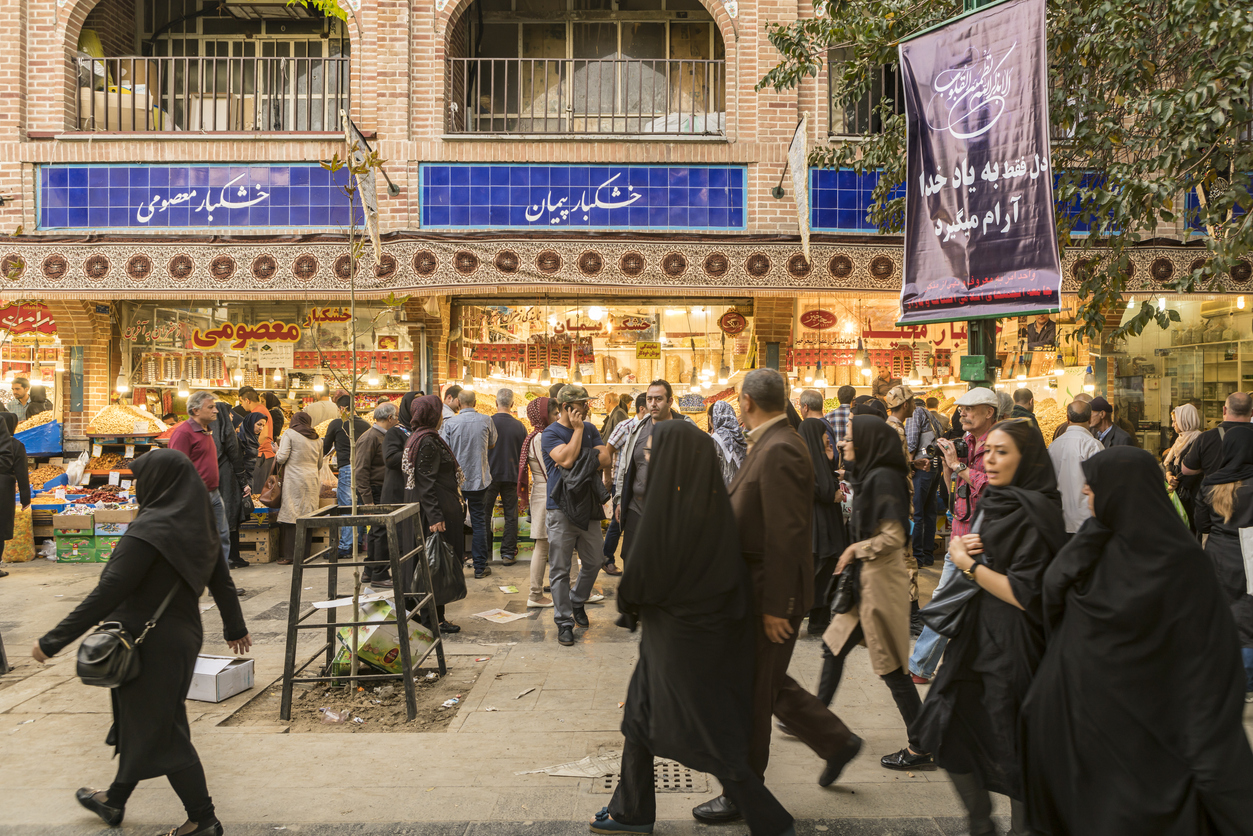
Image: Tehran, Iran - November 1, 2016: Shoppers walking past the outer stalls of the Grand Bazaar in Tehran, Iran