
At 1.4 million barrels per day, Libya is producing oil at a ten-year high while Libya’s Government of National Unity minister of oil and gas has set a goal of increasing oil production to 1.6 million barrels per day by the end of 2026. With Brent crude around $100 per barrel, it would appear that Libya is benefiting from a windfall of energy revenues.
Yet, the Libyan public is hit by dramatically rising costs of household goods as the Central Bank of Libya (CBL) devalued the dinar twice in less than a year to counter a high and resilient spread between the official exchange rates and the black market. In April, the International Monetary Fund (IMF) warned that Libya’s “current fiscal path is unsustainable” and cautioned that current higher oil revenues, if spent, “could further increase Libya’s vulnerabilities, as it will be more difficult to adjust spending once oil prices normalize.” Similar to the World Bank’s and African Development Bank’s recent assessments, the IMF views unrestrained parallel deficit spending by both the eastern and western authorities as a key cause of Libya’s economic woes.
The diagnosis is clear. Increased revenue will not fix Libya’s economy if it continues to flow into a political economy still shaped by parallel spending, institutional fragmentation, and weak oversight. The unified development program and subsequent unified budget announced by the Central Bank in April could be a path towards longer term economic and political stability in Libya, provided it is implemented in an accountable and transparent manner viewed as legitimate by the Libyan people and responsive to the public’s priorities.
SIGN UP FOR THIS WEEK IN THE MIDEAST NEWSLETTER
The cost of living crisis
In April 2025, the CBL devalued the dinar by 13.3 percent, attempting to close the spread between the official exchange rate and the black market. It did a second devaluation in January 2026, reducing the dinar’s value by an additional 14.7 percent, with the official rate moving to 6.37 dinars per dollar. Neither devaluation closed the gap between the official exchange rate and black market rate for long. By late February 2026, the parallel market rate had reached ten dinars per dollar.
A weaker dinar raises the cost of food, medicine, spare parts, and basic goods. It also erodes the value of public salaries, which remain one of the main channels through which oil revenue reaches households. The World Food Programme’s Minimum Expenditure Basket, which measures actual monthly household costs, rose 27.7 percent over the past year, reaching 1,128 dinars in February 2026.
In late February as most Libyans were observing Ramadan, supermarkets were reportedly rationing goods, gas stations were short on fuel, and ATMs were out of cash. Protests across western cities in Libya erupted the same month with demands for the removal of all Libyan political entities and leaders who they blame for the spike in prices and the decline of living standards. This unrest only reinforced the findings from a January public opinion survey that found economic challenges like rising prices and cash liquidity, not security concerns, topped the list of daily challenges faced by Libyans.
By April, UN Special Representative of the Secretary General Hanna Tetteh raised the deteriorating economic situation, marked by “currency pressures, rising prices, fuel shortages, uncontrolled and opaque public spending, and growing poverty.” She further warned that “Libya’s national wealth is being absorbed into a distorted political economy that fuels unaccountable spending and weaponizes oil revenue.”
The unified budget: Two paths forward
On April 11, Libya’s rival eastern and western authorities agreed to the first unified budget in thirteen years, following more than a decade of instability and civil war. The United States as well as nine other international allies and partners (the United Kingdom, Egypt, France, Germany, Italy, Qatar, Saudi Arabia, Turkey, and the United Arab Emirates) called the signing “a critical step to increase economic coordination between western and eastern Libyan leaders” and explicitly linked full implementation to dinar stability, Libyan purchasing power, National Oil Corporation financing, and transparent development investment across all regions. In his announcement of the unified budget agreement, CBL Governor Naji Issa said the agreement would strengthen economic stability as well as the dinar.
In remarks to the UN Security Council on April 22, Tetteh said that the UN Support Mission in Libya welcomed the agreement but cautioned that meaningful impact hinged on the “commitment of political leaders towards effective implementation and independent oversight.”
The easiest path forward for western and eastern Libyan leaders may well be to stick to the spending cap in the budget while ignoring the calls to ensure meaningful transparency, oversight, and accountability mechanisms are built into the budget implementation. This path may have real near-term value. A stronger dinar would lower inflation, and a reliably funded National Oil Company likely results in more stable production. However in the long run, this path will result in the same flawed outcomes that mired previous transactional deals among Libyan elites shepherded by international partners. The harder path is building accountability and transparency into budget implementation as well as independent oversight that ensures the budget is addressing the priorities of the Libyan people, not political elites. This path is more likely to produce the end state the United States has publicly endorsed: helping “create the conditions for lasting peace and prosperity” in Libya.
Policy recommendations for the United States
For more than two years, the United States has worked through economic dialogues to build consensus among eastern and western Libyan leaders on a unified development program. That engagement should continue. The US administration, led by Senior Advisor for African and Arab Affairs Massad Boulos, should continue to push for a unified budget with transparency, accountability, and oversight. Three priorities should guide that effort:
Technical support for public financial management: Proactive engagements by the United States with Libyan partners and the World Bank, particularly its governing board, could create the conditions and approvals necessary for the Libyan government to make contributions to a World Bank trust fund that provides the needed technical support to Libyan institutions required to ensure the “financial plumbing” is built for transparent and accountable budget spending.
Vocal support for budget implementation: Libyan leaders need to declare publicly their unequivocal support for the budget’s implementation with transparency and independent oversight. Boulos, in coordination with Tetteh and like-minded international partners, should leverage his existing relationships to press for such statements, particularly from Prime Minister Abdulhamid Dbeibah, House of Representatives Speaker Agilah Saleh, High Council of State President Mohammed Takala, Field Marshal Khalifa Haftar, and Libya’s Presidential Council.
Prepare for targeted sanctions: The US Treasury’s Office of Foreign Assets Control has not sanctioned a Libyan entity in over a decade. The most recent Libya-related sanction involved the Russian company GOZNAK in June 2024 for printing more than one billion dollars in counterfeit Libyan dinars. While the United States’ approach in recent years has been focused more on trust building and engagement with both eastern and western stakeholders in Libya, President Donald Trump in February renewed the executive order granting the authorities needed for sanctions against individuals and entities viewed as diverting Libyan assets or hindering Libyan national reconciliation. The United States should begin the preparations necessary to quickly designate Libyan entities that seek to prevent the implementation of the unified budget or resist accountability and oversight of public spending.
The window for change is open
Libya’s problem has never been a shortage of revenue. It has been a political economy that converts resource wealth into patronage and parallel power rather than public goods. Implementing a unified budget without accountability, transparency, and independent oversight will likely only produce short-term monetary stability, not the long term prosperity Libyans demand.
The United States has a window to shape which path Libya takes. Boulos can push Libyan leaders to take the harder, but more sustainable, path. Technical support for public financial management, unequivocal statements from Libyan leaders, and a credible sanctions posture are reinforcing levers that together could determine whether the unified budget becomes a foundation for durable stability or another transactional arrangement that the next oil price shock will expose. Libya’s oil windfall will not fix its economy. But a unified budget built on transparency, independent oversight, and genuine accountability to the Libyan people could be the beginning of something that does.
Ahmed Shalghoum is the founder and CEO of Germa Ltd. He is a Libyan policy analyst with more than fifteen years of experience advising diplomatic missions, UN agencies, and international think tanks on security sector reform and conflict sensitivities.
Frank Talbot is a nonresident senior fellow with the North Africa Program at the Atlantic Council’s Rafid Hariri Center & Middle East programs. Previously, he served in the Department of State supporting stabilization initiatives in the Middle East and North Africa.
Related Reading

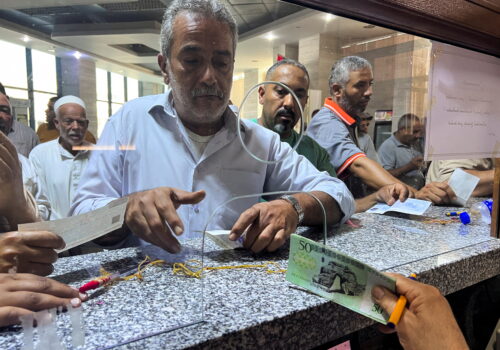
Image: A person fuels a car at a gas station in Misrata, Libya, August 29, 2024. REUTERS/Ayman Sahely