
The Board of Peace (BOP), formally launched in January by US President Donald Trump at the World Economic Forum in Davos, was promoted as a new international mechanism for addressing crises more effectively than traditional institutions, one that could push the United Nations toward its demise. Yet, nearly ten months after its creation and following several high-profile events, the board is struggling to meet expectations. Gaza was intended as an early demonstration of the new model’s effectiveness, but the reconstruction process instead highlights the challenge of turning political declarations into operational systems.
The Board of Peace and its bylaws lack four key elements: easily identifiable institutional infrastructure, a network of implementation partners on the ground and internationally, sufficient financing, and credible security guarantees. Most significantly, after months of negotiations, the founding members of the board still can’t establish a workable partnership with Israel, which is essential for movement, access, border arrangements, security, and the success of any substantial disarmament, demobilization, and reintegration process.
This raises serious questions on whether the emerging international framework for Gaza, and specifically the Board of Peace, can meet the expectations placed upon it.
Building an institution
There has always been a disconnect between the Board of Peace’s vision and implementation of the ambitious plan for Gaza. At the January Davos meeting, Jared Kushner, Trump envoy and member of the BOP Executive Board, presented an ambitious, artificial intelligence–assisted vision for Gaza, depicting beachfront developments, greenery, and new infrastructure—more reminiscent of a Mediterranean resort than a war-torn territory. In reality, Gaza is barely habitable. Due to security circumstances and limitations imposed by both Israel and its adversaries, the strip is entirely dependent on aid. This has been effectively the case for three years now.
The key issue is not whether this vision is ultimately achievable, but how projects are identified, priced, and prioritized, and what institutional mechanisms exist for implementation.
Established reference points could inform these questions. UN-managed projects in Gaza before the October 7 Hamas attacks offer valuable lessons. For example, the Gaza Reconstruction Mechanism (GRM), established by the UN, the Palestinian Authority, and Israel in 2014, included a mechanism for the approval of goods and projects by all three parties. It answered the question of who is responsible. Regardless of its internal dynamics and the criticism it drew, the GRM served its purpose. But certain decisions after 2018 in the aftermath of the negotiated ceasefire with Hamas diminished the role of the GRM, and by October 2023 it lost its grip over the control and monitoring of Gaza.
The International Gaza Support Center (formerly known as the Civil-Military Coordination Center) established in October 2025 should have had similar functions. However, the absence of the BOP and the Office of the High Representative and National Committee for the Administration of Gaza from its daily work made it dysfunctional. This deprived those groups of insight into what was really happening in the coordination of aid in Gaza, while key BOP members were busy fundraising. It also solidified the opinion of potential partners from the international community that the BOP and its Gaza Office are inconsistent.
The BOP today lacks an independent technical capacity to translate assessments of reconstruction needs into an implementation program tailored to its own capabilities, resources, and access. While the most recent assessments (the EU, UN, and World Bank all estimate $71 billion) outline the basic requirements for reconstruction, they do not include implementation plans.
The implementation gap
One obstacle is the physical environment. Gaza needs more than rebuilt structures. It requires restored or new systems that enable reconstruction, including roads, utilities, communications, waste management, supply chains, storage, border crossings, and administrative structures. Large construction projects depend on these systems, whether they be housing projects, hospitals, or industrial sites. Infrastructure destruction increases both the difficulty and cost of all other reconstruction projects.
The BOP is studying options that strongly resemble the experience from Gaza Humanitarian Foundation operations in Gaza and other places in the Middle East where the US has been present for decades. Projects are being marketed to international companies, Palestinian businesses, regional contractors, or other foreign firms.
But none of these possibilities by itself constitutes a reconstruction system. A successful one would require an ecosystem of offices with clear responsibilities for procurement, engineering, project management, financial control, labor, security, monitoring, and coordination. It also requires a reliable system of coordination between international organizations that for years were present in Gaza and Israeli and Palestinian institutions.
Meanwhile, the BOP’s absence within the International Gaza Support Center mechanism means it does not influence the movement of goods and services in Gaza. This had a knock-on effect in the disarmament negotiations, as aid delivery was not under the control of the BOP, limiting the perception of effectiveness and gravitas.
Financing remains inadequate
Another constraint is funding. Gaza’s estimated reconstruction needs of $71 billion far exceed the funds currently available. The BOP has only secured funds to cover operational costs such as salaries and travel.
The lack of funding, combined with little progress on Hamas’s disarmament, creates a fundamental chicken-egg problem. Donors have been unwilling to commit significant resources without a credible implementation mechanism, while such a mechanism cannot function without predictable financing. This has been evident over the past nine months. At a recent UN General Assembly event in New York, the BOP attempted to raise $2.45 billion for sixty-six Gaza projects. Some of these projects appear questionable in substance and timing (for example, ones to revive Palestinian Airlines or set up data centers and cloud storage facilities), raising concerns about how they were developed.
A real reconstruction plan requires multi-year funding, disbursement mechanisms, transparent procurement, donor coordination, and confidence that projects can be completed through a robust logistical system in line with agreed international rules and legal frameworks.
Security is not an auxiliary issue
The most immediate operational constraint is security. A reconstruction program of this scale requires a security framework to protect workers, sites, supply routes, warehouses, and infrastructure. Israel’s valid concerns must also be addressed. For years the Israeli security establishment has been critical of the ability of the UN and civil society groups under the Gaza Reconstruction Mechansim to guarantee the entry of goods and their safe storage. The October 7 attack reinforced these concerns; for example, a group of Israelis sued the UN agency for Palestinian refugees, accusing it of providing aid to Hamas that enabled the terrorist group’s attack. However, the International Stabilization Force proposed to improve the security situation has not been adequately staffed, and the proposed Palestinian police force has not yet been stood up.
Meanwhile, Hamas retains control over the import and distribution of commercial goods, which constitute two-thirds of all supplies into Gaza, generating $15 million to $17 million per week, according to Atlantic Council calculations. The dynamic reflects an ongoing pattern of wartime economic relations between Gaza and the outside world. If no international security force is deployed and no capable Palestinian police structure exists, the security environment will remain largely dependent on Israel.
Israel cannot simply be taken out of the equation
Regardless of the future political framework for Gaza, Israel’s role is indispensable to the strip’s reconstruction due to its control over access, movement, and security.
Reported restrictions on foreign labor and on workers traveling from the West Bank to the Israel-controlled Green Zone portion of Gaza illustrate this challenge. Calculating workforce needs is of little value if the necessary personnel cannot access the work area. The same applies to construction materials, heavy equipment, fuel, humanitarian supplies, and technical personnel.
Whatever future political arrangements are ultimately negotiated, reconstruction requires practical agreements concerning crossings, movement, security coordination, imports, exports, construction materials, personnel, and the protection of infrastructure. Without these arrangements, even fully funded projects may remain impossible to execute.
The Green Zone question
The program’s geographical scope also remains ambiguous. It is unclear whether the proposed projects are intended for all of Gaza or only for areas currently accessible to reconstruction mechanisms, such as the Green Zone.
If reconstruction focuses on a limited area, it may create pockets of stability and allow selected projects to begin, but it will do so in an inherently unstable broader area, with legally contentious dividing lines. A plan focused on a restricted area cannot be presented as a comprehensive reconstruction strategy without addressing how and when the rest of Gaza will be also be rehabilitated and the population assisted and protected.
From political project to operational system
The core weakness of the current BOP approach is not its ambition, but the gap between the board’s vision and the operational requirements for reconstruction. A successful reconstruction framework would need, at minimum:
- a logical set of projects that fit a reasonable timeline of six months and pay attention to the circumstances and dire conditions on the ground;
- functioning logistical infrastructure and access routes;
- a competent administrative structure with sufficient personnel;
- a network of Palestinian, Arab, and international implementation partners;
- reliable construction and procurement chains;
- substantial and predictable multi-year financing;
- an international security and policing mechanism capable of operating on the ground;
- arrangements concerning Hamas and other armed actors;
- and, critically, a practical security and access partnership with Israel.
Several of these components remain incomplete or unresolved. As a result, Gaza’s reconstruction risks becoming trapped between political announcement and practical implementation. Despite grandiose statements to the contrary about mass hiring and mobilizations, the National Committee for the Administration of Gaza, which sits under the BOP, still does not have sufficient personnel on the ground. This raises a fundamental question: who will implement a multi-billion-dollar reconstruction program?
The most serious deficiency is structural. The Gaza reconstruction plans that have been developed thus far were done without resolving the relationship with Israel, whose cooperation is essential for reconstruction. This lacuna was clearly demonstrated through Israel’s recent rejection of the negotiated settlement with Hamas. Until this issue is addressed, other challenges—financing, capacity, infrastructure, labor, logistics, and security—will persist and reinforce each other.
Gaza’s reconstruction will require a network of partners to deliver results. The international community can offer funding, expertise, and legitimacy; Arab states can provide contractors and logistical support; Palestinian institutions can contribute local knowledge and administration. However, without effective security arrangements and a practical relationship with Israel, these resources cannot be translated into reconstruction on the ground.
The key question for the Board of Peace is not whether it can produce an attractive vision for Gaza, but whether it can build the institutional, financial, security, and political systems needed to implement that vision.
Until such a plan is in place, Gaza’s reconstruction will remain little more than a promise undelivered.
Miroslav M. Zafirov is a nonresident senior fellow with the Scowcroft Middle East Security Initiative at the Atlantic Council’s Middle East programs. He is a senior diplomatic and policy professional with more than twenty years of experience in Middle Eastern affairs, conflict resolution, and international negotiations.
Related Reading


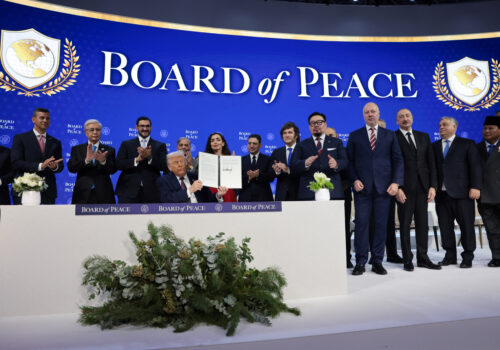
Image: September 24, 2026, New York, New York, United States: Board of Peace High Representative for Gaza NICKOLAY MLADENOV speaks during the High-Level Ministerial Meeting of the Global Alliance for the Implementation of the Two-State Solution in the ECOSOC Chamber during UNGA81. (Bianca Otero/ZUMA Press Wire)