This month, Saudi Arabia appointed Fahad Al-Saif as minister of investment. Al-Saif brings extensive experience overseeing investment strategy and global capital finance at the Public Investment Fund, the kingdom’s sovereign wealth fund. His appointment signals the leadership’s recognition that the next phase of the country’s economic transformation will depend not only on capital, but on how strategically that capital is deployed. Al-Saif will take office at a decisive moment for Saudi Arabia’s economy as Riyadh shifts from a period of capital accumulation to one of total factor productivity and positive return on capital. This shift in focus is important given some of the disappointing results to date of large infrastructure projects such as Neom.
As I have previously argued, global investors increasingly assess countries not just on their resources, but on credibility, predictability, and institutional coherence. Markets reward transparency and disciplined commercial execution because those qualities signal durability. Saudi Arabia’s development strategy is therefore not simply about attracting capital; it is about convincing global markets that its transformation is structural rather than cyclical. Saudi Arabia’s external position increasingly resembles that of a sovereign investor state rather than a traditional emerging-market borrower. Its foreign direct investment (FDI) inflows have risen sharply since 2021, increasing from roughly $3 billion in 2019 to a range of about $22–28 billion in recent years, with projections suggesting continued growth. This rise reflects investor confidence in reforms, infrastructure investment, and the expansion of non-oil sectors. Yet Saudi Arabia simultaneously deploys substantial capital abroad through sovereign and institutional channels.
Saudi Arabia’s outbound capital flows are crucial for its development. Economies dependent on foreign inflows often face instability when global liquidity tightens. Saudi Arabia, by contrast, engages global capital markets from a position of balance-sheet strength, supported by large sovereign assets and reserves. The central policy question is therefore not simply how to attract capital, but how to ensure that inbound investment complements domestic priorities and raises productivity. Thus, Riyadh’s challenge is not quantitative but qualitative.
An example of Saudi Arabia’s increasingly ambitious outbound investment was just illustrated last week, when Elon Musk’s xAI received a three billion dollar investment from the Saudi state-backed artificial intelligence (AI) company Humain. Shortly thereafter, Musk announced a merger between xAI and SpaceX, combining it into a single business worth more than one trillion dollars. The timing of this transaction could produce a very large financial return for Humain, as SpaceX is reportedly preparing for an initial public offering.
Yet capital alone does not determine long-term growth. The more decisive variable may be demographics. Saudi Arabia’s population stands at roughly 34.6 million, with one of the youngest profiles among the Group of Twenty (G20). About 23 percent of citizens are between ages ten and twenty-four, while about 75 percent fall within working age. Only 3 percent are age sixty-five or older. Demography, unlike capital flows, cannot be adjusted quickly by policy; it is a structural force that policymakers must either harness or be constrained by.
Larger numbers of young Saudis are entering the workforce, with a demonstratable increase in the number of Saudi women. And this is not an isolated surge. It reflects structural shifts in education, participation, and opportunity that will continue to expand the labor supply over the next decade. Saudi Arabia is entering a phase in which its workforce growth will exceed that of most advanced economies.
This is where the true fork in the road emerges: Some economists describe this as a demographic dividend. History shows that youthful societies tend to follow one of two paths. They either translate demographic momentum into productivity, innovation, and rising living standards, or they struggle to absorb new entrants into the labor market, producing underemployment and unrealized potential.
Long-term development depends on deploying capital in ways that raise labor productivity. Investment that transfers knowledge, builds skills, and fosters innovation amplifies human potential. Investment that does not translate into capability risks producing only temporary gains.
This is why human capital must now sit at the center of the kingdom’s strategy. Human capital is not simply a social priority; it is a strategic asset. In a global economy increasingly shaped by AI, advanced manufacturing, and knowledge-intensive industries, the countries that cultivate and deploy talent most effectively will define the next phase of economic leadership. For investors, human capital also functions as a signal. Markets evaluate not just current performance, but trajectory. Indicators such as skills development, labor participation, and innovation capacity offer insight into whether growth will be sustained. In that sense, human capital development is a message to global markets about the durability of reform and the credibility of long-term strategy.
As the new minister of investment, Al-Saif must convince investors that long-term foreign direct investment in the Saudi enterprise centered on the kingdom’s human capital can produce and sustain a positive net present value. If done correctly, this demographic dividend of youth joining and adding value to labor inputs can create positive economic momentum for the kingdom.
The next phase of Saudi Arabia’s transformation will be judged by measurable improvements in productivity, skills alignment, innovation output, and entrepreneurial dynamism. The kingdom now stands at a pivotal juncture. Its financial resources, institutional reforms, and global partnerships have positioned it for a new stage of development. Yet the ultimate determinant of success will not be the volume of capital it mobilizes, but how effectively that capital is translated into human capability.
Khalid Azim is the director of the MENA Futures Lab at the Atlantic Council’s Rafik Hariri Center for the Middle East.
Further reading
Wed, Jan 21, 2026
Why US markets are betting on Saudi Arabia
MENASource By Khalid Azim
Saudi Arabia’s long-term strategy is coherent, ambitious, and increasingly credible. US debt capital markets, for now, appear to agree.
Fri, Dec 19, 2025
Dispatch from Riyadh: Why Syria is central to the Middle East’s future
Inflection Points By Frederick Kempe
One year after Bashar al-Assad's fall, a visit to Saudi Arabia reveals the opportunities emerging to ensure that Syria doesn’t again fall prey to Iranian adventurism and regional chaos.
Wed, Nov 19, 2025
Digging into the details of the US-Saudi deals
Fast Thinking By
Our experts dive into the US-Saudi announcements that followed Saudi Crown Prince Mohammed bin Salman’s White House visit on Tuesday.
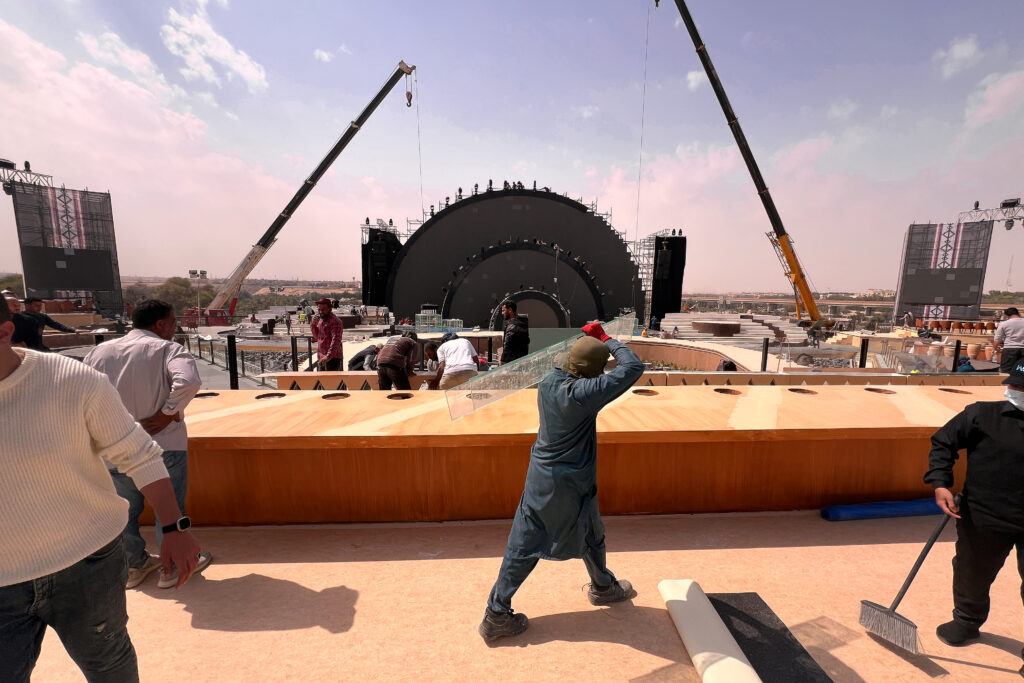
Image: Migrant workers are seen at a construction site near Riyadh, Saudi Arabia on 03 March, 2024. (Photo by Jaap Arriens/NurPhoto)