
Earlier this month, Turkey and France signed a new defense cooperation roadmap aimed at expanding military cooperation and creating a more regular strategic dialogue between the two countries. Under normal circumstances, such an agreement between NATO allies might not attract much attention. But in the case of Paris and Ankara, which have spent years at odds over regional security, the agreement could signal a shift toward more pragmatic defense cooperation despite continuing political disagreements.
Only a few years ago, the relationship had become one of the more difficult inside NATO. Paris and Ankara found themselves on different sides of several regional issues, including Libya and the Eastern Mediterranean. They also disagreed over Syria and, increasingly, the South Caucasus. These tensions eventually reached NATO itself. In 2020, the French frigate Courbet, a stealth French Navy warship, was involved in a confrontation with Turkish vessels while participating in NATO’s Sea Guardian mission, after which France suspended its participation in the operation.
Many of those disagreements still exist. France has maintained its close relationships with Greece and Armenia, while Turkey continues to pursue its close strategic partnership with Azerbaijan and its own regional priorities. However, Russia’s invasion of Ukraine has also changed the way European governments think about military power and collective defense. At the same time, growing uncertainty about the future role of the United States in European security has increased pressure on European allies to take on more responsibility. And for Turkey, closer ties with France could also make it easier to participate in European defense initiatives despite remaining outside the European Union (EU).
The regional environment has changed
During the Eastern Mediterranean crisis, France strongly supported Greece and Cyprus. In Libya, Paris and Ankara supported opposing sides. Their approaches toward Syria were also very different. Those tensions were already visible when French President Emmanuel Macron described NATO as experiencing “brain death,” pointing in part to Turkey’s military operation in northern Syria and the lack of coordination among allies. In the South Caucasus, France has developed a particularly close relationship with Armenia, while Turkey has remained Azerbaijan’s closest strategic partner, recent diplomatic rows notwithstanding.
Several of these fault lines have since eased. Tensions in the Eastern Mediterranean have declined considerably since 2020. Syria has gone through major political changes after the fall of Bashar al-Assad. Armenia and Azerbaijan have moved closer to normalization, while Turkey and Armenia have continued their own dialogue.
None of this means that France and Turkey will suddenly see these issues in the same way. It does mean, however, that these disputes might no longer define their entire relationship.
Europe’s military needs have made Turkey more relevant
Russia’s invasion of Ukraine has been the most important change in the broader European security environment. For much of the post-Cold War period, most European countries could discuss security without seriously preparing for the material requirements of large-scale territorial defense. Now, military production, ammunition, air and missile defense, and the ability to sustain a long conflict have come to the center of European security debates.
Under these conditions, Turkey’s military capabilities are more relevant to Europe. Turkey has NATO’s second-largest military, boasting around 495,000 personnel, according to NATO’s 2025 estimate. Moreover, it is geographically close to several of Europe’s most important security challenges, including in the Black Sea, Eastern Mediterranean, and South Caucasus. Its defense industry has also expanded considerably. Turkish defense and aerospace exports reached nearly $11 billion over the twelve months ending in September 2026, with NATO countries accounting for more than half of exports earlier in the year. Turkish companies are now producing drones, missiles, armored vehicles, naval systems, and other capabilities at a time when NATO countries are trying to expand their own defense production.
For France, this creates a fairly simple strategic question. Paris has argued for years that Europe needs greater military capacity and should be able to assume more responsibility for its own defense. Achieving that goal will also require working with countries that can contribute military capabilities and industrial capacity even where political disagreements persist. Maintaining a difficult relationship with one of NATO’s largest European military powers therefore makes less strategic sense.
Uncertainty over US commitments adds even more urgency. Washington has increasingly asked European allies to carry a greater share of their own defense burden and made clear that American military resources have to address priorities outside Europe. Ahead of the NATO summit in Ankara in July 2026, the French government itself pointed to the possibility of American resources moving away from Europe and reiterated that European countries would have to assume greater responsibility. The Ankara Summit Declaration similarly called for “a stronger Europe in a stronger NATO,” with European allies and Canada taking on a larger share of the burden.
France and Turkey are approaching this debate from different positions, although their interests are beginning to overlap. France wants Europe to have greater military capacity and more freedom of action. Turkey, meanwhile, wants to be treated as an integral part of European security despite remaining outside the EU. For Paris, Turkey offers military scale, an important geographic position, and a growing defense industry. For Ankara, a better relationship with France could make it easier to participate in some of the European defense initiatives from which Ankara has often found itself excluded.
These overlaps are already producing areas for practical cooperation. France and Turkey are part of the Coalition of the Willing for Ukraine, in which Ankara has agreed to lead the maritime component of possible post-ceasefire security guarantees. The renewed discussion over the Franco-Italian SAMP/T air and missile defense system, one of Europe’s principal domestically produced systems capable of defending against ballistic missiles, is another example. Cooperation between Turkey and the French-Italian Eurosam consortium had been considered for years to help close Turkey’s air-defense gaps, but political tensions repeatedly complicated progress. In July, France softened its opposition to a possible SAMP/T sale to Turkey, reopening a project that had previously become caught up in wider political disagreements.
What this could mean for NATO
The France-Turkey relationship also highlights a recurring problem in European defense debates: the tendency to treat European security and European Union security as if they were the same thing.
Turkey shows why this distinction is increasingly difficult to maintain. Despite being outside the EU, Ankara has military and industrial capabilities that Europe needs. Any serious effort to strengthen European military capacity will therefore have to find some way of drawing on non-EU NATO allies like Turkey.
France approaches the same issue from almost the opposite institutional position. It is one of the central military powers inside the EU and has probably been the strongest advocate of greater European strategic autonomy. Closer cooperation between the two countries could therefore help connect two debates that are often discussed separately: the effort to strengthen European defense capacity and the effort to preserve NATO as the main framework for collective defense in Europe, including with a major role for the United States.
There are already practical opportunities. Progress on SAMP/T could strengthen European air and missile defense. Cooperation between French and Turkish defense industries could also increase production capacity at a time when demand across Europe remains high, and regular cooperation between the two militaries could improve interoperability. The October roadmap already covers many of these areas, including air defense, interoperability, joint exercises, and cooperation between the two countries’ defense industries.
NATO also provides an existing framework for continued practical cooperation between the two countries. On July 1, for example, France took over command of the air component of NATO’s Allied Reaction Force directly from Turkey. The handover illustrates that NATO’s institutions can sustain practical French-Turkish military cooperation even during periods of political tension.
Can they compartmentalize old rivalries in the South Caucasus?
The South Caucasus is one area where the limits of the rapprochement can still be seen clearly.
NATO has been working to deepen its partnerships with both Armenia and Azerbaijan through Individually Tailored Partnership Programmes. Progress on both programs, however, has been held up by disagreements among NATO members.
According to reports citing anonymous NATO diplomats, France objected to Azerbaijan’s program during the period of serious tensions between Paris and Baku. Turkey, meanwhile, opposed allowing Armenia’s program to move forward separately.
Regardless of the exact motivation behind each position, the episode shows how bilateral disputes an affect the alliance’s wider regional objectives. Both Armenia and Azerbaijan are seeking closer ties with Euro-Atlantic institutions at a time when Russia’s position in the South Caucasus has weakened. NATO therefore has an opportunity to expand its role in a region where its room for maneuver has traditionally been limited. But this disagreement has delayed deeper cooperation with both rival countries.
Relations between France and Azerbaijan have begun to improve to a degree, which could make the problem easier to resolve. Further normalization between Paris and Baku could remove one of the obstacles surrounding Azerbaijan’s partnership program and make broader NATO engagement with both countries easier.
The South Caucasus will therefore provide a useful indication of how far French-Turkish cooperation can go. Progress here would suggest that the relationship has entered a more stable period.
Where the relationship may go from here
The durability of the current improvement will probably depend on whether cooperation develops beyond high-level political contact.
The October roadmap can help by creating more regular contacts between the two defense establishments. Progress on SAMP/T would provide another indication that the improvement in political relations is beginning to produce concrete military cooperation. Similarly, a resolution to the dispute over NATO’s partnerships with Armenia and Azerbaijan would show that Paris and Ankara can prevent their regional disputes from obstructing broader alliance objectives.
At the same time, there is little reason to expect France and Turkey to stop disagreeing on major regional issues. The more realistic possibility is that both countries become better at keeping these disagreements from derailing other areas of cooperation.
Only a few years ago, relations between France and Turkey were regularly presented as an example of NATO’s internal problems. Today, the same changes taking place in European security are creating stronger reasons for them to cooperate. If the new roadmap develops into sustained defense cooperation, the France-Turkey reset could become part of the larger adjustment already taking place inside NATO. Their rapprochement could demonstrate how European allies can build greater military capacity and assume more responsibility for their defense while strengthening (rather than competing with) NATO as the main framework for transatlantic security.
Ali Mammadov is a PhD candidate at George Mason University’s Schar School of Policy and Government and managing editor at the Center for Security Policy Studies. His research focuses on NATO, alliance politics, and European and Eurasian security. You can find him on X.
The views expressed in TURKEYSource are solely those of the authors and do not necessarily reflect the views of the Atlantic Council, its staff, or its supporters.
Explore the program
Within the Atlantic Council’s longstanding commitment to strengthening the transatlantic relationship, the Atlantic Council Turkey Program conducts research, provides thought leadership, and offers a platform for strategic dialogue between the US, Turkey, and NATO allies to address the region’s toughest challenges and explore opportunities, including in the fields of energy, business & trade, technology, defense, and security.
Related Reading


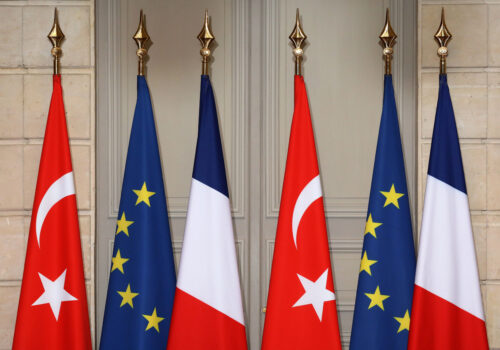
Image: French Minister for Europe and Foreign Affairs Jean-Noel Barrot talks to media on the sidelines of the meeting of R4, E3 countries and Italy, in Istanbul, Turkey, October 23, 2026. REUTERS/Dilara Senkaya