
At the latest NATO Summit, Turkey demonstrated that its role in the Alliance is evolving beyond its geostrategic importance. By securing a place in key NATO capability programs and showcasing its expanding defense-industrial base, Ankara signaled its ambition to become more deeply integrated into Alliance-wide procurement and production.
The real test, however, is whether Turkey can translate this political momentum into tangible contributions to NATO’s defense strategy. That means taking a more active part in shaping the Alliance’s future capabilities, especially in areas such as air defense and unmanned systems, and establishing Turkish defense companies as a core pillar of “NATO 3.0.”
Achieving this will require sustained investment, closer industrial cooperation with allies, and the successful implementation of a series of political commitments. If Turkey can deliver, the Ankara summit may be remembered not simply as a diplomatic milestone, but as the starting point of a broader transformation in Turkey’s role within NATO.
From strategic ally to capability provider
More than just a nod to Turkey’s important role in NATO, the Ankara summit provided Turkey with an opportunity to showcase the strategic assets it brings to the Alliance—from its regional diplomatic influence to its expanding defense-industrial base—and to shape the summit’s discussions on issues where it seeks greater influence.
Crucially, Turkey formally joined five strategic NATO capability programs covering integrated air and missile defense, long-range strike capabilities, space surveillance, critical defense raw materials, and unmanned systems superiority. At the NATO Summit Defence Industry Forum, NATO Deputy Secretary General Radmila Shekerinska announced that Turkey would directly contribute its air defense systems, satellites, and communications systems to the Alliance’s broader surveillance capabilities. Since these assets are linked to Turkey’s “Steel Dome” national air defense architecture, the move marks a shift beyond Ankara’s traditional contributions to NATO. These have primarily focused on participation in peacekeeping missions, including deployments to the Kosovo Force and participation in the International Security Assistance Force in Afghanistan; hosting allied and NATO infrastructure, such as Incirlik Air Base in Adana and LANDCOM in Izmir; and maritime security cooperation, including Operation Black Sea Harmony and the more recent Operation Sea Guardian in the Eastern Mediterranean, led by the Turkish flagship TCG Gaziantep.
The next challenge for the Turkish defense industry will be translating these commitments into concrete capabilities and products that integrate Turkey more deeply into NATO’s future procurement and production ecosystem. Deeper integration into the Alliance’s capability programs will also improve the competitiveness of the Turkish defense sector, creating new opportunities for defense exports to NATO members and partner countries.
Raw materials, jet engines, and cutting-edge technology
Turkish defense manufacturers have significantly expanded their capabilities in areas including integrated air defense, unmanned systems, and aerospace technologies. At the Ankara summit, the Turkish defense sector underscored its commitment to making these technologies available to NATO in the coming years. This willingness to contribute to the Alliance’s capability development was also reflected in the fact that Turkey hosted the Defence Industry Forum alongside the main summit agenda for the first time, bringing together major global defense companies and creating new opportunities for cooperation.
Moreover, the summit introduced new mechanisms such as the NATO Front Door for Industry and the Strategy for Industry-NATO cooperation, which could create additional avenues for Turkish companies to engage more directly with future procurement and capability development projects. To take advantage of these opportunities, Turkish companies will need to meet NATO requirements and expand partnerships with allied firms. This includes pursuing joint ventures with European and American counterparts in areas such as fighter jet engines and critical raw materials.
By continuing to invest in its domestic defense production and directly contributing to emerging NATO projects, Turkey can solidify its position as a key provider of cutting-edge military capabilities.
A reset for US-Turkey defense ties?
Turkey’s push to become a more central actor within NATO, however, will not only depend on its industrial capabilities, but also on its ability to rebuild defense partnerships with key allies—most importantly the United States. With US President Donald Trump joining other NATO leaders in Ankara, the summit provided a rare opportunity for both sides to demonstrate political alignment and reinforce a message of unity.
Discussions between Washington and Ankara focused on resolving long-standing disputes, including Turkey’s expulsion from the F-35 program in 2019 and US sanctions against Turkey under the Countering America’s Adversaries Through Sanctions Act (CAATSA) over its purchase of Russian missile batteries. At an Atlantic Council event, Turkish Deputy Minister of Foreign Affairs Levent Gümrükçü noted that Turkey now has “full confidence” that new deals with the US can be reached and that the two countries can forge “a much deeper defense-industrial cooperation.” The renewed engagement was accompanied by plans for joint development and supply of advanced jet engines for Turkey’s indigenous KAAN fighter jets and efforts to address sanctions-related barriers.
For Turkey, the opportunity is clear: stronger defense ties with Washington could help unlock access to technology, partnerships, and markets that would further accelerate its ambitions to become a more integrated NATO capability provider.
Turning momentum into results
By bringing its defense relationship with the United States back onto a more constructive path, expanding its defense-industrial base, and embedding its companies more deeply into NATO’s procurement networks, Turkey has positioned itself to exert greater influence within the Alliance.
The challenge now is turning this ambition into lasting results. Ankara will need to move from political commitments to industrial partnerships, further strengthen coordination with key allies, and leverage improved US ties to secure new frameworks for defense exports while addressing regulatory barriers, including sanctions imposed under CAATSA.
The Ankara summit created an opening. But Turkey’s ability to deliver will determine whether this marks the start of a lasting transformation.
Alp Ozen is an assistant director at Atlantic Council Turkey Program.
The views expressed in TURKEYSource are solely those of the authors and do not necessarily reflect the views of the Atlantic Council, its staff, or its supporters.
Related Reading
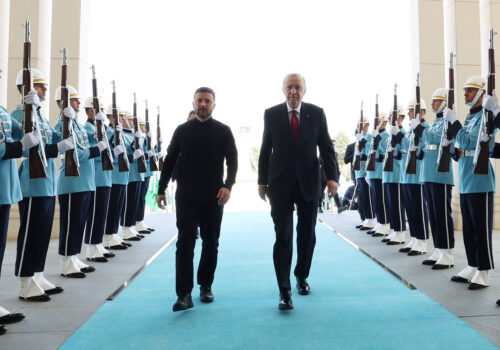

Image: A view of the venue during the Defence Industry Forum at the NATO Summit in Ankara on July 7, 2026. Source: Reuters/Jakub Porzycki/NurPhoto.